
Heat Induction Tools for Bolts: 4 Models Compared

For bolts from 3/8 to 3/4 inch, choose Bolt Buster 1800W Induction Heater for its 1,800W rating and stated fastener range. Induction bolt heaters use electromagnetic fields to heat conductive metal without an open flame; choose another model if your work needs a different coil selection or fastener coverage.
We earn a commission if you buy through links on this page. As an Amazon Associate I earn from qualifying purchases. Products are compared on manufacturer specifications, not hands-on testing.
- Best overall: Bolt Buster 1800W Induction Heater – It pairs a 1,800W rating with a 3/8- to 3/4-inch fastener range.
- Best for coil variety: 1500W Induction Heater with 8 Coils – Its kit includes eight coils, more than the other kits with a count.
- Best for handle features: 1300W Induction Heater with 5 Coils – It has a non-slip handle and built-in LED light.
| Product | Best for | Power | Coils included | Shop |
|---|---|---|---|---|
| Bolt Buster 1800W Induction Heater | Specified fastener range | 1,800W | Advanced coil kit; count — | Check Price on Amazon |
| 1500W Induction Heater with 8 Coils | Broad coil selection | 1,500W | 8 | Check Price on Amazon |
| 1300W Induction Heater with 5 Coils | Handle and light | 1,300W | 5 | Check Price on Amazon |
| Solary 1200W Induction Heater with 3 Coils | Compact kit | 1,200W | 3 | Check Price on Amazon |
Heat induction tools for bolts
Compare the power, coil kit and fastener coverage to match a heater to the repair at hand.
Bolt Buster 1800W Induction Heater

For work on 3/8- to 3/4-inch fasteners, this 1,800W heater is the only option here that gives a specific fastener range. Its kit includes preformed coils and flexible cable, and the maker says it heats bolts and nuts to red hot in 15–20 seconds. The maker also says the tool is made in the USA and uses focused induction without an open flame or sparks. It suits shop work within that size range; buyers handling fasteners outside it should verify coil fit before ordering.
Bottom line: Choose it when your fasteners fall within the 3/8- to 3/4-inch range.
1500W Induction Heater with 8 Coils

The eight-coil kit is the largest coil count among these choices, giving this 1,500W heater a broad selection for different repair setups. The maker says it heats a bolt in 25 seconds and highlights work around fuel lines, wiring and plastic components. It is a fit for buyers who value coil options across automotive, farm-equipment and home repairs. The coil count does not define the fastener sizes each coil fits, so confirm the coil opening suits the target fastener before buying.
Bottom line: Pick it when having eight coils matters more than a fastener range.
1300W Induction Heater with 5 Coils
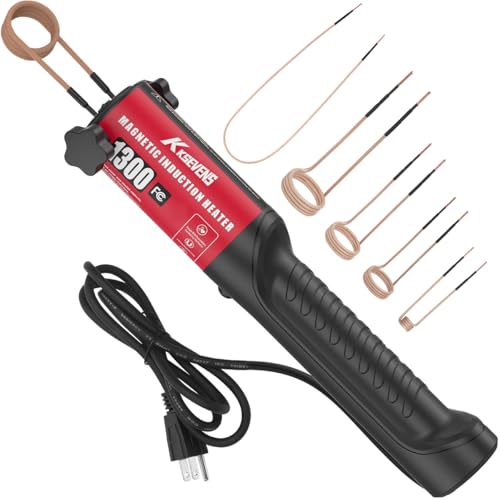
The built-in LED and ergonomic non-slip handle distinguish this 1,300W model from the other kits. It includes five coils in different lengths, and the maker says the heater works through high-frequency magnetic fields and heats stubborn metal parts in 25 seconds. Those features suit repairs where visibility at the work area and a comfortable grip matter. The coil lengths are not tied to a fastener range, so check that the coil geometry fits the bolt or nut you need to heat.
Bottom line: Choose it for the LED, non-slip grip and five-coil assortment.
Solary 1200W Induction Heater with 3 Coils

The Solary kit is the simplest assortment here, with three fixed coils and a 1,200W rating. The maker says it heats bolts quickly, with a 15-second claim, and describes uses including rusty screws, threaded nuts and small-part heat treatment. Its dimensions are 17.32 by 4.33 by 6.3 inches. This suits buyers who want a small stated coil set for repair tasks; it offers fewer coils than the other two counted assortments, so it may not suit work requiring more coil shapes.
Bottom line: Choose it when three fixed coils are enough for the jobs you handle.
How induction bolt heaters work
An induction heater creates a changing magnetic field that induces electrical currents in conductive metal, producing heat in the workpiece. The coil transfers energy without needing to touch the bolt, but coil shape and spacing affect how well energy couples into the metal. Steel and iron respond readily; nonferrous metals such as aluminum can also heat, while some stainless-steel grades respond differently. The surrounding fastener assembly still conducts heat, so nearby parts can warm even when the coil is focused on one component. Use a coil that fits around the target without forcing it, and keep the coil and work area clear of oil, grease and debris. A heated bolt or nut remains a burn and ignition hazard after the heater is switched off.
Choosing a coil and fit
Match the coil opening and shape to the fastener before comparing wattage: a coil that is too small will not fit, and a much larger opening can reduce coupling. A nut is often the more useful target because heating it can expand the nut around the bolt; avoid assuming the whole assembly will stay cool. Flexible cable and preformed coils provide different ways to position heat, while a larger coil count does not by itself guarantee a fit for a particular fastener. With fasteners from 3/8 to 3/4 inch, the model that states that range is the clearest match. Outside that range, confirm the maker’s coil dimensions and fit before ordering.
| Need | What to prioritize |
|---|---|
| Known 3/8–3/4 in. fastener | A model with that stated range |
| More coil choices | A kit with a higher coil count |
| Visibility and grip | Built-in light and non-slip handle |
Safe heating around vehicle parts
Induction heating avoids an open flame, but a red-hot fastener can still burn skin or ignite oil, grease, undercoating and other nearby material. Move combustible debris away, protect wiring and plastic from conducted heat, and do not touch the coil or fastener until they have cooled. Fuel lines and sealed components deserve particular care: a flame-free tool does not make the surrounding work area fireproof. Keep the coil positioned only where heat is needed, and stop if insulation, coatings or adjacent materials begin to soften or smoke. Use eye protection and heat-resistant gloves suitable for handling nearby hot parts, not as permission to touch the heated fastener.
Heating a seized fastener effectively
Start by cleaning loose rust and debris from the fastener so the coil can sit close and consistently around the target. When access allows, heating the nut rather than the bolt can encourage the nut to expand and break its grip; avoid heating surrounding brackets or components unnecessarily. Use short heating intervals and reassess the fastener instead of relying on a claimed heating time, since fastener mass, coil fit and starting temperature change how quickly it warms. After heating, let parts cool enough for safe handling before applying penetrant or working near combustible residue. Do not use a coil or heater beyond its fit, and keep hands clear of hot metal even when no flame is present.
Frequently Asked Questions
Does an induction heater work on stainless steel bolts?
Induction heaters work on electrically conductive metals, but stainless-steel grades do not all respond the same way. Test cautiously on a small area and use a compatible coil fit rather than assuming every stainless fastener heats like carbon steel.
Should I heat the bolt or the nut first?
When the fastener design allows it, heating the nut can help it expand around the bolt and loosen corrosion. Keep heat away from nearby components and remember that both parts can become hot through conduction.
Can induction heating damage nearby wiring or plastic?
Yes, nearby materials can be damaged by heat conducted from the fastener even without an open flame. Keep the coil focused on the target, move combustible material away, and stop if insulation or plastic begins to soften.
How do I choose the right induction coil size?
Choose a coil opening that fits around the fastener without forcing it and can sit close to the metal. A coil that is too small will not fit, while a loose fit may couple energy less effectively.
How long should I heat a seized bolt?
There is no universal heating time because bolt mass, coil fit and starting temperature affect heating. Use short intervals and reassess the part; a maker time should not replace checking the actual fastener and surrounding materials.