
Heavy Duty Eye Bolts for Swings: 3 Mounts Compared

For a swing, the Dolibest hanger is the most directly purpose-built choice because it is designed for swing movement and has a 180-degree range. Choose OHIYO 5-Inch M10 Screw Eye for a simpler screw-in eyelet explicitly suited to swing chairs; 6-Inch M10 Stainless Screw Eye is a general screw eye and is less directly tailored to swing mounting.
These mounts attach hanging hardware to a support; they are not substitutes for a sound beam or verified structural connection.
We earn a commission if you buy through links on this page. As an Amazon Associate I earn from qualifying purchases. Products are compared on manufacturer specifications, not hands-on testing.
- Best overall: Dolibest 7.67-Inch Swing Hanger – Its swing-hanger design allows 180-degree movement and is specified for wood and steel beams.
- Best screw-in eyelet: OHIYO 5-Inch M10 Screw Eye – It is a 5-inch, 304 stainless steel screw eye described for hanging swings.
- Best long screw eye: 6-Inch M10 Stainless Screw Eye – Its 6-inch M10 screw eye form provides more length than the other screw-in eyelet.
| Product | Best for | Mount style | Length | Shop |
|---|---|---|---|---|
| Dolibest 7.67-Inch Swing Hanger | Pivoting swing mount | Pivoting hanger | 7.67 in | Check Price on Amazon |
| OHIYO 5-Inch M10 Screw Eye | Swing chair eyelet | Self-tapping screw eye | 5 in | Check Price on Amazon |
| 6-Inch M10 Stainless Screw Eye | Long screw eye | Self-tapping screw eye | 6 in | Check Price on Amazon |
Heavy duty eye bolts for swings compared
Compare the attachment style and dimensions first, then match each mount to a structural support suited to the swing and its movement.
Dolibest 7.67-Inch Swing Hanger
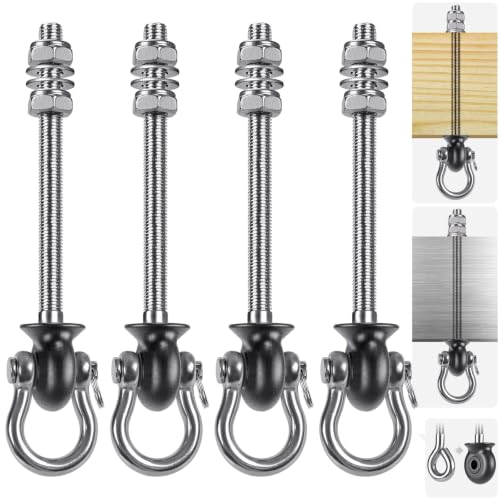
The Dolibest is the only pivoting swing hanger in this group, with a 180-degree swing range rather than a screw eye fixed in place. It is 7.67 inches long and made from 304 stainless steel. The maker gives a 1,500-pound capacity and specifies a 0.32-inch pre-drilled hole; treat the capacity as a maker claim, not a guarantee for a complete swing setup. This style suits a swing that needs room to move at its attachment point. Its larger, beam-mounted form is less suitable when a compact screw-in eyelet is what the installation calls for.
Bottom line: Choose this when a pivoting swing hanger is the right match for your beam and swing.
OHIYO 5-Inch M10 Screw Eye

The OHIYO is a screw-in eyelet, not a pivoting hanger, and is explicitly intended for swing-chair and hammock-chair uses. Its 5-inch M10 body is 304 stainless steel, and the closed eyelet is designed to resist deformation. The maker’s capacity figures conflict: the name says 700 pounds while the maker says 600 pounds, so do not use either figure as a verified working-load rating. This is a reasonable style to consider when a fixed eyelet suits the swing; its limitation is the absence of a pivot range.
Bottom line: Choose this for a fixed screw eye attachment when its size and support are suitable.
6-Inch M10 Stainless Screw Eye

The 6-inch M10 screw eye is longer than the OHIYO eyelet and is made from 304 stainless steel. Its name gives an 800-pound breaking strength, which describes a breaking figure rather than a safe working load for a swing installation. The use cases focus on securing cables and wire, not swing mounting, so consider it only if its geometry and installation suit the application.
Bottom line: Choose this only when a fixed long screw eye fits the support and intended use.
How to choose heavy duty swing mounts
Choose the mount by matching its movement and attachment style to the swing and support. A fixed screw eye holds the attachment point in one orientation, while a pivoting hanger can move at the beam. Swinging creates repeated, changing forces, so a breaking-strength figure alone does not establish a safe working load for the complete assembly. For wood, use a sound structural beam rather than drywall or a thin finish board; drywall is not a structural anchor. If the mount will attach to steel, confirm that its installation method matches that beam. A measurable starting rule is to reject any setup where the fastener cannot engage the full structural member or where the beam shows cracking, rot, or movement.
Fixed eyelets and pivoting hangers
Fixed eyelets and pivoting hangers serve different movement needs. A screw eye is a compact threaded attachment, while a swing hanger uses a separate pivoting connection. A pivot range matters when the swing travels forward and backward; a fixed eyelet may twist or wear differently under repeated movement. Use the maker’s installation guidance for the specific fastener, including any required pilot hole. The comparison table is a quick style guide, not a load rating.
| Need | Style to consider | Key check |
|---|---|---|
| Fixed attachment | Screw eye | Thread and support fit |
| Movement at beam | Pivoting hanger | Pivot direction and clearance |
| Steel support | Beam-compatible mount | Approved fastening method |
Anchor swings to structural supports
A swing mount belongs in a load-bearing support, not drywall, trim, or a decorative fascia board. Wood grain, beam condition, edge distance, and fastener engagement all affect how securely an attachment holds; a large capacity number cannot compensate for a weak substrate. For steel beams, a self-tapping wood screw eye is not automatically appropriate, and the attachment method must suit the steel. Before installation, identify whether the support is solid wood, engineered lumber, or steel and verify its suitability for the load. If the beam type or attachment method is uncertain, have a qualified installer assess it rather than relying on an eyelet’s breaking-strength figure.
Inspect swing hardware and avoid common mistakes
Inspect swing hardware regularly for rust, bent metal, looseness, cracking, or unusual movement, and stop using the swing if any appears. Outdoor exposure and repeated motion can wear both the mount and the support, so examine the connection at the start of each use season and periodically during use. A common mistake is comparing breaking strength directly with a person’s weight; swing motion adds changing forces, and the whole assembly includes the support, fastener, connectors, and swing. Keep the swing clear of obstacles and use only a setup intended for its motion. Do not exceed a maker’s working-load limit when one is provided, and do not treat an unspecified limit as unlimited.
Frequently Asked Questions
Can I install swing eye bolts in drywall?
No, drywall is not a structural anchor for a swing. Attach the mount to a suitable structural beam, and do not rely on a wall finish or hollow cavity to carry the load.
Is breaking strength the same as working load?
No, breaking strength is the force at which a part fails, not a safe working-load rating. Swing motion creates changing forces, so assess the entire assembly and use a verified working-load limit where available.
Should a swing use a fixed eyelet or pivoting hanger?
A fixed eyelet suits an attachment that should stay in one orientation, while a pivoting hanger allows motion at the support. Choose based on the swing’s movement and required clearance rather than assuming the styles are interchangeable.
How often should swing mounts be inspected?
Inspect them before each season and periodically during use, especially outdoors. Stop use if you see rust, bending, cracks, looseness, or movement in the supporting beam.
Can screw eyes be installed in a steel beam?
A wood-style self-tapping screw eye is not automatically suitable for steel. Use a mounting method intended for the beam material and verify the support and fastener compatibility before hanging a swing.