
Hot Dog Bread Mold: 4 Pans Compared by Size and Material

For standard 6-inch hot dog buns, GDDGCUO 4-Cup Silicone Hot Dog Bun Pan is the clearest fit because its four silicone cavities are sized for 6-inch rolls. Choose TOPZEA Silicone Hamburger and Hot Dog Pan Set for a mixed hamburger-and-hot dog set, or 3-Pan Perforated Steel Hot Dog Mold Set if you prefer perforated high-carbon steel rather than flexible silicone.
We earn a commission if you buy through links on this page. As an Amazon Associate I earn from qualifying purchases. Products are compared on manufacturer specifications, not hands-on testing.
- Best overall: GDDGCUO 4-Cup Silicone Hot Dog Bun Pan – Four cavities make standard 6-inch buns in food-grade silicone rated to 450°F.
- Best for mixed buns: TOPZEA Silicone Hamburger and Hot Dog Pan Set – The set combines a hamburger bun pan, a hot dog bun pan and a scraper.
- Best for steel pans: 3-Pan Perforated Steel Hot Dog Mold Set – Three perforated high-carbon steel pans provide 12 bun cavities total.
| Product | Best for | Material | Capacity | Bun size | Shop |
|---|---|---|---|---|---|
| GDDGCUO 4-Cup Silicone Hot Dog Bun Pan | Standard buns | Food-grade silicone | 4 buns per pan; 2 pans | 6 × 2 × 1.2 in. | Check Price on Amazon |
| 2-Pack Silicone Hot Dog Bun Mold | Eight buns | Food-grade silicone | 8 buns across 2 pans | 6 × 2 × 1.2 in. | Check Price on Amazon |
| TOPZEA Silicone Hamburger and Hot Dog Pan Set | Mixed bun batches | Silicone | Hamburger and hot dog pans | — | Check Price on Amazon |
| 3-Pan Perforated Steel Hot Dog Mold Set | Steel construction | High-carbon steel | 12 buns across 3 pans | — | Check Price on Amazon |
Hot Dog Bread Molds Compared
Compare the pan materials and cavity sizes to find a mold that matches your bun recipe and batch size.
GDDGCUO 4-Cup Silicone Hot Dog Bun Pan

For a dedicated standard-size bun mold, GDDGCUO 4-Cup Silicone Hot Dog Bun Pan has four cavities sized for 6-inch rolls, and the two-pan set can make eight buns at once. The maker says the food-grade silicone is heat-resistant up to 450°F; the pans are dishwasher safe. A small amount of cooking oil is recommended for easier release, so this is not a completely hands-off nonstick option. The 2-inch-wide, 1.2-inch-tall cavities suit recipes aimed at standard rolls, but bakers wanting larger buns should compare the cavity dimensions with their dough portions before choosing.
Bottom line: Pick this if your recipes call for standard 6-inch buns and you want two pans.
2-Pack Silicone Hot Dog Bun Mold
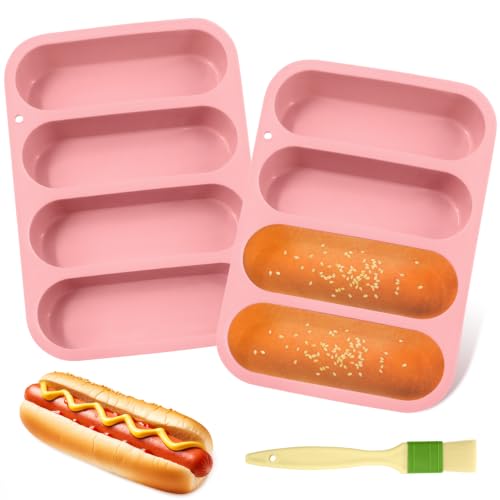
2-Pack Silicone Hot Dog Bun Mold is another two-pan silicone option for eight 6-inch buns, with the same cavity dimensions as GDDGCUO 4-Cup Silicone Hot Dog Bun Pan but a pink color and an included oil brush. The maker says the food-grade silicone is heat-resistant up to 450°F and naturally nonstick; the brush can help coat the cavities for release. This set suits bakers who want to prepare a full eight-bun batch and use a brush for applying oil. The maker does not confirm dishwasher-safe cleaning, so choose it for the brush and capacity rather than assuming the same cleanup details as another pan.
Bottom line: Choose this for an eight-bun batch with an included oil brush.
TOPZEA Silicone Hamburger and Hot Dog Pan Set

TOPZEA Silicone Hamburger and Hot Dog Pan Set differs from the dedicated hot dog molds by pairing a hamburger bun pan with a hot dog bun pan and a scraper. That makes it useful when a bake includes more than one bun shape, rather than only standard hot dog rolls. The set has flexible nonstick silicone pans with edge handles, and the maker says they are dishwasher safe. The cavity measurements apply to the hamburger pan, not clearly to the hot dog pan, so bakers needing a particular roll length should confirm that measurement before ordering.
Bottom line: Pick this for baking hamburger and hot dog buns in one set.
3-Pan Perforated Steel Hot Dog Mold Set

3-Pan Perforated Steel Hot Dog Mold Set stands apart from the silicone options with three high-carbon steel pans and 12 bun cavities in total. Each pan measures 13.7 × 8.5 × 1.14 inches, and the maker says its perforated surface promotes heat circulation while the U-shaped cavities guide dough upward. The pans withstand up to 446°F, according to the maker.
Bottom line: Choose this if you want three perforated steel pans for a larger batch.
How to Choose a Hot Dog Bread Mold
Choose a hot dog bread mold by cavity dimensions first, then by material and batch capacity. A standard roll cavity around 6 inches long, 2 inches wide and 1.2 inches high is a useful reference when comparing molds; dough quantity and proofing can still change the finished bun size. Silicone is flexible and releases by bending, while steel holds a rigid shape and can be perforated for airflow. For a single batch of eight standard-size rolls, a two-pan four-cavity set is a straightforward match. If you bake more than one bun shape, a combo set may be more useful than extra hot dog cavities.
| Need | Look for |
|---|---|
| Standard 6-inch rolls | Cavities near 6 × 2 × 1.2 inches |
| More buns at once | More cavities or multiple pans |
| Hamburger and hot dog buns | A set with both pan shapes |
| Rigid construction | Steel rather than silicone |
Silicone and Steel Hot Dog Molds
Silicone and steel shape dough differently, so choose based on handling and construction rather than assuming one material guarantees better buns. Silicone bends for release and generally needs a rigid baking sheet beneath it while being moved, especially when filled; verify the mold maker’s handling guidance. Steel stays firm during transfer, and perforations allow hot air to circulate around the pan surface. The steel set is rated to 446°F, while the silicone pans with a heat limit are rated to 450°F. Those figures are maximums, not target baking temperatures: use the recipe’s oven setting and do not exceed the particular mold’s heat limit.
Match Bun Size to the Recipe
A cavity near 6 inches long is a practical target for standard hot dog buns, but length alone does not determine the finished roll: cavity width, depth and dough amount also matter. Measure the cavity rather than relying on labels such as standard or mini, and compare it with the portion size in your recipe. A cavity that is too shallow can constrain dough expansion, while excess dough can rise over the edge and connect adjacent rolls. Leave room for proofing and baking expansion. If a mold’s cavity dimensions are not available, confirm them before ordering when a specific bun length is essential.
Use and Care for Bun Molds
Set flexible silicone molds on a firm baking sheet before filling them, then transfer the sheet rather than carrying a full, floppy mold by its edges. Greasing can help with release even when a pan is called nonstick; silicone pans with a temperature limit should stay at or below that limit. Cool baked buns enough to handle before flexing silicone, since hot surfaces and steam can burn. Follow food-safe handling practices: wash pans before first use, avoid cutting against the mold, and inspect reusable pans for tears, warping or damage. Dishwasher cleaning is specified for some of these pans, but use the care method identified for the particular mold.
Frequently Asked Questions
How many buns fit in a four-cavity pan?
A four-cavity pan makes four buns per batch, so two pans with four cavities each can hold eight. Check whether a set’s cavity count refers to each pan or the complete set.
What size are standard hot dog buns?
A common standard-size mold cavity is about 6 inches long, 2 inches wide and 1.2 inches high. Finished buns can vary with dough quantity and proofing, so match the cavity to your recipe’s portion size.
Should silicone bun molds go on a baking sheet?
A baking sheet gives a flexible silicone mold support during filling and transfer to the oven. Move the sheet rather than lifting a full mold by its edges.
Do hot dog bun molds need greasing?
A light coating of cooking oil can make release easier, even with nonstick silicone. Grease each cavity lightly rather than leaving pools of oil that can affect the bun surface.
What temperature can silicone bun molds handle?
The silicone molds with a limit here are rated up to 450°F. Use the recipe’s baking temperature and stay within the heat limit for the specific pan.