
HUPEJOS 360 Dash Cam Models Compared by Coverage

HUPEJOS offers several 360° dash cams; HUPEJOS V8PLUS 4-Channel suits most drivers who want a 4K front camera plus three 1080P views for the left, right and rear. Choose a different model if you need driver monitoring, a telephoto lens, or dedicated cabin coverage.
A 360° dash cam uses multiple adjustable lenses to record several directions at once, so camera layout and resolution matter more than the label alone.
We earn a commission if you buy through links on this page. As an Amazon Associate I earn from qualifying purchases. Products are compared on manufacturer specifications, not hands-on testing.
- Best overall: HUPEJOS V8PLUS 4-Channel – Its 4K front camera pairs with three adjustable 1080P lenses for left, right and rear coverage.
- Best for driver monitoring: HUPEJOS V9 AI 4-Channel – It adds an AI driver-monitoring system to four-channel 4K and 1080P recording.
- Best for distant detail: HUPEJOS V7 4-Channel – Its 60° telephoto lens is designed to capture plates and signs up to 80 feet away.
- Best for cabin coverage: HUPEJOS V8Ultra 5-Channel – Five lenses record views including the cockpit and rear compartment.
| Product | Best for | Channels | Recording resolution | Included card | Shop |
|---|---|---|---|---|---|
| HUPEJOS V8PLUS 4-Channel | Balanced coverage | 4 | 4K + 1080P × 3 | 128GB | Check Price on Amazon |
| HUPEJOS V9 AI 4-Channel | Driver monitoring | 4 | 4K + 1080P × 3 | 128GB | Check Price on Amazon |
| HUPEJOS V7 4-Channel | Cabin recording | 4 | 1080P × 4 or 2K + 1080P × 2 | 64GB | Check Price on Amazon |
| HUPEJOS V9Pro 5-Channel Telephoto | Distant details | 5 | 4K; rear 1080P | 128GB | Check Price on Amazon |
| HUPEJOS V8Ultra 5-Channel | Multiple cabin views | 5 | 4K + 1080P × 2; other modes available | 128GB | Check Price on Amazon |
HUPEJOS 360 Dash Cams
Compare the camera layouts and distinguishing features to find a setup that matches the views you need.
HUPEJOS V8PLUS 4-Channel

HUPEJOS V8PLUS 4-Channel combines a 4K front view with three adjustable 1080P lenses for the left, right and rear, making its resolution mix the clearest differentiator in this group. Each lens has a 150° field of view, and the feature set includes 5GHz Wi-Fi, GPS, voice control, WDR, night vision and app control. The 128GB card gives buyers a ready-to-use storage card. This setup suits drivers who want four-direction recording without a fifth lens. Its three secondary views are 1080P rather than 4K, which matters if matching front-camera resolution across every angle is a priority.
Bottom line: Choose this model if a 4K front view and three 1080P supporting views fit your coverage needs.
HUPEJOS V9 AI 4-Channel
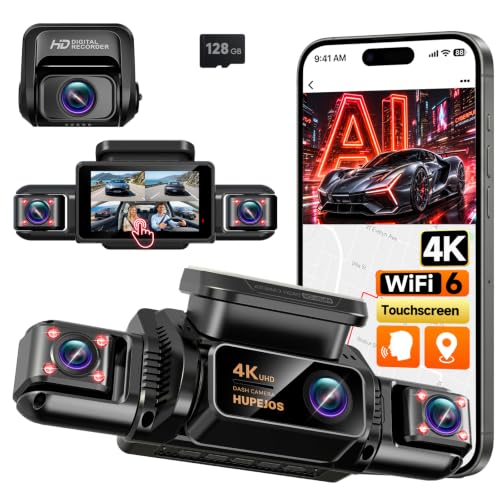
HUPEJOS V9 AI 4-Channel stands out for its AI driver-monitoring system, which the maker says can detect distraction, yawning, driver absence and phone calls. Its four adjustable 150° lenses record a 4K front view and three 1080P views, while a touchscreen, GPS and 5.8G Wi-Fi are also included. The included 128GB card supports recording without selecting a card separately. This is the choice for someone who wants driver-monitoring features alongside multi-direction coverage. The maker says it has no wireless connectivity, despite naming Wi-Fi elsewhere; confirm the wireless capability before ordering if app transfer matters.
Bottom line: Pick this model if driver monitoring is a priority and you are willing to confirm wireless capability.
HUPEJOS V7 4-Channel

HUPEJOS V7 4-Channel is the four-channel option whose views include the vehicle interior as well as exterior directions, with a 3.16-inch IPS screen and waterproof rear camera. It records 1080P on all four channels or offers a 2K front view with two 1080P interior views. The included 64GB card supports cards up to 256GB, and the features include loop recording, a G-sensor, Wi-Fi and 24-hour parking mode. This suits drivers who want an in-car view and a built-in screen. Its included card is smaller than the 128GB cards supplied with the other options here.
Bottom line: Choose this model if cabin views and a built-in screen matter more than a 4K front camera.
HUPEJOS V9Pro 5-Channel Telephoto

HUPEJOS V9Pro 5-Channel Telephoto adds a 60° telephoto lens alongside a 150° wide-angle front lens, setting it apart for buyers focused on distant detail. The maker says the telephoto view can capture plates and signs up to 80 feet away; HDR is applied to the telephoto and rear 1080P cameras to balance nighttime headlight glare. Four wide-angle lenses provide the 360° panoramic coverage, and the package includes a 128GB card, touchscreen and GPS. This model suits highway or long-distance drivers who value a tighter forward view. Its telephoto lens covers a narrower 60° angle than the 150° wide-angle lens.
Bottom line: Pick this model if a dedicated telephoto view for distant road details is useful.
HUPEJOS V8Ultra 5-Channel

HUPEJOS V8Ultra 5-Channel uses five independently adjustable 150° lenses, with the views spanning the front, cockpit, rear compartment, sides and rear. It offers three resolution combinations: 2K plus four 1080P views, 3K plus three 1080P views, or 4K plus two 1080P views. The feature set also includes an AI driver-monitoring system, 5.8GHz Wi-Fi, HDR night vision, GPS, app control and a 128GB card. This is the broadest cabin-and-exterior layout here. The buyer must choose among the resolution modes, so it is less suited to someone expecting 4K across all five channels.
Bottom line: Choose this model if five separately adjustable views and a choice of recording modes fit your needs.
How to choose a 360 dash cam
Choose by the views you need first, then compare resolution and add-ons. Four-channel systems commonly cover front, rear and both sides, while a fifth channel can add a separate cabin or telephoto view; the actual lens layout is more important than the channel count by itself. A wider field of view captures more of the surroundings but makes distant objects appear smaller, while a narrower telephoto view frames farther-away details more tightly. For routine all-around coverage, prefer four wide-angle views; if cabin monitoring or distant plate detail is the priority, favor the layout with that dedicated lens. Higher resolution demands more storage per minute, so capacity and recording mode should be considered together.
The table maps needs to the model differences.
| Need | Relevant feature | Choice |
|---|---|---|
| Left, right and rear views | Four-channel, 4K front | HUPEJOS V8PLUS 4-Channel |
| Driver monitoring | AI driver monitoring | HUPEJOS V9 AI 4-Channel |
| Cabin and exterior views | Five independently adjustable lenses | HUPEJOS V8Ultra 5-Channel |
| Distant forward detail | 60° telephoto lens | HUPEJOS V9Pro 5-Channel Telephoto |
Resolution and storage modes
Resolution choices determine how much detail each camera records and how quickly a memory card fills. A 4K front channel captures more image detail than a 1080P channel, but a multichannel system also records several streams at once. Among these models, one offers 4K plus three 1080P views, another offers four 1080P channels or a 2K front view with two 1080P views, and the five-channel V8Ultra lets drivers choose 2K, 3K or 4K front modes paired with fewer 1080P feeds. Select the mode based on which view needs the most detail, then make sure the card capacity suits continuous recording. Loop recording generally overwrites older unlocked clips when storage fills; important footage may need to be saved before it cycles out.
Mounting and wiring a multi-camera system
Mount every lens where its view is useful without blocking the driver’s sightline. A front camera should avoid obstructing the windshield area needed for clear forward visibility, and side or rear lenses need an unobstructed view rather than a position hidden by trim. Keep power cables away from pedals, steering controls and airbag deployment paths; loose wiring can interfere with driving or become a hazard if an airbag deploys. Parking-mode recording also needs power while the vehicle is parked, so confirm the required power arrangement and whether it can protect the car battery before installation. For models with adjustable lenses, set each angle after mounting and check the recorded view while parked before relying on it on the road.
Parking mode and saved footage
Parking mode is useful only when the camera has power while the vehicle is off, and the setup must avoid draining the starter battery. Many parking-mode dash cams use a hardwire kit with low-voltage cutoff, which stops drawing power when battery voltage reaches a set threshold; the maker does not establish the power method for each model, so confirm the required setup before ordering. A G-sensor can mark footage after a detected impact, but it does not replace continuous coverage or a separate backup of critical clips. Memory cards also wear with repeated loop recording; high-endurance microSD cards are made for continuous video writing. Check card compatibility and maximum capacity, and export important clips promptly rather than assuming they remain protected indefinitely.
Frequently Asked Questions
How many camera channels do I need for a car?
Four channels can cover the front, rear and two sides when the lenses are arranged that way. A fifth channel is useful when you want a separate cabin view or telephoto angle; choose by view layout rather than channel count alone.
Does a 360 dash cam record inside the car?
Some do, but 360° coverage does not automatically mean cabin recording. Check whether a model explicitly includes an interior or cockpit view; lens placement determines what the cameras actually capture.
What memory card size should I use for a multi-channel dash cam?
Use a card capacity supported by the camera, and favor a high-endurance microSD card for continuous recording. Multi-channel 4K recording can fill storage faster than a single lower-resolution stream, while loop recording typically cycles over older unlocked footage.
Can a dash cam record while the car is parked?
Parking recording requires the camera to receive power after the ignition is off. Many installations use a hardwire kit with low-voltage cutoff; verify the model’s power setup and battery protection requirements before installation.
Where should I mount a multi-camera dash cam?
Place lenses so they have clear views without obstructing the driver’s forward sightline. Route cables clear of pedals and airbag deployment paths, then check the recorded angles while parked before driving.