
Hygger Mini Wave Maker: 5 Models Compared by Fit

For most aquariums in the 15–40-gallon range, Hygger Mini Wave Maker 530 GPH is the closest fit because its 530 GPH rating and 360-degree adjustable head suit flexible current placement. Choose a different model if you need a smaller tank range, a higher flow rate, or more controller modes.
A wave maker is a small pump that moves aquarium water to improve circulation and surface movement; the right choice depends on tank volume, livestock, and how directly the current reaches them.
We earn a commission if you buy through links on this page. As an Amazon Associate I earn from qualifying purchases. Products are compared on manufacturer specifications, not hands-on testing.
- Best overall: Hygger Mini Wave Maker 530 GPH – Its 530 GPH flow and 360-degree adjustable head are paired with a 15–40-gallon range.
- Best for stronger flow: Hygger Mini DC Powerhead 1600 GPH – The 1600 GPH model has a controller for adjustable wave modes and a 10-minute feeding pause.
- Best for nano tanks: Hygger Wave Maker 660 GPH, 5–10 Gallons – The 660 GPH pump is specified for 5–10-gallon tanks and includes three interchangeable outlets.
| Product | Best for | Recommended tank size | Maximum flow | Flow controls | Shop |
|---|---|---|---|---|---|
| Hygger Mini Wave Maker 530 GPH | Flexible placement | 15–40 gallons | 530 GPH | 360° rotatable head | Check Price on Amazon |
| Hygger Mini DC Powerhead 1600 GPH | High flow control | 5–30 gallons | 1600 GPH | Modes, strength, frequency | Check Price on Amazon |
| Hygger Wave Maker 660 GPH, 5–10 Gallons | Small tank tuning | 5–10 gallons | 660 GPH | 3 modes, 6 rates | Check Price on Amazon |
| Hygger Mini Wave Maker 792 GPH | Multiple wave patterns | 10–50 gallons | 792 GPH | 4 modes, 10 levels | Check Price on Amazon |
| Hygger Mini Wave Maker 660 GPH | Compact 5–10 gallon | 5–10 gallons | 660 GPH | Controller included | Check Price on Amazon |
Hygger Mini Wave Makers Compared
Compare the rated tank range and control style first, then consider how much current your aquarium inhabitants can handle.
Hygger Mini Wave Maker 530 GPH

Hygger Mini Wave Maker 530 GPH stands out for its 360-degree rotatable head, which lets you direct the current toward different parts of the tank. Its 530 GPH flow is intended for aquariums from 15 to 40 gallons, and the maker says the circulation can help reduce dead corners, move debris toward filtration, and agitate surface water.
This option suits keepers who want to aim a fixed-flow pump rather than tune several wave patterns. The limitation is that the feature set does not describe variable flow settings, so buyers who want adjustable intensity should consider a controller-equipped model.
Bottom line: Pick it if you want an adjustable direction and your tank is within the 15–40-gallon range.
Hygger Mini DC Powerhead 1600 GPH
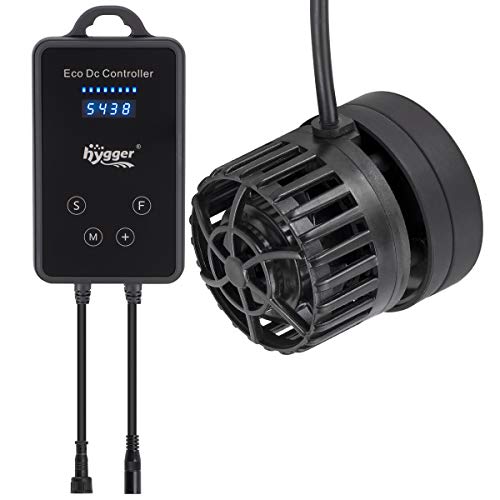
Hygger Mini DC Powerhead 1600 GPH has the highest flow here at 1600 GPH and a built-in LED display controller for setting wave modes, strength, and frequency. It also offers a 10-minute automatic feeding pause and uses 12V DC power, making it the control-heavy choice among these five pumps.
This model may suit saltwater keepers who want to adjust current rather than rely on a single fixed output. Its 5–30-gallon range is unusually broad relative to its maximum flow, so confirm the current is gentle enough for delicate coral or fish that avoid strong flow before choosing it.
Bottom line: Choose it if controller options and high maximum flow matter more than simplicity.
Hygger Wave Maker 660 GPH, 5–10 Gallons

Hygger Wave Maker 660 GPH, 5–10 Gallons is designed for 5–10-gallon aquariums and offers three interchangeable outlets for different water-flow widths. Its controller provides constant, wave, and pulse modes plus six flow-rate steps, giving small-tank owners a way to adjust both pattern and output.
The outlet choices can help direct flow around a compact layout, while the pump’s circulation can agitate sediment and move surface water. Its limitation is the narrow recommended tank range; aquariums larger than 10 gallons should be matched to a model with a suitable stated range rather than assuming this pump will cover them.
Bottom line: Pick it for a 5–10-gallon tank where outlet width and rate adjustment are useful.
Hygger Mini Wave Maker 792 GPH

Hygger Mini Wave Maker 792 GPH pairs a 792 GPH flow rate with a 10–50-gallon tank range, broader than the other models except the 1600 GPH unit. Its LCD controller provides constant, classic pulse, sine, and random modes, with 10 adjustment levels for pulse frequency or flow; a one-touch control pauses circulation for 10 minutes during feeding.
This option suits aquarists who want several current patterns and a feeding pause in one controller. Its limitation is that it is not the lowest-flow choice, so take care with placement and settings in smaller tanks or around livestock that cannot tolerate a strong direct current.
Bottom line: Choose it if you want multiple wave patterns across a 10–50-gallon range.
Hygger Mini Wave Maker 660 GPH

Hygger Mini Wave Maker 660 GPH is a compact 660 GPH pump specified for 5–10-gallon aquariums, with a controller and magnetic mount. Its 1.9-by-1.5-by-1.5-inch size keeps the pump body small inside the tank, while the maker says its circulation supports water movement for fish, corals, and invertebrates.
This is a straightforward fit for a small tank when compact dimensions matter. Unlike Hygger Wave Maker 660 GPH, 5–10 Gallons, whose features call out three interchangeable outlets and six flow rates, this model’s features do not identify those options; choose it for the small form factor and controller rather than those specific adjustments.
Bottom line: Pick it when a compact pump for a 5–10-gallon aquarium is the priority.
How to choose a Hygger mini wave maker
Start with the maker’s recommended tank range, then check whether the flow can be tuned for the livestock and aquascape. A pump’s GPH rating is its maximum flow, not a guarantee that the whole tank receives even circulation; rockwork, plants, and pump direction can create sheltered pockets or strong jets. If your aquarium is 5–10 gallons, compare the two 660 GPH choices and their controls; for a 15–40-gallon tank, Hygger Mini Wave Maker 530 GPH is explicitly rated for that span. In any tank, position the outlet so fish and coral are not pinned by a direct current, and adjust toward broad movement rather than a concentrated blast. Choose a controller-equipped model when changing mode or output is important.
Flow placement and livestock comfort
Surface movement and circulation are useful for gas exchange and carrying suspended debris toward filtration, but strong flow can stress animals that prefer calmer areas. Aim the pump across the tank or slightly toward the surface instead of directly at a resting fish, soft coral, or anemone. Leave a lower-flow refuge behind rock or decor, and watch whether animals can hold position and feed normally after changing the setting. The common mistake is choosing by GPH alone: aquarium shape, obstacles, and outlet direction change how the current feels at the far end. For smaller tanks, begin at a low controller setting if available; with a fixed-output model, angle the head away from sensitive areas.
Controller features and feeding pauses
Controller features differ more than the compact form factors suggest. Hygger Mini DC Powerhead 1600 GPH provides settings for modes, strength, and frequency, while Hygger Wave Maker 660 GPH, 5–10 Gallons specifies three modes and six flow rates; Hygger Mini Wave Maker 792 GPH names four patterns and ten adjustment levels. Those settings let an aquarist change the rhythm or intensity, but more modes do not remove the need to check livestock response after every adjustment. A feeding pause is useful because a stopped current can keep food from immediately drifting away; Hygger Mini DC Powerhead 1600 GPH and Hygger Mini Wave Maker 792 GPH specify a 10-minute pause. Restarting circulation after feeding helps resume normal movement, but do not leave a pump paused longer than the control is designed for.
Keep a wave maker clear and secure
Keep the intake and outlet free of algae, plant fragments, and snails so debris does not restrict movement or block the impeller. A magnetic mount needs clean contact surfaces and a secure fit against the aquarium glass; avoid sliding the magnet while grit is trapped between the surfaces, since grit can scratch glass. Inspect the pump during routine aquarium maintenance and disconnect power before removing it from the water for cleaning. Saltwater can leave mineral deposits as water evaporates, so rinse removable pump parts with aquarium-safe fresh water during maintenance and reassemble them securely. Keep cables arranged with a drip loop below the outlet so water cannot run along the cord toward an electrical receptacle.
Frequently Asked Questions
How much water movement does a small aquarium need?
There is no single GPH target that suits every small aquarium because livestock and aquascape change how current affects animals. Use the pump’s recommended tank range as a starting point, then reduce or redirect flow if fish struggle to hold position or coral stays bent over.
Can a wave maker replace an aquarium filter?
No, a wave maker moves water but does not perform the mechanical or biological filtration of a filter. Circulation can carry suspended debris toward a filter intake, but the filter still needs to be sized and maintained for the aquarium.
Where should I place a wave maker in a fish tank?
Place it high enough to move the surface, then aim across the tank rather than straight at animals or a resting area. Leave a sheltered zone behind decor, especially when keeping livestock that prefers gentle current.
How often should I clean an aquarium powerhead?
Inspect a powerhead during routine aquarium maintenance and clean it whenever algae or debris restricts the intake or impeller. In saltwater, check for mineral buildup as part of maintenance because evaporation can leave deposits on wet parts.
Should a wave maker run during fish feeding?
A brief pause can help keep food from being swept away, and some controllers provide a 10-minute feeding pause. Resume circulation after feeding so water movement and filtration continue normally.