
Indoor HF Ham Radio Antennas: 4 Options Compared

For indoor HF reception, the GA450 is the closest match because it is a compact active loop covering 2.3–30 MHz; the other two antennas are transmitting-oriented setups better suited to outdoor deployment. Choose a transmitting antenna instead if you need to radiate on amateur bands, and check that your indoor installation has enough room and a suitable antenna arrangement.
We earn a commission if you buy through links on this page. As an Amazon Associate I earn from qualifying purchases. Products are compared on manufacturer specifications, not hands-on testing.
- Best overall: GA450 Active Loop – The 7.9-inch active loop is designed for indoor/outdoor receiving across 2.3–30 MHz HF.
- Best for broad reception: GOOZEEZOO GA800 Active Loop – The powered loop spans 10 kHz–159 MHz and covers several receiving bands beyond HF.
- Best for portable transmitting: GOOZEEZOO JYR4010 End-Fed Wire – The end-fed wire supports 40, 20, 15, and 10 meters with up to 150 W SSB.
| Product | Best for | Frequency range | Transmit power | Antenna type | Shop |
|---|---|---|---|---|---|
| GA450 Active Loop | Indoor HF reception | 2.3–30 MHz HF | Receive only | Active loop | Check Price on Amazon |
| GOOZEEZOO GA800 Active Loop | Wideband reception | 10 kHz–159 MHz | Receive only | Active loop | Check Price on Amazon |
| GOOZEEZOO JPC-12 Vertical | Portable HF transmitting | 7–50 MHz | 100 W SSB max | Vertical | Check Price on Amazon |
| GOOZEEZOO JYR4010 End-Fed Wire | Portable wire transmitting | 40, 20, 15, 10 m | 150 W SSB max | End-fed half-wave | Check Price on Amazon |
Indoor HF Ham Radio Antennas
Match the antenna to whether you want indoor receiving, portable HF transmitting, or wider-band reception.
GA450 Active Loop

The GA450 is the only compact loop here explicitly suited to indoor receiving: its 7.9-inch diameter suits limited spaces, and it covers shortwave from 2.3–30 MHz plus medium wave from 522–1,710 kHz. The built-in amplifier and noise filter are intended to help with weak signals and household interference, and its directional pattern lets you rotate it to target stations or reduce noise. The BNC cable connects to compatible receivers. This is a receiving antenna, not a choice for transmitting; verify that your receiver has a BNC input.
Bottom line: Choose this loop for compact indoor shortwave and medium-wave reception.
GOOZEEZOO GA800 Active Loop
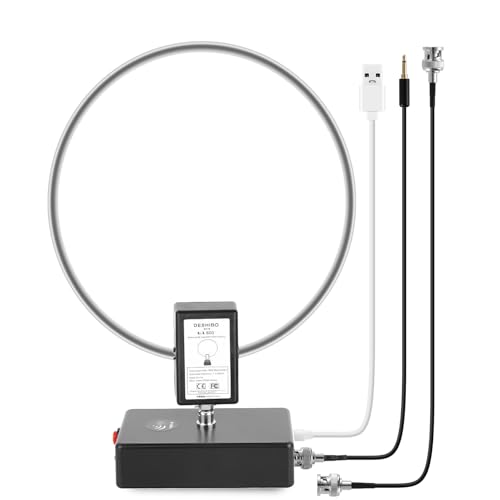
The GA800 reaches far beyond the HF range, covering 10 kHz–159 MHz for reception across longwave, medium wave, shortwave, FM, air band, and V band. Its no-tuning design suits listeners switching among those services, and the included BNC cable serves compatible receivers. The maker says to power the antenna for shortwave and medium wave, while switching the supply off for FM, aviation, and U/V reception to reduce noise and save power. Unlike a transmitting wire antenna, this is a receiving setup; its broad coverage does not make it an HF transmitter.
Bottom line: Pick this for receiving across HF plus several non-HF bands.
GOOZEEZOO JPC-12 Vertical

The JPC-12 is a portable transmitting vertical rather than a small indoor receiving loop, making it the relevant option here for operators who can install an outdoor or field setup. It covers eight bands from 40 through 6 meters, with a 4.1-meter antenna and 50-ohm impedance. The maker gives a maximum SSB power of 100 W and an SWR of 1.5 or lower across the bands. A sliding regulator is intended to make SWR adjustment tool-free. Its 4.1-meter length and deployment needs make it a poor fit for most indoor spaces.
Bottom line: Choose this when you want multiband HF transmission and can deploy a tall vertical.
GOOZEEZOO JYR4010 End-Fed Wire
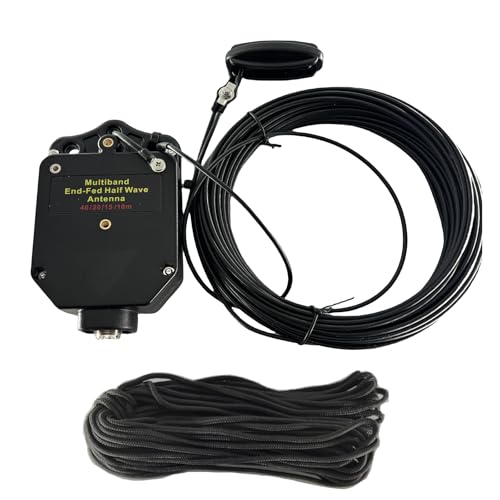
The JYR4010 uses an end-fed half-wave wire, a different portable transmitting approach from the JPC-12 vertical and the two receiving loops. It is designed for 40, 20, 15, and 10 meters, and the maker says no tuning is needed in most setups; its maker gives an integrated 1:49 / 1:64 transformer and SSB handling up to 150 W, or 100 W for CW and FT8. A wire antenna needs suitable space and support, so it is less practical indoors than the small loops.
Bottom line: Pick this for multiband portable wire operation when you have room to deploy it.
Choosing an indoor HF antenna by job
Choose a receiving loop for listening and a transmitting antenna for making HF contacts; the two jobs are not interchangeable. HF spans 3–30 MHz, while amateur HF allocations occupy portions of that range, so match coverage to the bands you actually use. A small active loop can fit near a receiver, but a transmitting wire or vertical needs a workable antenna arrangement and suitable separation from people and electronics. For limited room and receive-only listening, start with a loop; for transmitting, do not assume a receive-only loop can handle transmitter power.
Indoor operation also brings noise from switching power supplies, computers, LED lamps, and other electronics. Positioning and rotating a loop can change the noise and station level, while a transmitting antenna indoors can create RF exposure and interference concerns. Keep transmitting antennas away from people and follow applicable FCC RF-exposure requirements.
How HF band coverage affects fit
HF amateur bands are not one continuous operating range: common allocations include 80, 40, 20, 15, and 10 meters, and an antenna must be suitable for the band in use. Wavelength is approximately 300 divided by frequency in megahertz, so a quarter-wave wire at 7 MHz is roughly 35 feet long before adjustments. That scale is why compact indoor transmit antennas require tradeoffs in efficiency, placement, and tuning. The portable JPC-12 and end-fed wire are physically more demanding than the receiving loops; choose by frequency and room, not simply by the number of bands on a label.
For a transmitting installation, ensure the antenna and feed system are intended for the transceiver’s power and band. A low SWR alone does not prove an antenna is efficient or safe to touch while transmitting.
Receiving loops versus transmitting antennas
Receiving loops and transmitting antennas serve different electrical jobs: active receive loops amplify incoming signals, whereas transmitting antennas must safely handle RF power from the radio. A loop’s BNC connection and broad receive coverage do not establish transmit capability. Conversely, a transmitting antenna’s wattage rating does not indicate how well it will receive weak indoor signals. Select according to the intended use first, then compare coverage, dimensions, and required setup.
| Need | Suitable type | Decision point |
|---|---|---|
| Indoor listening | Active receiving loop | Receiver connector and coverage |
| HF transmitting | Wire or vertical antenna | Band, support space, and power |
| More than HF reception | Wideband active loop | Power requirements by frequency range |
For a room with less than about 8 inches of clear diameter, the GA450’s 7.9-inch ring is the compact physical option; give a wire or vertical only the space its deployment requires.
Indoor antenna placement and safety
Place a receiving loop away from noisy electronics and try more than one orientation; loop directionality can help reject an interfering source. Active antennas also need the correct power state for their intended bands, since the GA800’s maker recommends different power settings for shortwave and higher-frequency reception. For transmitting, an indoor antenna can expose nearby people to RF fields and couple energy into household wiring or electronics. Keep the antenna and feedline inaccessible during transmission, maintain separation, and use current FCC RF-exposure guidance rather than relying on SWR alone.
Frequently Asked Questions
Can an active loop antenna transmit HF signals?
An active receiving loop should not be treated as a transmitting antenna unless its manufacturer explicitly rates it for transmitter power. The GA450 and GA800 are described as receiving antennas, so use a transmitting antenna for on-air HF operation.
How large is a quarter-wave HF wire?
A quarter-wave wire is approximately 300 divided by frequency in megahertz, then divided by four, in meters; at 7 MHz it is about 10.7 meters, or 35 feet. The usable length changes with frequency and installation surroundings.
What connector should an indoor shortwave antenna use?
The receiver input must match the antenna cable connector or use a suitable adapter. The GA450 includes a BNC cable, so confirm the receiver has a BNC input before choosing it.
Why does an indoor antenna pick up household noise?
Switching power supplies, LED lighting, computers, and chargers can emit radio-frequency interference that an indoor antenna receives nearby. Move or switch off suspected sources and reposition a directional loop to reduce the noise.
Is low SWR enough to make an indoor antenna safe?
No; SWR describes the match between a radio and antenna system, not RF exposure or efficiency. Keep people away from transmitting antennas and consult current FCC RF-exposure requirements for the station setup.