
INIA Red Light Masks: 3 Models Compared by Fit

INIA GLOW 4DL suits most people who want the most configurable INIA red light mask, with 460 LEDs, three NIR channels and independent light controls. Choose INIA GLOW 4D Wireless for a cordless design with cooling eye pads, or INIA 850nm NIR Mask if you want its specified 630nm red and 850nm near-infrared wavelengths.
These wearable LED masks deliver visible light, and some also include near-infrared light, for a facial skincare routine. Follow the maker’s session guidance and protect your eyes; consult a clinician first if you have a light-sensitive condition or take photosensitizing medication.
We earn a commission if you buy through links on this page. As an Amazon Associate I earn from qualifying purchases. Products are compared on manufacturer specifications, not hands-on testing.
- Best overall: INIA GLOW 4DL – Its 460 LEDs, triple NIR and independent light controls offer the broadest configuration.
- Best for cordless use: INIA GLOW 4D Wireless – The mask is rechargeable and cordless, with under-eye cooling.
- Best for wavelength clarity: INIA 850nm NIR Mask – Its features specify 630nm red and 850nm near-infrared light.
| Product | Best for | LED count | NIR configuration | Controls or fit | Shop |
|---|---|---|---|---|---|
| INIA GLOW 4DL | Configurable sessions | 460 LEDs | Triple NIR | Voice guidance; overhead strap | Check Price on Amazon |
| INIA GLOW 4D Wireless | Cordless routines | 320 LEDs | Dual NIR | Rechargeable; cooling eye area | Check Price on Amazon |
| INIA 850nm NIR Mask | Specified wavelengths | 220 LEDs | 850nm NIR; 630nm red | 2600mAh battery; 10–30-minute timer | Check Price on Amazon |
INIA Red Light Masks
Compare light configurations and wearable features to find the INIA mask that fits your routine.
INIA GLOW 4DL

With 460 LEDs and independent controls for visible light, NIR and focused light, this mask offers more ways to configure a session than the other models here. It combines 68 five-chip LED units for broad coverage with 24 targeted units around the eyes, brows and mouth. The four modes are red, blue, amber and purple, and voice guidance accompanies the controls. Choose it if adjusting light combinations matters more than a cordless design. The product name identifies magnetic cooling eye pads and an overhead strap; confirm the session length that suits you before use.
Bottom line: Pick this if you want separate controls for different light components.
INIA GLOW 4D Wireless

The cordless, rechargeable format is the clearest distinction here, and the flexible silicone is designed to contour to the face. Its 320 LEDs cover the forehead, cheeks, chin and jaw, while dual NIR channels accompany four light modes. Under-eye cooling adds a comfort feature that the other models do not specifically name. This is a reasonable fit for routines where avoiding a cable matters.
Bottom line: Choose this for a flexible, rechargeable mask with under-eye cooling.
INIA 850nm NIR Mask
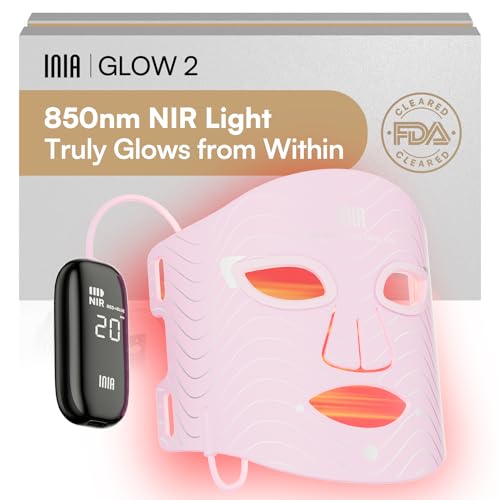
This model is the only one here with exact red and NIR wavelengths specified: 630nm red and 850nm near-infrared. It has 220 LEDs, four modes, a 2600mAh rechargeable battery and a 10-to-30-minute timer. The modes include red, blue and a red-plus-blue option, with optional NIR activation. That makes it useful for buyers who want wavelength and session-control figures to compare. Its LED count is lower than the two GLOW models, so it may not suit someone prioritizing the highest count; LED count alone does not establish treatment results.
Bottom line: Choose this if exact wavelength and timer figures are your priorities.
How to choose an INIA red light mask
Start with the control scheme and the light wavelengths you want, not LED count alone. Visible red light is commonly centered around 620–660nm, while NIR devices often use wavelengths around 800–850nm; the products here specify 630nm red and 850nm NIR only for INIA 850nm NIR Mask. A higher number of LEDs does not by itself prove stronger or more even light at the skin, because output, spacing and distance matter too. If customization is the priority, look for separately controlled light channels; if you want fewer setup decisions, a simpler mode setup may be easier. Treat claims about skin results as maker claims, and compare them only when the treatment schedule and measurement method are clear.
Fit and coverage for a face mask
A wearable mask needs stable contact without pressing hard on the nose, eyes or lips; gaps and shifting can change how light reaches a spot. Flexible silicone may conform more closely to different facial contours, while straps affect how securely the mask stays in place. INIA GLOW 4D Wireless names flexible silicone, and INIA GLOW 4DL names an overhead strap, so comfort priorities can help distinguish them. Before committing to a routine, check whether the mask’s eye area feels comfortable and whether you can keep your eyes closed or otherwise protected as directed. Do not stare into bright LEDs. Stop if the mask causes pain, excessive warmth or eye discomfort, and ask an eye-care professional about use if you have an eye condition.
Red, blue and near-infrared modes compared
Red, blue and near-infrared describe different parts of the light spectrum, so a mode label is not a guarantee of a particular skincare outcome. Red light is visible; NIR is invisible, which means you cannot judge its activity by looking at the mask. Blue light around 460–470nm is visible and appears as a separate option in INIA 850nm NIR Mask, while INIA GLOW 4DL includes amber and purple modes. Use this table to match the configuration to your preference; it does not rank effectiveness.
| Need | What to compare |
|---|---|
| Exact wavelengths | Red and NIR nanometer figures |
| Mode flexibility | Number of modes and independent controls |
| Light targeting | Broad coverage versus targeted light units |
Safe use and routine mistakes
Follow the mask maker’s session length and frequency rather than extending exposure to chase faster results. A timer is useful because it helps limit a session, but longer sessions are not automatically better. Keep the mask and skin clean and dry before wearing it, and do not use a device over irritated or broken skin unless a qualified clinician says it is appropriate. People taking photosensitizing medicines or managing a light-sensitive condition should check with a clinician before use. Avoid using multiple light devices on the same area in one session unless their makers explicitly allow it. If discomfort, headache or visual symptoms occur, stop using the mask and seek medical advice for persistent symptoms.
Frequently Asked Questions
How often should I use an LED face mask?
Use the frequency and session length in the mask’s instructions; there is no single schedule that applies to every LED device. A timer range is not a recommendation to use the longest session every time.
Can I keep my eyes open under a red light mask?
Do not look directly at bright LEDs, and use the eye protection or eye-closure guidance supplied for the device. Ask an eye-care professional before use if you have an eye condition or light sensitivity.
What is the difference between red light and NIR?
Red light is visible, while near-infrared (NIR) is outside the visible spectrum and cannot be seen as a glow. Wavelengths around 620–660nm are common for red devices, and many NIR devices use about 800–850nm.
Can photosensitizing medication affect mask use?
Yes, some medicines can increase sensitivity to light, so check with the prescribing clinician or pharmacist before using an LED mask. This precaution matters even when a device is intended for cosmetic use.
Does a higher LED count mean better results?
No; LED count alone does not establish how much light reaches the skin or what results to expect. Output, wavelength, spacing, fit and session schedule also matter.