
Instant Glue for Wood: 4 Adhesives Compared by Fit

For most wood repairs, FastCap 2P-10 SoloKit is the closest match because its thick adhesive and included activator are designed for rapid bonding; use LMQ Wood Super Glue 60g Thin instead when thin glue must wick into narrow gaps. Instant glue is usually cyanoacrylate (CA), a fast-setting adhesive best suited to small, close-fitting joints rather than structural wood assemblies.
Choose another option if you need slower working time or a large wood-to-wood joint: traditional PVA wood glue gives more time to position parts and is commonly clamped while curing.
We earn a commission if you buy through links on this page. As an Amazon Associate I earn from qualifying purchases. Products are compared on manufacturer specifications, not hands-on testing.
- Best overall: FastCap 2P-10 SoloKit – The thick adhesive and included activator are paired for rapid bonding, with a 10-second bond time.
- Best for narrow gaps: LMQ Wood Super Glue 60g Thin – Its thin viscosity and stated 10-to-30-second cure suit narrow joints that need glue to flow into them.
- Best for heat resistance: Titebond Instant Bond Thick 2 oz – The formula specifies heat resistance to 212°F and is made for instant wood bonding.
| Product | Best for | Viscosity | Adhesive amount | Set or cure time | Shop |
|---|---|---|---|---|---|
| FastCap 2P-10 SoloKit | Quick shop bonds | Thick | 2 oz | 10 sec bond | Check Price on Amazon |
| LMQ Wood Super Glue 60g Thin | Narrow joints | Thin | 2 oz | 10–30 sec cure | Check Price on Amazon |
| Titebond Instant Bond Thick 2 oz | Heat exposure | Thick | 2 oz | Fast set | Check Price on Amazon |
| Wood Super Glue Liquid 1 oz | Small furniture fixes | Thick | 1 oz | 30–60 sec dry | Check Price on Amazon |
Instant Glue for Wood Compared
Compare adhesive thickness, package contents, and stated set times against the joint you need to repair.
FastCap 2P-10 SoloKit

FastCap 2P-10 is the only option here that pairs thick adhesive with a separately included activator, making it suited to woodworking tasks where rapid positioning matters. The kit contains 2 oz of adhesive and 12 oz of activator; the maker says it bonds in 10 seconds and reaches 4,000 psi strength in 30 seconds when used with activator. Thick CA can bridge small gaps better than thin formulas and is less prone to running on vertical surfaces. The limitation is reduced repositioning time, so dry-fit parts and align them before applying adhesive.
Bottom line: Choose this kit when you can align the wood parts before triggering a fast bond.
LMQ Wood Super Glue 60g Thin

LMQ’s thin formula is the most fluid choice here, aimed at narrow joints where adhesive needs to wick into a tight seam rather than bridge a wider gap. The package includes ten extra tips, which can help direct small drops into fine repairs. The maker says it cures in 10 to 30 seconds and cites 3,580 psi tensile strength after full cure. Thin CA is a poor match for broad gaps or absorbent end grain because it can soak in before the joint is filled; choose a thick formulation for those jobs.
Bottom line: Pick this for tight seams and small wood repairs where low viscosity is useful.
Titebond Instant Bond Thick 2 oz

Titebond Instant Bond Thick is the wood-focused option with an explicit heat-resistance figure: 212°F. Its 2 oz bottle is a thick, fast-set cyanoacrylate intended to reduce or eliminate clamping for suitable small bonds, and it also names MDF and several nonwood materials among compatible surfaces. That heat figure is not a substitute for checking the demands of a load-bearing joint; CA bonds are generally better for small repairs than large structural seams. The fast set also means careful dry fitting is important before application.
Bottom line: Choose it for small wood bonds where the heat rating matters.
Wood Super Glue Liquid 1 oz
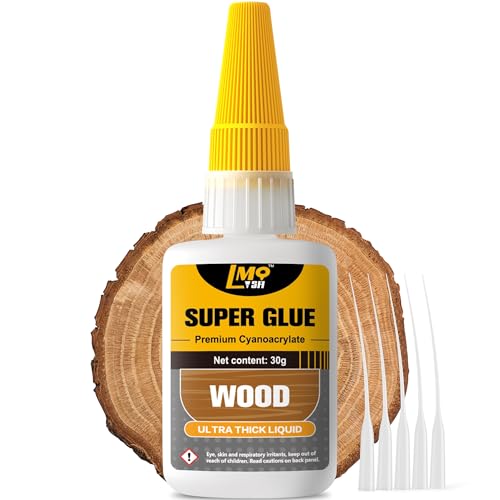
This clear 1 oz CA glue is the smallest wood-specific package among these choices and is described as thick, a useful combination for controlled small furniture or craft repairs. The maker says it dries in 30 to 60 seconds and fully cures within 24 hours, so handling and full cure are different milestones. Its use across wood, metal, ceramic, plastic, glass, leather, and pottery makes it a multipurpose repair adhesive. A one-ounce bottle is less suited to repeated shop use than the larger packages, and thick glue is not ideal for wicking into hairline seams.
Bottom line: Pick it for occasional small repairs needing a controlled, thick clear adhesive.
How to Choose Instant Glue for Wood
Match viscosity to the joint: thin CA flows into hairline cracks, while medium or thick CA stays in a small gap and on a vertical face. CA generally sets from seconds to about a minute, but humidity, material, and the amount applied affect speed. For a small joint where parts can be aligned first, fast set is useful; for a broad wood assembly, PVA wood glue is usually easier to position and clamp. A practical rule is to use CA for a seam under about 1/16 inch and switch to a gap-filling adhesive or fitted repair for wider openings. CA can bond skin quickly, so wear eye protection and keep fingers clear of wet joints.
| Joint need | Glue type | Why |
|---|---|---|
| Hairline seam | Thin CA | Flows into a tight joint |
| Small gap or vertical face | Thick CA | Stays in place better |
| Large wood assembly | PVA wood glue | Allows alignment and clamping |
When Thin or Thick CA Fits a Wood Joint
Thin and thick cyanoacrylate solve different fit problems, so choose by the space between the parts rather than by cure speed alone. Thin formulas are useful for close-fitting joints and capillary repairs; thick formulas are better for small gaps and surfaces where run-off is a concern. Neither is a substitute for correcting a badly mismatched joint: CA bonds best when surfaces meet closely and cleanly. On porous end grain, absorption can leave too little adhesive at the bond line, so a thicker formulation or a more suitable wood glue may be preferable. Keep applications small because excess CA can cure unevenly and leave visible residue.
Set Time, Full Cure, and Safe Handling
Initial set and full cure are not the same: some CA products grab in seconds, while full cure can take hours. Avoid stressing a repair just because the surfaces have held together; the wood glue option here gives a 24-hour full-cure interval. CA fumes can irritate eyes and airways, so work with ventilation and avoid leaning over the joint. Keep adhesive off skin and out of reach of children; if fingers bond, do not pull them apart forcibly. A small drop, dry-fit parts, and a stable work surface reduce both mess and accidental bonding.
Common Mistakes With Wood Super Glue
Using a fast adhesive to compensate for a loose or dirty joint is a common mistake; remove dust and make sure the mating faces fit before applying glue. Another is choosing thin CA for a wide opening, where it can drain away rather than bridge the gap. Apply a small amount and use an activator only when the chosen adhesive system calls for it, since accelerator can sharply shorten positioning time. Avoid relying on a small CA repair for a structural load: furniture legs, chair rails, and other load-bearing parts need a joint design and adhesive rated for the stresses involved.
Frequently Asked Questions
How long does instant glue take to cure on wood?
Many CA formulas grab in seconds, but full cure can take much longer. One wood-specific formula here gives 30 to 60 seconds to dry and 24 hours to fully cure, so avoid loading a repair before full cure.
Is thin or thick CA glue better for wood?
Thin CA is better for close-fitting seams that can wick adhesive into the joint, while thick CA suits small gaps and vertical surfaces. If a gap is wider than about 1/16 inch, improve the fit or use an adhesive intended for gap filling.
Can instant glue replace wood glue for furniture?
CA can handle small, close-fitting furniture repairs, but it is generally not the best choice for large structural joints. PVA wood glue gives more positioning time and is commonly clamped while curing.
Should wood surfaces be clamped with CA glue?
Many CA joints need firm contact rather than prolonged clamping, but holding pieces aligned during the initial set can help. The specific formula and activator pairing affect set speed, so dry-fit the parts and keep pressure controlled.
Is cyanoacrylate glue safe to use indoors?
Use CA in a ventilated area because its fumes can irritate eyes and airways. Keep it away from skin and eyes, and do not let children handle the adhesive.