
Inverter Portable Air Conditioners: 4 Models Compared

16,000 BTU Dual-Hose Inverter AC suits the widest range of rooms among these inverter portable air conditioners, with a 16,000 BTU ASHRAE rating, 12,000 BTU SACC, and coverage up to 850 square feet. Choose another model if you need heating, Wi-Fi control, or a different room-size fit.
Inverter portable air conditioners use a variable-speed compressor to adjust cooling output rather than repeatedly switching at one fixed speed.
We earn a commission if you buy through links on this page. As an Amazon Associate I earn from qualifying purchases. Products are compared on manufacturer specifications, not hands-on testing.
- Best overall: 16,000 BTU Dual-Hose Inverter AC – Its 850-square-foot coverage is the largest here, with a 16,000 BTU ASHRAE rating.
- Best for Wi-Fi and heating: SereneLife 14,000 BTU Wi-Fi Inverter AC – It combines Wi-Fi control and heating with coverage up to 650 square feet.
- Best for dual-motor design: AGTANA 16,000 BTU Dual-Motor Inverter AC – Its dual-motor, dual-hose design is paired with a 16,000 BTU ASHRAE rating.
- Best for heat and hose-in-hose design: Midea Duo 14,000 BTU Inverter AC with Heat – It combines heating with a dual hose-in-hose design and smart-assistant compatibility.
| Product | Best for | Capacity | Coverage | Modes or control | Shop |
|---|---|---|---|---|---|
| 16,000 BTU Dual-Hose Inverter AC | Larger rooms | 16,000 BTU ASHRAE / 12,000 SACC | Up to 850 sq. ft. | Cool, dehumidify, fan | Check Price on Amazon |
| SereneLife 14,000 BTU Wi-Fi Inverter AC | Wi-Fi and heating | 14,000 BTU | Up to 650 sq. ft. | Cool, heat, dehumidify, fan, Wi-Fi | Check Price on Amazon |
| AGTANA 16,000 BTU Dual-Motor Inverter AC | Dual-motor cooling | 16,000 BTU ASHRAE / 12,000 SACC | Up to 800 sq. ft. | Cool, fan, dehumidify | Check Price on Amazon |
| Midea Duo 14,000 BTU Inverter AC with Heat | Balanced airflow | 14,000 BTU / 12,000 SACC | Up to 550 sq. ft. | Cool, heat, Alexa, Google Assistant | Check Price on Amazon |
Inverter Portable Air Conditioners Compared
Compare room coverage, capacity, and the features that distinguish each unit before choosing.
16,000 BTU Dual-Hose Inverter AC
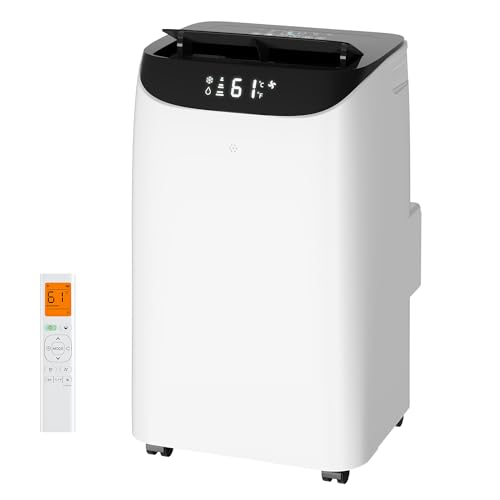
With coverage up to 850 square feet, this model reaches the largest room area among these units. It has a dual-hose design, inverter compressor, and 16,000 BTU ASHRAE rating (12,000 BTU SACC). The maker says its inverter technology can save up to 40% of electricity compared with standard portable AC units. Cooling, fan, dehumidifier, sleep mode, and remote control suit buyers who want several functions in one appliance. Its room coverage is a guide, not a guarantee; rooms with high ceilings or strong sun may need more capacity.
Bottom line: Choose this for a larger room when its coverage and cooling modes fit your needs.
SereneLife 14,000 BTU Wi-Fi Inverter AC

Heating and Wi-Fi control distinguish this model from the cooling-focused options. SereneLife gives it 14,000 BTU capacity and coverage up to 650 square feet, alongside cooling, heating, dehumidifying, and fan modes. The maker says the inverter motor is up to 40% more energy efficient than standard portable AC motors and operates at 43 dBA. That combination suits bedrooms, offices, and living spaces where app-based adjustment and seasonal heating matter. Its coverage is lower than the 800- and 850-square-foot models, so compare room size before choosing it for a large open area.
Bottom line: Pick this when Wi-Fi control and a heating mode matter more than maximum coverage.
AGTANA 16,000 BTU Dual-Motor Inverter AC

The dual-motor and dual-hose arrangement sets this model apart, with coverage up to 800 square feet. Its 16,000 BTU ASHRAE (12,000 BTU SACC) rating puts it in the same capacity class as the larger-rated option, while the coverage is 50 square feet lower. It includes cooling, fan, and dehumidifying modes, plus a self-evaporating system intended to reduce routine manual drainage. The maker says dry mode removes up to 96 pints of moisture per day and calls for a drain hose for continuous drainage. Buyers wanting heat or Wi-Fi should choose a different model.
Bottom line: Choose this for its dual-motor, dual-hose setup and room coverage up to 800 square feet.
Midea Duo 14,000 BTU Inverter AC with Heat

Midea’s dual hose-in-hose design is the defining feature: one assembly intakes and exhausts air outdoors, unlike separate dual hoses. This model has a 14,000 BTU rating, 12,000 BTU SACC, heating, smart and remote controls, and stated coverage up to 550 square feet. The maker says the hose arrangement supports balanced indoor air circulation and that the inverter saves more than 40% energy compared with the U.S. federal standard. Alexa and Google Assistant compatibility may suit connected homes. Its room coverage is the smallest of these four, so it is a less suitable match for a large room.
Bottom line: Pick this for a smaller room when heating and smart-assistant control are priorities.
How to Choose an Inverter Portable Air Conditioner
Start with the room’s floor area and the unit’s SACC rating, then account for conditions that increase cooling demand. A common starting estimate for room air conditioning is about 20 BTU per square foot; direct sun, high ceilings, and several occupants can call for more capacity. Portable AC packaging may show both ASHRAE and SACC capacity, and those numbers are not interchangeable: SACC is the adjusted rating intended to better reflect portable-unit performance. Compare the same rating basis when possible. For example, a unit labeled 12,000 BTU SACC is not a like-for-like match for another unit showing only an ASHRAE figure. If the room is near the coverage limit, favor a model with more capacity rather than assuming the maximum coverage will hold in every layout.
Single-Hose and Dual-Hose Portable AC Designs
Dual-hose portable ACs use one outdoor air path for intake and another for exhaust, while single-hose units draw room air and send it outside through one hose. Removing indoor air can create negative pressure that pulls warmer air into a room through gaps; a dual-hose layout reduces that imbalance. The Midea Duo uses a hose-in-hose design, putting intake and exhaust paths in one assembly, while the other dual-hose models use paired hoses. Neither layout removes the need to seal the window opening around the exhaust connection. Keep hose runs short and avoid sharp bends, because restricted exhaust airflow can undermine cooling. Choose a hose arrangement that fits the window and installation space you actually have.
Room Coverage and Capacity Fit
Room coverage is a useful first filter, but the square-foot figure is not a universal promise. A sunny top-floor room, an open-plan space, or a room with a tall ceiling can need more cooling than a shaded, closed room of equal floor area. Use the unit’s rating and coverage together: compare SACC values where available, then consider whether the room has extra heat sources such as cooking equipment or electronics. A practical decision rule is to avoid choosing a unit whose coverage is below the room’s measured area; if the room is within about 10% of the ceiling, account for sun and ceiling height before settling on capacity. Do not assume a portable AC will cool rooms beyond its coverage evenly.
| Room and feature need | What to prioritize |
|---|---|
| Room near or above 800 sq. ft. | Model with coverage of 800–850 sq. ft. |
| Heating and Wi-Fi | Unit with heating and Wi-Fi control |
| Heating and smart-assistant control | Unit with heat and Alexa or Google Assistant compatibility |
| Smaller space with dual-hose design | Check the model’s coverage and hose arrangement |
Portable AC Installation and Drainage
Portable AC performance depends on a well-sealed window connection and an unobstructed exhaust path. Install the window panel snugly, close gaps around it, and keep the hose from being crushed behind furniture; warm outdoor air leaking back in can make a correctly sized unit struggle. Dehumidifying mode also affects drainage: some units recycle condensate during ordinary cooling, while a dry mode may require a drain hose for continuous removal. The AGTANA model’s dry-mode directions call for connecting a drain hose for continuous drainage. Before choosing a unit for a bedroom, check the available window opening, hose reach, and a suitable drain location. Keep the appliance upright and follow its installation and electrical safety directions.
Frequently Asked Questions
What does SACC mean on a portable air conditioner?
SACC means Seasonally Adjusted Cooling Capacity, a rating that adjusts for conditions affecting portable ACs. Compare SACC with SACC rather than directly comparing it with an ASHRAE figure.
How much portable AC capacity does a room need?
About 20 BTU per square foot is a common starting estimate for room air conditioning. Strong sun, tall ceilings, and multiple occupants can increase the cooling load, so use the unit’s coverage as a guide rather than a guarantee.
Do dual-hose portable air conditioners cool differently?
A dual-hose portable AC uses one hose for intake and one for exhaust, reducing the negative pressure created when a single-hose unit exhausts room air. Keep both paths clear and seal the window opening to limit warm-air leakage.
Does a portable air conditioner need a drain hose?
Some portable ACs recycle condensate during cooling, but dehumidifying or dry mode can require drainage. For continuous dry-mode drainage, connect a hose to an appropriate drain when the model calls for it.
Can portable air conditioners heat a room?
Only models with a heating mode provide that function; the SereneLife and Midea options here include heating. Check the unit’s room coverage and use its heating mode only within the conditions specified for the appliance.