
J.A. Henckels Cookware: 3 Sets Compared by Cooking Style

The Henckels Clad H3 suits cooks who want tri-ply stainless steel, induction compatibility, and a strainer-integrated lid in a 10-piece set. Choose the Paradigm instead for a ceramic nonstick cooking surface, or Twin Classic for a 9-piece steel set with three stock pots.
These sets differ in cooking surface and construction; stainless steel favors browning and durability, while nonstick surfaces prioritize easier release. The sets are cookware, not a direct match for every item sold under the J.A. Henckels name.
We earn a commission if you buy through links on this page. As an Amazon Associate I earn from qualifying purchases. Products are compared on manufacturer specifications, not hands-on testing.
- Best overall: Henckels Clad H3 10-Piece Set – Tri-ply stainless steel, induction compatibility, and a strainer-integrated glass lid make it the most versatile fit.
- Best for nonstick cooking: Henckels Paradigm 10-Piece Set – Its hybrid stainless and ceramic nonstick surface is designed for both searing and easier food release.
- Best for stock pots: Twin Classic Steel 9-Piece Set – The 9-piece Twin Classic set includes three stock pots with 2-, 4-, and 7-liter capacities.
| Product | Best for | Construction | Cooking surface | Pieces | Shop |
|---|---|---|---|---|---|
| Henckels Clad H3 10-Piece Set | Stainless steel cooking | Tri-ply clad, aluminum core | Stainless steel | 10 | Check Price on Amazon |
| Henckels Paradigm 10-Piece Set | Hybrid nonstick cooking | Tri-ply stainless steel | Ceramic nonstick | 10 | Check Price on Amazon |
| Twin Classic Steel 9-Piece Set | Stock-pot cooking | Aluminum-core base | Stainless steel | 9 | Check Price on Amazon |
J.A. Henckels Cookware Sets
Compare these sets by their construction, cooking surface, and included cookware before choosing a fit for your stovetop and cooking style.
Henckels Clad H3 10-Piece Set

The Clad H3 stands out for its tri-ply construction and strainer-integrated glass lid. Its aluminum core is designed for even, quick heating, and the set works on induction and other cooktops. The set is oven-safe to 500°F and dishwasher-safe; Henckels says it includes a lifetime warranty. It suits cooks who want stainless steel and plan to brown food or move cookware from stovetop to oven. Stainless steel can require more attention to preheating and cooking fat than nonstick cookware, so it may be less convenient for delicate foods that tend to stick.
Bottom line: Pick this set if you want tri-ply stainless steel and a built-in lid strainer.
Henckels Paradigm 10-Piece Set
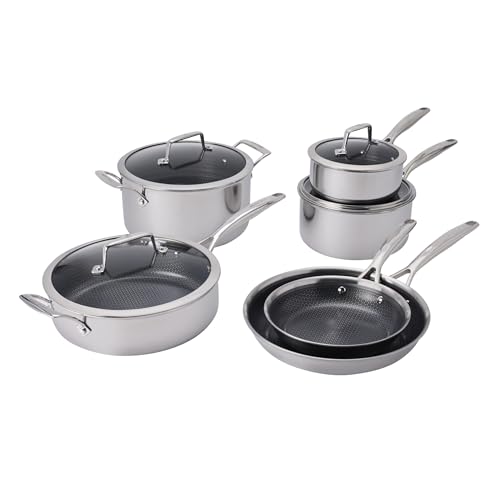
The Paradigm pairs a ceramic nonstick surface with tri-ply stainless steel, unlike the Clad H3’s stainless cooking surface. Henckels says the exposed stainless top layer supports searing and browning while the ceramic coating helps food release. The coating is made without PFAS, PTFE, lead, or cadmium, according to Henckels. This set suits cooks who want easier release but still want a steel contact surface for browning. Ceramic nonstick coatings can wear with rough tools and excessive heat, so cooks who prefer metal utensils or frequent high-heat cooking may favor uncoated stainless steel.
Bottom line: Choose this set for a ceramic nonstick surface paired with stainless steel construction.
Twin Classic Steel 9-Piece Set

The Twin Classic is the only set here with three specified stock-pot capacities: 2, 4, and 7 liters. Its base has a pure-aluminum core, while the two 10-piece sets use tri-ply construction. That makes it a useful match for cooks who regularly simmer soup, boil pasta, or need multiple pot sizes. The set is stainless steel, but its features do not establish oven safety, dishwasher safety, or induction compatibility. Confirm stovetop compatibility before buying if you use induction; induction requires cookware with a magnetic base.
Bottom line: Choose this set if three stock-pot capacities matter more than a specified nonstick surface.
How to Choose J.A. Henckels Cookware
Start with the cooking surface: stainless steel offers an uncoated surface suited to browning, while ceramic nonstick makes food release easier. A tri-ply pan sandwiches an aluminum layer between steel layers to spread heat across the cooking surface; a base-core design concentrates its layered construction in the bottom. If you cook eggs or other delicate foods often, a nonstick surface can reduce sticking, while stainless steel is a better fit for fond and pan sauces. For frequent oven use, compare the cookware’s temperature limit with your recipes; the Clad H3 and Paradigm are rated to 500°F, but the Twin Classic’s oven rating is not established here.
Induction Compatibility and Cooktop Fit
Induction works by magnetic coupling, so a pan needs a magnetic base that sits flat on the cooking zone. Henckels says the Clad H3 and Paradigm work on induction and other cooktops; verify compatibility for the Twin Classic before choosing it for an induction range. Match a pot’s base to the burner: a base much smaller than the burner wastes heated area, while a base that overhangs a glass-ceramic element can heat unevenly. Keep cookware centered and lift it rather than sliding it across glass to limit scratching. The handle and lid materials also matter for oven transfers, so use the oven limit rather than assuming every component tolerates high heat.
Stainless Steel and Ceramic Nonstick Compared
Stainless steel and ceramic nonstick serve different cooking habits, even when both sets have steel construction. Stainless steel needs controlled preheating and adequate cooking fat for foods prone to sticking; ceramic coating is intended to release food more readily but benefits from gentler tools and heat. For a typical stovetop routine, medium heat is a sensible starting point, then adjust to the food and burner rather than leaving an empty pan over high heat. Use this comparison to connect the cooking task to the surface.
| Cooking need | Surface to consider | Practical tradeoff |
|---|---|---|
| Pan sauces and browning | Stainless steel | More sticking risk without proper preheating and fat |
| Delicate foods and easy release | Ceramic nonstick | Protect the coating from rough tools and high heat |
| Multiple soup or pasta batches | Stock pots | Check capacity against recipe batch size |
Care and Safe Cookware Use
Use medium heat as a starting point and avoid leaving an empty pan on a hot burner; overheating cookware can cause burns and damage surfaces. Ceramic-coated pans generally last longer when used with wood, silicone, or nylon utensils instead of metal, and abrasive scrubbers can wear the coating. Stainless steel tolerates more vigorous cleaning than coated surfaces, but cooling a hot pan suddenly under cold water can warp it. Let cookware cool before washing, and use the dishwasher only when the set is rated for it: the Clad H3 is dishwasher-safe, while that rating is not established for the other sets here. Always use dry oven mitts when handling hot handles or lids.
Frequently Asked Questions
How do I keep stainless steel cookware from sticking?
Preheat stainless steel over medium heat for a couple of minutes, then add cooking fat before the food. A pan that is too cool or overloaded is more likely to stick, so cook in batches when food crowds the surface.
Can I use ceramic nonstick cookware over high heat?
Use low to medium heat for routine cooking and avoid heating an empty coated pan. Repeated high heat can shorten the life of a ceramic nonstick surface, and silicone or wood utensils help limit scratches.
How can I tell whether a pot works on induction?
A magnet should cling firmly to the pot’s base for induction use. A flat, magnetic base that matches the burner size heats more consistently than a small or warped base.
When should I replace a nonstick pan?
Replace a coated pan when the cooking surface is deeply scratched, peeling, or no longer releases food reliably. Stop using it if coating fragments are coming loose, and avoid abrasive cleaning that can accelerate wear.
Does oven-safe cookware mean the lid is safe too?
Not necessarily; the oven limit can differ for lids, handles, and knobs. Use the temperature rating for the entire piece, and do not assume a glass lid has the same heat tolerance as its pan.