
Kick Pad for Karate: 4 Training Options Compared

For most karate practice, Nicunom 2-Pack Kick Pads is a practical pick because its two 15-inch pads have wrist straps and double-sided targets. Choose Poen 3-Piece Kick Pad Set instead if you want a three-piece set with both paddle and square target shapes; target pads are held by a partner to give kicks a defined landing surface.
We earn a commission if you buy through links on this page. As an Amazon Associate I earn from qualifying purchases. Products are compared on manufacturer specifications, not hands-on testing.
- Best overall: Nicunom 2-Pack Kick Pads – Two 15-inch pads combine double-sided targets with wrist straps.
- Best for varied target shapes: Poen 3-Piece Kick Pad Set – The three-piece set includes a paddle and a wider square pad.
- Best for reinforced seams: Taekwondo Kick Pads 2-Pack – The maker describes double-thread sewing and nylon-rope perimeter stitching.
| Product | Best for | Pack count | Target dimensions | Outer material | Shop |
|---|---|---|---|---|---|
| Nicunom 2-Pack Kick Pads | Double-sided targets | 2 pads | 15 × 7.5 × 2.5 in | PU leather | Check Price on Amazon |
| Poen 3-Piece Kick Pad Set | Multiple target shapes | 3 pieces | 15.35 × 7.48 in; 15.75 × 7.87 in | PU | Check Price on Amazon |
| Taekwondo Kick Pads 2-Pack | Reinforced stitching | 2 pads | 15.35 × 7.48 × 1.97 in | PU leather | Check Price on Amazon |
| Black Double-Sided Kick Pads, 2-Pack | Grip-focused drills | 2 pads | 15.35 × 7.48 in | PU leather | Check Price on Amazon |
Kick Pads for Karate
Compare target dimensions, construction, and pack contents to find a set that suits your partner drills.
Nicunom 2-Pack Kick Pads

Nicunom 2-Pack Kick Pads stands out for its 2.5-inch thickness and double-sided target design. The two blue pads have PU leather exteriors, elastic compression-sponge interiors, and wrist straps; the maker says the boards inside create a striking sound during practice. That makes the set a straightforward choice for partner drills covering high and low kicks. The 15-inch length and 7.5-inch width offer a compact paddle shape rather than a broad square target, so choose a wider surface if your drills call for more room for placement.
Bottom line: Choose this set for compact, double-sided targets with wrist straps.
Poen 3-Piece Kick Pad Set

Poen 3-Piece Kick Pad Set is the only set here that combines two target shapes: a chicken-leg-style paddle measuring about 15.35 by 7.48 inches and a square pad measuring about 15.75 by 7.87 inches. The three red pieces use PU material and sponge filling, according to the maker. A square target gives a broader face than the paddle, making this set useful when partners alternate precision work with a larger target. The source dimensions give separate thicknesses, but the exact count of each shape is unclear, so confirm the set contents if that split matters to your drills.
Bottom line: Pick this set when both paddle and square target shapes suit your practice.
Taekwondo Kick Pads 2-Pack

Taekwondo Kick Pads 2-Pack emphasizes its stitched construction: the maker describes double-thread sewing and a hand-sewn perimeter with nylon rope. Each black-and-blue pad measures about 15.35 by 7.48 by 1.97 inches and has a PU leather exterior with high-density EVA foam inside. Its soft, flexible handle is intended to make holding the target more comfortable during drills. The dimensions match a slim paddle format, not a wide shield, so it is better suited to partner-held kick targets than to covering a large area.
Bottom line: Choose this pair if reinforced seam construction is a priority.
Black Double-Sided Kick Pads, 2-Pack
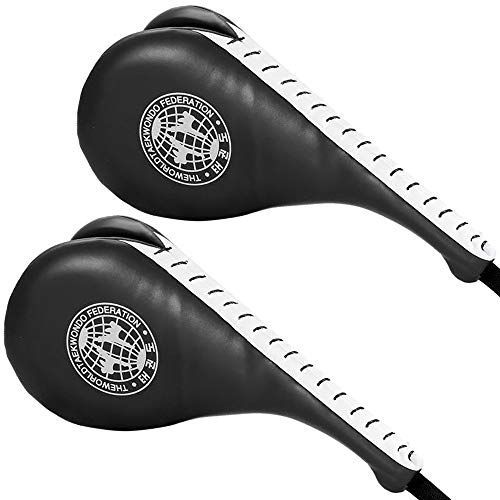
Black Double-Sided Kick Pads, 2-Pack is distinguished by its textured, non-slip wrist-grip straps, which are designed to help the holder keep each black target in hand. The pair uses a double-sided paddle design, and the maker says a snap sound accompanies impact. Its length and width are 15.35 by 7.48 inches, similar to the other paddle-shaped options here. This set suits partner sessions where a secure-feeling grip and audible feedback matter; the measurements give no reliable thickness, so choose another option if thickness is central to your decision.
Bottom line: Pick this pair for textured wrist straps and audible impact feedback.
How to choose a karate kick pad
Choose a paddle target for focused partner-held kicks and a wider face when your drill needs more room for placement. The options here range from roughly 7.5 inches wide to a square target about 7.87 inches wide; that difference is modest, but the square shape adds more landing area. For a narrower precision target, select a paddle around 15 inches long and 7.5 inches wide. Check the intended drills and the holder’s grip before choosing: a target is only useful when the partner can hold it securely and present the intended striking surface. Keep kicks controlled and agree on the target height and pace before starting.
Pad size and target shape
Target shape changes the practice area more than a small difference in length. The paddle-style pads in this group measure about 15 inches long and 7.5 inches wide, while the square pad is approximately 15.75 by 7.87 inches. Use the paddle when a partner is presenting a specific target for repeated kicks; choose the square when you want a somewhat broader face. A simple decision rule is to choose a target at least 7.5 inches wide for these options, then favor the square shape if your drill benefits from the extra width. Pad thickness also matters for feel and impact absorption, but do not compare thickness unless the measurement is given consistently.
Comparing kick-pad construction
PU leather is the shared exterior material across these four options, while the described inner materials differ. Taekwondo Kick Pads 2-Pack uses high-density EVA foam, Nicunom 2-Pack Kick Pads has elastic compression sponge, and Poen 3-Piece Kick Pad Set is filled with sponge; Black Double-Sided Kick Pads, 2-Pack identifies PU leather but not a specific inner fill. The maker describes double-thread sewing and nylon-rope edge stitching for Taekwondo Kick Pads 2-Pack, while Nicunom 2-Pack Kick Pads and Black Double-Sided Kick Pads, 2-Pack focus on double-sided striking surfaces. Use the table to compare the construction, then choose by the feature that affects your practice most: grip, target shape, or inner fill. These descriptions do not establish a standardized impact rating, so they should not be treated as equivalent safety certifications.
| Practice need | Useful feature | Option |
|---|---|---|
| Two-sided striking surface | Double-sided target | Black Double-Sided Kick Pads, 2-Pack or Nicunom 2-Pack Kick Pads |
| Choice of target shape | Paddle and square forms | Poen 3-Piece Kick Pad Set |
| Stitching emphasis | Double-thread seams and nylon rope edge | Taekwondo Kick Pads 2-Pack |
Safe partner practice with kick pads
Agree on the target height, kick type, and pace before each round, and have the holder keep fingers clear of the striking face. A handheld target depends on the partner’s grip and stance; stop if the holder cannot brace comfortably or the target shifts on impact. Begin with controlled kicks rather than full-power strikes, especially when partners are new to holding pads. Wrist straps can help keep a target in hand, but they do not replace a secure grip or an appropriate stance. Use a suitable training area with clear space around both partners, and avoid directing kicks at an unprotected person instead of the pad.
Frequently Asked Questions
What size kick pad works for karate practice?
A paddle around 15 inches long and 7.5 inches wide is a compact partner-held target. Choose a broader face, such as the roughly 15.75-by-7.87-inch square option, when the drill calls for more landing area.
Are double-sided kick pads useful for training?
A double-sided face lets a holder present either side of the target during partner drills. The two-sided designs here are paddles, so they remain narrower than a square target.
How should a partner hold a karate kick pad?
The holder should grip the handle securely, keep fingers clear of the striking surface, and brace in a stable stance. Start with controlled kicks and pause if the pad shifts or the holder loses a comfortable grip.
What is the difference between EVA foam and sponge filling?
EVA foam and sponge are different inner materials, but those labels alone do not establish a comparable impact rating. Compare the dimensions and target shape too, and use controlled practice rather than assuming a particular fill allows full-power strikes.