
LabCharge Ionic Air Purifiers for Home Compared

For a LabCharge ionic air purifier for home use, choose LabCharge Ionic Purifier, 5-Pack if you want a five-unit pack and the claimed coverage of 250 square feet per unit. These plug-in ionizers are different from fan-driven HEPA cleaners: they charge particles rather than collecting them in a filter, so choose a conventional HEPA purifier if particle capture is your priority.
All three options are black, compact plug-in ionizers; their main differences are pack count and the product claims attached to them. Check whether the unit has an ozone-emissions certification before using it in an occupied room.
We earn a commission if you buy through links on this page. As an Amazon Associate I earn from qualifying purchases. Products are compared on manufacturer specifications, not hands-on testing.
- Best overall: LabCharge Ionic Purifier, 5-Pack – A five-unit pack with a claimed 250-square-foot coverage per unit.
- Best for a four-unit pack: LabCharge Ionic Purifier, 4-Pack – The four-unit option has the same coverage and compact dimensions.
- Best for an eight-unit pack: LabCharge Air Ionizer, 8-Pack – The largest pack count, with a claimed 250-square-foot coverage per unit.
| Product | Best for | Pack count | Shop |
|---|---|---|---|
| LabCharge Ionic Purifier, 5-Pack | Multi-room placement | 5 units | Check Price on Amazon |
| LabCharge Ionic Purifier, 4-Pack | Four-room setup | 4 units | Check Price on Amazon |
| LabCharge Air Ionizer, 8-Pack | More room coverage | 8 units | Check Price on Amazon |
LabCharge Ionic Air Purifiers for Home
Compare the claimed room coverage, pack count and compact size before choosing an ionizer.
LabCharge Ionic Purifier, 5-Pack

LabCharge Ionic Purifier, 5-Pack is the five-unit option, while the other packs contain four and eight units. Each unit measures 3.5 × 1.5 × 2 inches and weighs 0.3 pound, making the plug-in format suited to small spaces where a floor-standing purifier is inconvenient. The product claims coverage up to 250 square feet and filter-free operation. An ionizer is not the same as a HEPA purifier: it does not draw particles through a collection filter, so it may not suit buyers who specifically need filtered particle removal.
Bottom line: Choose this pack when five plug-in units suit your room layout.
LabCharge Ionic Purifier, 4-Pack

LabCharge Ionic Purifier, 4-Pack provides four units, one fewer than the five-pack and four fewer than the eight-pack. Each black unit is 3.5 × 1.5 × 2 inches and weighs 0.3 pound; the product claims coverage up to 250 square feet per unit. Its compact, plug-in design may work for separate bedrooms or offices where outlets are available. The title mentions HEPA, but the maker describes ionizing and filterless operation, not a HEPA filter. Buyers who need true HEPA filtration should verify the filtration mechanism before choosing it.
Bottom line: Pick this pack if four compact units match the number of rooms you plan to equip.
LabCharge Air Ionizer, 8-Pack
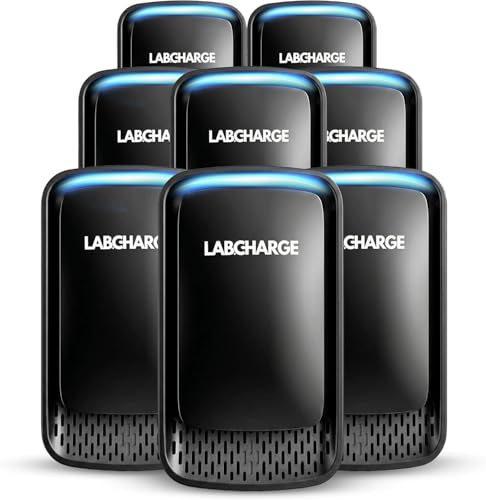
LabCharge Air Ionizer, 8-Pack has the largest pack count, with eight units; its features specifically describe negative-ion operation and a design with no fan or filter. Each unit measures 3.5 × 1.5 × 2 inches, weighs 0.3 pound and carries a claimed coverage of up to 250 square feet. The product says ions help airborne particles settle, but settled particles remain on room surfaces and may need cleaning. This option suits buyers wanting several plug-in ionizers, not shoppers seeking a fan-driven cleaner that captures particles in a replaceable filter.
Bottom line: Choose this pack when you want eight filterless plug-in ionizers.
How ionic air purifiers differ from HEPA cleaners
An ionizer charges airborne particles so they can settle onto nearby surfaces; a HEPA purifier pulls air through a filter that captures particles. Settling does not remove particles from the room, so regular surface cleaning still matters. Neither approach should be assumed to remove gases or odors just because a product is called an air purifier. The product names here mention HEPA, but its maker describes ionizing and filterless operation rather than a HEPA filter. If certified particle capture is essential, confirm the filtration mechanism before choosing an ionizer.
How to choose coverage and pack size
Start with the room you want to address, then compare its floor area with the 250-square-foot coverage claim per unit. Coverage claims do not establish how quickly a unit cleans a room; clean-air delivery rate (CADR) is the useful measure for comparing particle-cleaning output. Match the pack count to the number of outlets and rooms rather than assuming that several units in one room equal a single high-CADR purifier. The units are each 3.5 × 1.5 × 2 inches, so check that the outlet location leaves enough space and does not block adjacent plugs.
Ionizer safety and ozone checks
Some ionizing air cleaners can produce ozone, a lung irritant, so check the exact model for an ozone-emissions certification before using one indoors. California Air Resources Board certification indicates an air cleaner meets its ozone-emission limit of 0.050 parts per million; it does not prove that the device removes particles effectively. Do not treat a “filterless” claim as evidence of zero emissions. If someone in the home has asthma or another respiratory sensitivity, avoid ozone-generating devices and favor a mechanical purifier with a clearly identified particle filter and CADR appropriate to the room.
What ionizers do with dust and odors
Ionizers act on particles rather than functioning as a general-purpose gas filter. A particle that settles on a table or floor has moved out of the air but has not left the home, so wiping and vacuuming remain part of routine cleaning. Odor compounds and other gases typically require an adsorbent such as activated carbon; a claim about ions alone does not establish gas removal. For smoke or cooking odors, distinguish particle filtration from odor control and look for a purifier that identifies both a particle filter and a substantial carbon stage.
Frequently Asked Questions
Do ionic air purifiers remove particles from a room?
Ionizers can charge airborne particles and help them settle on nearby surfaces, but that does not capture them in a filter or remove them from the home. Clean settled dust from floors and surfaces regularly.
Can an ionizer produce ozone indoors?
Some ionizing cleaners can emit ozone, which can irritate the lungs. Check for a model-specific ozone-emissions certification, such as California Air Resources Board certification to its 0.050-parts-per-million limit.
Does a HEPA label mean the purifier has a HEPA filter?
A HEPA claim should be supported by an actual HEPA filtration mechanism, not just ionizing operation. Verify that the product includes a HEPA filter if particle capture is the reason for your purchase.
Do ionizers remove odors and smoke?
An ionizer may cause some smoke particles to settle, but that is different from capturing them in a filter or removing odor gases. For gases and odors, look for a purifier with an identified activated-carbon stage.
How do I size an air purifier for a bedroom?
Compare the room’s floor area with the unit’s coverage and CADR figures, rather than relying on coverage alone. CADR gives a particle-cleaning output measure; select a rating appropriate to the room size.