
Leaf Vacuums for Riding Mowers: 3 Options Compared

For most riding-mower owners, Agri-Fab Soft Top Mow-N-Vac is the best fit because its 29-cubic-foot collection system and deck adapter combine large capacity with mower hookup. Choose SuperHandy Towable Leaf and Lawn Vacuum instead if you prefer its pin hitch and one-hand dump; TerraKing Standard Leaf Bag is a replacement bag, not a complete vacuum.
A riding-mower leaf vacuum collects leaves through a hose connected to a mower deck or uses a separate tow-behind intake; confirm your mower’s discharge side and adapter fit before ordering.
We earn a commission if you buy through links on this page. As an Amazon Associate I earn from qualifying purchases. Products are compared on manufacturer specifications, not hands-on testing.
- Best overall: Agri-Fab Soft Top Mow-N-Vac – Its 29-cubic-foot collector and universal deck adapter suit larger cleanups and right-hand-discharge decks.
- Best for one-hand dumping: SuperHandy Towable Leaf and Lawn Vacuum – The towable unit has a pin-style hitch and a one-hand bag-dump design.
- Best for replacement capacity: TerraKing Standard Leaf Bag – The 54-cubic-foot bag expands an existing ride-on mower collection system.
| Product | Best for | Collection capacity | Power or type | Connection or use | Shop |
|---|---|---|---|---|---|
| Agri-Fab Soft Top Mow-N-Vac | Large yard cleanup | 29 cu ft | 208cc engine | Deck adapter; right-hand discharge | Check Price on Amazon |
| SuperHandy Towable Leaf and Lawn Vacuum | Easy emptying | 24.1 cu ft | 15HP engine | Pin-style hitch | Check Price on Amazon |
| TerraKing Standard Leaf Bag | Existing systems | 54 cu ft | Replacement bag | Slips over collector hood | Check Price on Amazon |
Leaf vacuums for riding mowers
Compare tow-behind vacuums with an add-on collection bag, and match the setup to your mower and yard.
Agri-Fab Soft Top Mow-N-Vac

Agri-Fab Soft Top Mow-N-Vac pairs a deck adapter with a 29-cubic-foot collection system, making it the most direct match here for gathering leaves with a riding mower. Its 126-inch hose is 6 inches wide, and the maker says it can also be used with right-hand-discharge zero-turn mowers. A 10-cubic-foot poly bed and 13-by-4-inch pneumatic tires support tow-behind use. The 208cc engine is specified to produce suction speeds up to 80 mph. This setup is a better fit for owners with compatible discharge geometry than for anyone seeking a walk-behind or handheld vacuum.
Bottom line: Choose this for a tow-behind vacuum with a deck adapter and a 29-cubic-foot collector.
SuperHandy Towable Leaf and Lawn Vacuum
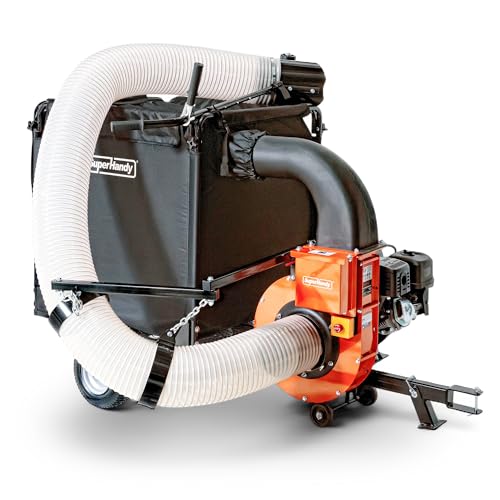
SuperHandy Towable Leaf and Lawn Vacuum stands out for its one-hand dump design and pin-style hitch, rather than a deck adapter. The maker says its 15HP electric-start engine powers a 16-inch serrated impeller; its 180-gallon bag converts to about 24.1 cubic feet. A pin hitch connects to most riding mowers, tractors, or trailers, but the specific hitch arrangement and clearance still need to suit the towing machine. Its 13-inch pneumatic wheels are intended for mobility over uneven ground. Choose it when simpler dumping matters more than matching a deck-mounted intake.
Bottom line: Pick this if a towable vacuum with one-hand emptying fits your hitch setup.
TerraKing Standard Leaf Bag

TerraKing Standard Leaf Bag is a replacement or capacity-expansion bag for a ride-on mower’s existing material collection system, not a standalone vacuum. Its 54-cubic-foot capacity is larger than either tow-behind collector here, but it only helps if your current collector accepts a hood-mounted bag. The polyester-blended fabric is abrasion-resistant and woven to trap dust while allowing air to escape; cord locks secure it over the hood, and a front flap helps contain leaves and dust. The limitation is compatibility: owners without an existing suitable collection system need a complete vacuum instead.
Bottom line: Choose this only if your mower already has a compatible collector hood.
How to choose a riding-mower leaf vacuum
Choose first between a deck-connected vacuum and a tow-behind unit with its own intake. Deck-connected systems depend on mower deck discharge direction, adapter shape, and hose reach; a tow-behind machine can be more independent but still needs a hitch that matches the mower. Capacity matters for stopping frequency: the examples here range from about 24.1 to 54 cubic feet, but a larger bag only helps if the collector and towing setup can handle it. Measure the deck outlet and available hose path before ordering. If you have under 6 inches of clearance along the hose route, check the hose routing carefully so it will not kink or rub during turns.
Capacity and yard cleanup
A 29-cubic-foot collector holds about 217 gallons, while the 180-gallon unit holds about 24.1 cubic feet; a 54-cubic-foot bag is meant to expand an existing system. These numbers describe volume, not how many leaves a machine can collect before clogging: damp, matted leaves pack differently from dry, loose leaves. Wet debris is heavier and can strain towing and handling, so wait for drier conditions when practical. A useful rule is to prioritize a larger collector for a broad, leaf-heavy yard where unloading stops dominate the job, but favor maneuverability and access if the cleanup area has narrow gates or tight turns. The product capacities are not direct measures of suction strength.
Tow-behind vacuum versus collector bag
A tow-behind vacuum is a complete powered unit; a collector bag is an accessory that relies on equipment already installed on the mower. The distinction affects setup, not just capacity. Before selecting a replacement bag, compare the collector hood dimensions and securing method with the mower’s existing system. For a tow-behind unit, verify hitch style and turning clearance, and remember that the trailer follows a wider path than the mower itself. The table separates those roles so you can choose by the equipment you already own.
| Setup | What it does | Best match |
|---|---|---|
| Deck-adapter tow-behind | Hose draws debris from mower deck | Compatible discharge outlet and hose route |
| Pin-hitch tow-behind | Powered vacuum tows behind mower | Matching hitch and turning room |
| Replacement collector bag | Expands an existing collection system | Compatible hood already installed |
Safe operation and clog prevention
Keep hands, feet, and tools away from a running impeller, and shut the engine off before inspecting or clearing a blockage. Vacuum impellers can pull in twigs and propel debris, so clear the work area of stones and larger branches before starting. These products include engine-powered designs, which also require outdoor operation; never run a gasoline engine in a garage or enclosed shed because carbon monoxide can build up quickly. Dry leaves usually flow more freely than damp clumps, so avoid forcing wet material through a hose. Stop if suction drops, let moving parts come to a complete stop, and only then inspect the hose or intake.
Frequently Asked Questions
Can a riding mower tow a leaf vacuum?
Many tow-behind vacuums use a pin hitch or mower-deck adapter, but the connection must match the mower. Check hitch compatibility and turning clearance, especially if the mower has a wide deck or tight route.
How much does 180 gallons equal in cubic feet?
A 180-gallon collection bag holds about 24.1 cubic feet, using 7.48 gallons per cubic foot. Actual leaf capacity by weight changes with moisture and how tightly debris packs.
Should I vacuum wet leaves with a mower?
Dry leaves generally flow more freely through a hose than wet, matted leaves. Wet material can clog the intake or hose, so wait for drier conditions when possible and stop the engine before clearing a blockage.
How do I know whether a deck adapter will fit?
Match the adapter to the mower deck’s discharge side and outlet shape, then confirm the hose can reach without kinking. A right-hand-discharge adapter is not automatically compatible with a left-hand-discharge deck.
How often should I empty a leaf vacuum?
Empty when airflow drops or the collector reaches its safe working fill level; the useful load varies with leaf moisture and packing. Do not continue if debris obstructs the intake or reduces control while towing.