
Legs for Butcher Block Table: 5 Options Compared

For legs for a butcher block table, the KOMOHOM adjustable set suits the widest range of builds because it adjusts from 22 to 37 inches. Choose fixed-height legs instead when you already know the finished table height and want a simpler fit.
Butcher-block tops can be heavy, so match the frame’s mounting footprint and claimed capacity to the top and intended load, and use suitable fasteners.
We earn a commission if you buy through links on this page. As an Amazon Associate I earn from qualifying purchases. Products are compared on manufacturer specifications, not hands-on testing.
- Best overall: KOMOHOM Adjustable Table Legs – Height adjusts from 22 to 37 inches, covering workbench, dining, and counter-height setups.
- Best for counter height: CHICAURA 34-Inch Counter-Height Legs – The 34-inch legs are intended to produce a 35–36-inch surface with the top.
- Best for added bracing: KaKaBB 28-Inch Metal Legs – The frame includes a slot for a horizontal stabilizer bar.
| Product | Best for | Height | Width | Claimed capacity | Shop |
|---|---|---|---|---|---|
| KOMOHOM Adjustable Table Legs | Adjustable workbenches | 22–37 in | 23 in | 1,000 lb | Check Price on Amazon |
| CHICAURA 34-Inch Counter-Height Legs | Counter-height tables | 34 in | 24 in | 1,000 lb | Check Price on Amazon |
| KaKaBB 28-Inch Metal Legs | Braced table frames | 28 in | 23.6 in | 800 lb | Check Price on Amazon |
| VEVOR 28-Inch Square Steel Legs | Wide square frames | 28.3 in | 23.6 in | 2,204 lb | Check Price on Amazon |
| 30-Inch Industrial Pipe Legs | Industrial-style tables | 30 in | — | — | Check Price on Amazon |
Legs for Butcher Block Table Builds
Compare the leg heights, frame widths, and capacity claims against your tabletop and finished-height target.
KOMOHOM Adjustable Table Legs

For a butcher-block build that may need more than one working height, this adjustable set spans 22 to 37 inches rather than locking the tabletop to one fixed level. KOMOHOM says the I-shaped metal frame supports up to 1,000 pounds, and the leveling feet can help steady a table on an uneven floor. That range can accommodate several common furniture uses, from dining to workbench height. The tradeoff is a more involved mechanical frame than a pair of fixed legs; choose fixed legs if the table will stay at one height and simplicity matters more.
Bottom line: Choose these when height flexibility matters more than a fixed, simple base.
CHICAURA 34-Inch Counter-Height Legs

These legs are the clear choice for a counter-height butcher-block surface: the 34-inch leg height is intended to create a 35- to 36-inch finished surface with the top. CHICAURA says its 14-gauge carbon-steel frame supports 1,000 pounds; the 24-inch base and 4.5-inch mounting plate provide a broad stance and attachment area. The product is intended for tabletops 26 to 30 inches deep. Its fixed height is the limitation, so a lower workbench or dining table needs another leg height.
Bottom line: Pick these for a fixed counter-height top in the depth range.
KaKaBB 28-Inch Metal Legs

Unlike the other fixed-height options, this pair has a crossbar slot for adding a horizontal stabilizer bar, a useful design detail for a butcher-block table where side-to-side movement is a concern. KaKaBB says the legs support up to 800 pounds and are 28 inches high, a common starting point for dining or desk-height builds. The set includes screws and non-slip floor pads. The slot does not make the bar itself part of the set, so account for sourcing and fitting that brace if you need it.
Bottom line: Choose these if you want a 28-inch frame with the option to add a brace.
VEVOR 28-Inch Square Steel Legs

The VEVOR pair stands out for its substantial 3.15-inch square box sections and 28.3-inch height, giving a butcher-block dining or desk build a broad, squared-off frame. VEVOR gives a maximum load claim of about 2,204 pounds and specifies cold-rolled steel with a sandblasted finish and varnish coating. Its top plates measure 3.9 inches, so plan attachment points around those plates. These are fixed-height legs; choose an adjustable base if you expect to change between sitting and standing or different work heights.
Bottom line: Pick these for a fixed-height build where a square, wide frame suits the design.
30-Inch Industrial Pipe Legs
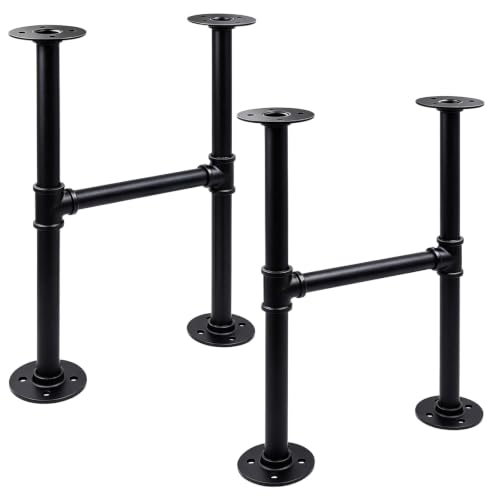
For a butcher-block top with a vintage workshop look, this pair uses carbon-steel pipe legs with a rough dark gray-black finish and wide mounting flanges. At 30 inches high, the fixed legs suit projects where that height and industrial appearance are the priorities. The specifications give no pair width or capacity figure, so confirm the mounting footprint and allowable load before choosing them for a heavy top. Compared with the framed designs, pipe legs offer a different visual profile rather than a height-adjustment feature.
Bottom line: Choose these for a 30-inch industrial-pipe look after confirming fit and load limits.
How to choose butcher block table legs
Start with the finished table height, then subtract the thickness of the butcher-block top to find the leg height. A common dining table is about 28 to 30 inches high; counter-height surfaces are typically 35 to 36 inches. For a fixed 36-inch counter, a 34-inch leg leaves roughly 2 inches for the top. For changing work heights, an adjustable base spanning 22 to 37 inches offers a broader fit, but confirm that its frame and feet suit the intended floor and working load.
Next, compare the mounting plate or flange footprint with the underside of the top and place legs far enough from the edges to avoid splitting the wood. Capacity claims describe a maximum load, not a guarantee for every installation; the screws, top thickness, and load distribution also matter.
Leg height and tabletop fit
Leg width and top depth affect stability and usable seating space. A 24-inch-wide base is intended for a 26- to 30-inch-deep tabletop, while frames around 23 to 24 inches wide leave only a small overhang on a top of similar depth. Decide whether chairs, stools, or work equipment need clear space beneath the edges before fixing the mounting position.
Butcher block can be thick and heavy, so use fasteners suited to the wood and mounting plates; avoid driving screws so deep that they break through the finished surface. Solid-wood tops also change dimension as humidity changes. Slotted or elongated mounting holes and tabletop fasteners designed for wood movement can help avoid restraining seasonal expansion across the grain.
| Finished height goal | Leg-height starting point | Good fit |
|---|---|---|
| Dining, 28–30 in | About 28 in with a thin top | Fixed dining-height legs |
| Counter, 35–36 in | About 34 in with a 1–2 in top | Fixed counter-height legs |
| Variable work height | Adjustable range covering target | Adjustable workbench legs |
Stability, load claims, and mounting
A table’s real capacity depends on the full assembly, not the leg claim alone. A heavy top, tools, and a concentrated load can stress screws and wood more than a distributed load, so use the maker’s capacity as an upper limit and avoid treating it as a safe working-load rating. A broad base and larger mounting plate increase contact area, while a crossbar can resist side-to-side racking on a long frame.
For a butcher-block workbench used for impact or clamping, prioritize a braced frame and secure attachment rather than choosing by the largest number alone. Check the leg spread against the top and leave room for knees, drawers, or clamps. Leveling feet correct small floor variations, not an unstable or damaged floor.
Preventing wobble and wood movement
Wobble often comes from uneven flooring, loose fasteners, or a frame that can rack laterally. Leveling feet can compensate for modest floor differences; a stabilizer bar or cross-bracing addresses movement in the frame itself. Recheck fasteners after assembly and periodically during use, especially on a workbench that sees repeated clamping or impact.
Solid wood expands and contracts mainly across its grain as indoor humidity changes. Use attachment hardware that permits that movement instead of rigidly pinning every point, and keep the top acclimated to the room before final installation. Never exceed the load limits of the legs or mounting hardware, and keep heavy loads centered rather than cantilevered over one edge.
Frequently Asked Questions
How tall should legs be for a butcher block table?
Subtract the top thickness from the target finished height. A 36-inch counter-height table with a 2-inch top needs legs about 34 inches tall.
Are 28-inch legs tall enough for dining?
They are a common starting point for dining-height tables, especially with a thinner top. Measure the top thickness and check the finished height against the chairs you plan to use.
How do I stop butcher block table legs from wobbling?
Level the feet on an uneven floor and tighten the mounting hardware, then add a stabilizer bar if the frame can rack sideways. A brace addresses frame movement; leveling feet do not.
Can butcher block expand after I attach the legs?
Yes, solid wood changes width as humidity changes, especially across the grain. Use mounting hardware that allows seasonal movement instead of rigidly restraining the top at every attachment point.
How much weight can table legs safely hold?
Treat a manufacturer’s maximum capacity as an upper limit, not a working-load guarantee for your complete table. The top, fasteners, wood thickness, load placement, and floor all affect the assembled table’s safe capacity.