
Liquid Hardener for Fiberglass Resin: Types Compared

For polyester fiberglass resin, choose a compatible MEKP catalyst or the resin maker’s specified liquid hardener; 3M Bondo Liquid Hardener 0.37 fl oz is designed for Bondo polyester resin and filler. LET’S RESIN Part B Epoxy Hardener 8 oz is an epoxy Part B hardener instead, so choose it only with matching LET’S RESIN Part A epoxy.
Anyone working with fiberglass should match the hardener to the resin chemistry and follow its mixing directions; the wrong pairing will not cure as intended.
We earn a commission if you buy through links on this page. As an Amazon Associate I earn from qualifying purchases. Products are compared on manufacturer specifications, not hands-on testing.
- Best overall: 3M Bondo Liquid Hardener 0.37 fl oz – Designed for Bondo polyester fiberglass resin and Metal Reinforced Filler.
- Best for polyester systems: Fiberglass Supply Depot MEKP Catalyst 4 oz – MEKP catalyst is intended for polyester and vinyl ester resins and gelcoat.
- Best for epoxy: LET’S RESIN Part B Epoxy Hardener 8 oz – Part B is intended for use with LET’S RESIN Part A epoxy.
| Product | Best for | Chemistry | Package size | Intended pairing | Shop |
|---|---|---|---|---|---|
| 3M Bondo Liquid Hardener 0.37 fl oz | Bondo resin repairs | Polyester | 0.37 fl oz | Bondo polyester resin and filler | Check Price on Amazon |
| Fiberglass Supply Depot MEKP Catalyst 4 oz | Polyester fabrication | MEKP for polyester/vinyl ester | 4 oz | Polyester, vinyl ester, and gelcoat | Check Price on Amazon |
| Fiberglass Evercoat Liquid Hardener | Evercoat pairing | Liquid hardener | — | — | Check Price on Amazon |
| LET’S RESIN Part B Epoxy Hardener 8 oz | Matching epoxy | Epoxy Part B | 8 oz | LET’S RESIN Part A epoxy | Check Price on Amazon |
Liquid Hardener for Fiberglass Resin Compared
Match the hardener chemistry to the resin before comparing package size or application.
3M Bondo Liquid Hardener 0.37 fl oz

Unlike a general-purpose catalyst, this liquid hardener is designed for Bondo polyester fiberglass resin and Bondo Metal Reinforced Filler. The 0.37 fl oz tube is intended for repair work, including auto bodies and boats, and the maker says it creates a fast-curing reaction and waterproof repair when used in the system. The product is for the Fill stage of the 3M Body Repair System. Its key limitation is important: it is marked for industrial or occupational use only, not consumer sale or use, so it is not the right choice for a consumer repair.
Bottom line: Choose this only for compatible Bondo systems and occupational use.
Fiberglass Supply Depot MEKP Catalyst 4 oz
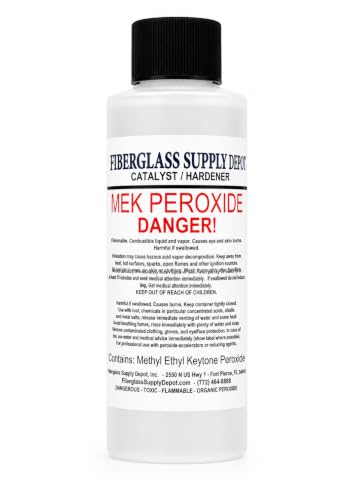
This 4 oz bottle is the broadest resin-system match here: its clear MEKP catalyst is designed for polyester resin, vinyl ester resin, and gelcoat. The maker identifies uses such as boat building, mold making, surfboard construction, and fiberglass repair, making it a fit for fabrication as well as repairs. It differs from a Bondo-specific hardener by being presented for several composite systems.
Bottom line: Pick this for polyester, vinyl ester, or gelcoat work when the resin calls for MEKP.
Fiberglass Evercoat Liquid Hardener

Fiberglass Evercoat Liquid Hardener is the other liquid hardener option in this group, but its specifications do not establish a resin chemistry or package volume. That makes it less straightforward to match than the Bondo-specific hardener or the MEKP catalyst, which name compatible systems. Its maker says “new and improved formula,” without identifying a technical property that would distinguish it for a particular repair. Choose it only if the resin manufacturer identifies it as the compatible hardener for your resin; buyers seeking a broadly specified MEKP should choose a different type.
Bottom line: Choose it only when your resin maker confirms compatibility.
LET’S RESIN Part B Epoxy Hardener 8 oz

Unlike the polyester-oriented options, this 8 oz product is a Part B epoxy hardener intended for LET’S RESIN Part A epoxy. That makes it relevant only when the project uses that matching epoxy system, rather than polyester fiberglass resin or MEKP-catalyzed gelcoat. The fields also mention included instructions, but provide no mixing ratio here; consult the matching resin’s directions for the correct proportion before combining components. Its system-specific pairing is a limitation for buyers seeking a catalyst for polyester resin, but a useful distinction for epoxy work.
Bottom line: Pick this for compatible LET’S RESIN epoxy, not polyester resin.
How to choose a fiberglass resin hardener
Start by matching resin chemistry, because polyester and epoxy hardeners are not interchangeable. Polyester resin and gelcoat commonly use MEKP catalyst; epoxy uses a two-part system with its own matched resin and Part B hardener. Read the resin label for the required hardener type and mixing ratio before opening either component. If the resin does not identify a matching chemistry, do not assume a catalyst will work based on the word “fiberglass.” For these options, 3M Bondo Liquid Hardener 0.37 fl oz names Bondo polyester resin and filler, Fiberglass Supply Depot MEKP Catalyst 4 oz specifies MEKP for polyester, vinyl ester, and gelcoat, and LET’S RESIN Part B Epoxy Hardener 8 oz names LET’S RESIN Part A epoxy. A measurable decision rule is simple: if the resin is epoxy, exclude MEKP; if it is polyester and calls for MEKP, exclude epoxy Part B.
MEKP and epoxy hardener differences
MEKP is a catalyst used to initiate curing in compatible polyester and vinyl ester systems, while epoxy cures by combining its Part A resin with a matched Part B hardener. Those chemical systems require different products and ratios, so swapping one for the other is a common cause of a failed cure. Gelcoat generally belongs with the polyester/MEKP family, but the resin maker’s directions determine the particular catalyst and proportion. A product described as liquid hardener is not enough to establish compatibility. Use the chemistry stated on the resin container, then select the matching category; for example, a resin that calls for MEKP points to a catalyst like Fiberglass Supply Depot MEKP Catalyst 4 oz, not an epoxy hardener.
Hardener safety and mixing precautions
MEKP is a reactive organic peroxide and can cause serious eye and skin injury; keep it off skin, protect eyes, and use the safety directions and protective equipment required by its label and safety data sheet. Polyester and epoxy components can also irritate or sensitize skin, so use suitable gloves and ventilation and avoid breathing vapors. Never estimate a hardener ratio: resin makers set the proportion, and excess or insufficient hardener can impair cure or generate excess heat. Mix only the amount you can apply within the resin’s working time, and keep reactive components away from contamination and incompatible materials. 3M Bondo Liquid Hardener 0.37 fl oz is explicitly marked for industrial or occupational use only, making that restriction decisive for consumers.
How to match the hardener to the job
Repair products and fabrication catalysts differ in how narrowly their compatible resin is identified. A Bondo-specific tube is for its named repair system, while a bottle of MEKP is intended for compatible polyester, vinyl ester, or gelcoat work; epoxy Part B is for its paired epoxy. Use this quick decision table before mixing.
| Resin on the container | Choose | Do not substitute |
|---|---|---|
| Bondo polyester resin or filler | Compatible Bondo liquid hardener | Epoxy Part B |
| Polyester, vinyl ester, or gelcoat requiring MEKP | MEKP catalyst | Epoxy Part B |
| LET’S RESIN Part A epoxy | Matching Part B epoxy hardener | MEKP catalyst |
When a project surface or laminate has structural consequences, use the resin system specified for that repair rather than selecting by bottle size alone.
Frequently Asked Questions
Can MEKP hardener be used with epoxy resin?
No; MEKP is for compatible polyester or vinyl ester resin and gelcoat, while epoxy uses its matched Part B. Check the resin container for its named chemistry before mixing.
How much catalyst should I add to fiberglass resin?
Use the exact ratio specified by the resin maker, not a guessed amount. Temperature and resin formulation can affect working time, but they do not justify changing the prescribed ratio.
Can polyester resin cure without hardener?
Polyester resin needs its specified catalyst, commonly MEKP, to initiate curing. Without the correct catalyst and ratio, expect an improper or incomplete cure rather than a dependable repair.
How should MEKP be handled during mixing?
Protect eyes and skin because MEKP can cause serious injury, and follow the product label and safety data sheet. Keep it away from incompatible materials and mix only the amount the resin directions allow.
Is a liquid hardener the same as epoxy Part B?
No; “liquid hardener” can refer to different chemistries, while epoxy Part B is paired with a specific epoxy resin. Match by the resin system, not by the generic word hardener.