
Liquid Solder for Electrical Connections Compared

For liquid soldering flux for electrical connections, choose RMA Liquid Solder Flux Dropper, 30 mL if you want a 30 mL RMA rosin flux dropper; liquid flux helps prepare a joint but does not supply solder metal. Choose solder wire instead when you need both filler metal and flux in one strand, and choose a different product if you need a waterproof insulating coating rather than a soldering material.
We earn a commission if you buy through links on this page. As an Amazon Associate I earn from qualifying purchases. Products are compared on manufacturer specifications, not hands-on testing.
- Best overall: RMA Liquid Solder Flux Dropper, 30 mL – The 30 mL dropper contains RMA rosin flux for electronic soldering.
- Best for rosin flux: BEEYUIHF Liquid Rosin Flux, 30 mL – Its high-purity rosin formula is described as non-corrosive and suitable for electronic repair.
- Best for leaded wire: MAIYUM 63/37 Rosin-Core Solder Wire, 1.0 mm – The 1.0 mm, 63/37 wire includes rosin flux and melts at 361°F.
| Product | Best for | Format | Amount | Flux or alloy | Shop |
|---|---|---|---|---|---|
| RMA Liquid Solder Flux Dropper, 30 mL | Liquid rosin flux | Liquid flux | 30 mL | RMA rosin | Check Price on Amazon |
| BEEYUIHF Liquid Rosin Flux, 30 mL | Electronic repairs | Liquid flux | 30 mL | RMA rosin | Check Price on Amazon |
| MAIYUM 63/37 Rosin-Core Solder Wire, 1.0 mm | Lead solder wire | Rosin-core wire | 100 g | 63/37 tin-lead | Check Price on Amazon |
| TOWOT 63/37 Rosin-Core Solder Wire, 1.0 mm | Smaller wire spool | Rosin-core wire | 50 g | 63/37 tin-lead | Check Price on Amazon |
Liquid Solder for Electrical Connections
Choose between liquid flux for joint preparation and rosin-core wire that supplies solder metal as well as flux.
RMA Liquid Solder Flux Dropper, 30 mL

RMA Liquid Solder Flux Dropper, 30 mL is a liquid RMA rosin flux, not a solder-metal alloy, so it suits jobs where you already have solder wire or another filler metal. The 30 mL dropper is formulated for electronic soldering and says it removes oxides from tin-lead, lead-free, gold, silver, and copper alloys. Its neutral-pH formula is described as non-corrosive. Choose it when you want a separate liquid flux for applying to a joint; choose a rosin-core solder wire instead if you want the flux inside the solder strand.
Bottom line: Choose this if you need a separate liquid rosin flux for electronics work.
BEEYUIHF Liquid Rosin Flux, 30 mL
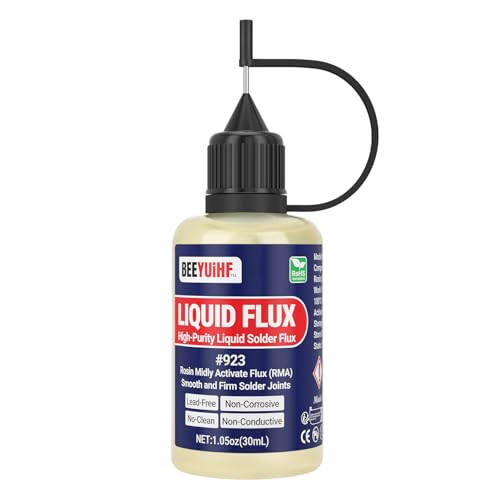
BEEYUIHF Liquid Rosin Flux, 30 mL pairs a 30 mL squeeze bottle with high-purity RMA rosin flux for electronic soldering and repair. The manufacturer says the formula is lead-free, chloride-free, halogen-free, and non-flammable, and that dried residue is non-conductive. It is intended to remove oxides from tin, lead, copper, silver, and nickel alloys. This is still flux rather than solder metal, so it will not fill a gap by itself. Pick it for liquid application; use rosin-core wire when the job calls for a combined solder-and-flux strand.
Bottom line: Choose this for electronic repair when you want liquid rosin flux in a squeeze bottle.
MAIYUM 63/37 Rosin-Core Solder Wire, 1.0 mm

MAIYUM 63/37 Rosin-Core Solder Wire, 1.0 mm differs from liquid flux by supplying solder metal in a 1.0 mm wire with a rosin-core. The alloy is 63% tin and 37% lead, with 1.8% flux content; the melting point is 361°F. That makes it a fit for buyers who need a traditional leaded solder strand for circuit boards, cables, or small appliance repair rather than a bottle of flux alone. The wire contains lead, so keep it away from food surfaces, wash hands after handling, and use suitable ventilation while soldering.
Bottom line: Choose this when you need leaded rosin-core solder wire rather than liquid flux.
TOWOT 63/37 Rosin-Core Solder Wire, 1.0 mm

TOWOT 63/37 Rosin-Core Solder Wire, 1.0 mm is another 1.0 mm, 63/37 tin-lead rosin-core solder wire, but its 50 g amount is half the 100 g amount in MAIYUM 63/37 Rosin-Core Solder Wire, 1.0 mm. Its flux content is 1.8%, and the maker describes it as flowing smoothly for circuit-board and household-appliance repair. Like other rosin-core wire, it combines filler metal with flux, rather than acting as a standalone liquid flux. The leaded alloy is a limitation for anyone avoiding lead; use lead-free solder wire compatible with the joint if that is a requirement.
Bottom line: Choose this if you want a smaller quantity of leaded rosin-core wire.
How liquid soldering flux works
Liquid soldering flux prepares metal surfaces; solder wire or another filler metal still forms the conductive joint. Flux helps remove oxide films and encourages molten solder to wet the metal, but it does not bridge a gap on its own. Rosin flux is common in electronics because it is designed for soldering work on metal contacts and circuit connections. RMA means rosin mildly activated, a flux category rather than an alloy or solder temperature. Choose a liquid flux when you need to apply it separately, especially to a joint shape that is awkward to reach with a flux-core strand. For a routine wire-to-terminal joint, rosin-core solder wire can provide both filler and flux in one pass.
Choosing flux or rosin-core solder wire
Choose liquid flux when your solder wire lacks flux, or when a joint needs extra flux applied separately; choose rosin-core wire when you need filler metal and flux together. A 63/37 tin-lead wire melts at 361°F in the product specifications, while flux has no corresponding solder-alloy melting point because it is not filler metal. The choice is therefore about the work process, not simply which item is more liquid. Before starting, confirm that the flux and solder are intended for the electronics or metals in the joint. Avoid substituting plumbing acid flux for electronics rosin flux: residues and intended uses differ, and the wrong flux can damage a circuit.
| Need | Choose |
|---|---|
| Flux applied separately | Liquid rosin flux |
| Filler metal and flux in one strand | Rosin-core solder wire |
| Lead-free joint | Lead-free solder compatible with the work |
Temperature and joint preparation
For small electronics joints, use a temperature-controlled iron and a tip suited to the pad; a broad tip transfers heat faster than a needle tip, while an oversized tip can touch neighboring contacts. The 63/37 wire melts at 361°F, but an iron must be set hotter than the alloy’s melting point to transfer heat into the joint. A practical starting range for many electronics tasks is about 600°F to 700°F, then adjust for the iron, tip, and thermal mass rather than dwelling on a pad. Clean oxidation from the work, heat the pad and lead together, and feed solder to the joint—not just to the iron. If the solder beads instead of wetting, stop and reassess cleanliness, heat, and flux.
Lead and rosin soldering safety
Lead-containing solder calls for basic exposure controls: keep food and drink away, avoid touching your face during work, and wash hands with soap and water afterward. Soldering also produces fumes, so use local fume extraction or work with effective ventilation; do not rely on a fan that merely blows fumes across your breathing zone. Rosin flux can irritate the respiratory system when heated, even when the residue is described as non-conductive. Keep the hot iron in a stable stand, and let the joint cool before handling. For children’s items, medical equipment, or other regulated applications, verify the applicable material and workmanship requirements before choosing an alloy.
Frequently Asked Questions
Does liquid solder flux contain solder metal?
Liquid solder flux is a surface-preparation aid, not a metal filler. Use solder wire or another suitable alloy to form the joint; the 63/37 wire here has a melting point of 361°F.
Can liquid rosin flux be used on circuit boards?
Liquid rosin flux is intended for electronic soldering, including circuit-board work. Apply only enough to wet the joint area, and avoid letting liquid run across connectors or areas that should remain clean.
What does 63/37 solder mean?
A 63/37 alloy contains 63% tin and 37% lead by composition. The wire data gives a 361°F melting point, and the alloy contains lead, so use lead-handling hygiene.
How hot should an iron be for soldering electronics?
About 600°F to 700°F is a practical starting range for many small electronics joints, although tip size and joint mass change the heat needed. Set the iron high enough to form the joint promptly without prolonged contact that can lift a circuit pad.
Should rosin flux residue be cleaned from a circuit board?
Cleaning depends on the flux formula and the assembly requirements; no-clean products are designed to leave residue under their intended conditions, but sensitive or high-impedance circuits may need a cleaner surface. Confirm compatibility before using a solvent, since the wrong cleaner can harm components or plastics.