
Long Handled Cleaning Brushes for Showers Compared

For most shower cleaning, choose Qaestfy 4-in-1 Shower Scrubber, 51 in. if you want a long adjustable handle plus multiple scrub heads; its 51-inch pole and rotating head cover varied surfaces. Choose CLEANHOME Tile Tub Scrubber, 56 in. instead if maximum listed reach matters most, or JDNOZW Extendable Shower Scrubber, 37 in. if a shorter, lighter-feeling kit with replaceable sponge heads suits your routine.
We earn a commission if you buy through links on this page. As an Amazon Associate I earn from qualifying purchases. Products are compared on manufacturer specifications, not hands-on testing.
- Best overall: Qaestfy 4-in-1 Shower Scrubber, 51 in. – A 51-inch extendable handle and 4 head styles make it the most versatile shower set.
- Best for maximum reach: CLEANHOME Tile Tub Scrubber, 56 in. – Its extendable handle reaches 56 inches, the longest specified here.
- Best for shorter reach: JDNOZW Extendable Shower Scrubber, 37 in. – Its handle adjusts to 26 or 37 inches and includes three sponge pads.
| Product | Best for | Handle reach | Head configuration | Weight | Shop |
|---|---|---|---|---|---|
| Qaestfy 4-in-1 Shower Scrubber, 51 in. | Mixed surfaces | 51 in. extendable | 4 head styles | 0.66 lb. | Check Price on Amazon |
| CLEANHOME Tile Tub Scrubber, 56 in. | Maximum reach | 56 in. extendable | 4 heads | 1.5 lb. | Check Price on Amazon |
| JDNOZW Extendable Shower Scrubber, 37 in. | Shorter handle | 26 or 37 in. | 1 brush, 3 pads | 0.44 lb. | Check Price on Amazon |
Long Handled Cleaning Brushes for Showers
Compare pole reach, scrubbing-head choices and tool design to match your shower surfaces and preferred cleaning posture.
Qaestfy 4-in-1 Shower Scrubber, 51 in.

The 51-inch extendable pole and pivoting head distinguish this scrubber for people cleaning both broad surfaces and awkward angles. The set includes a stiff-bristle brush, a non-scratch pad, a scrubber head with refill, and a fiber-ball brush; its head locks at 0°, 45°, or 90°. The handle is described as non-rust and has a hanging loop for storage. Brand claims the pole reduces bending and kneeling. The four head styles make the kit adaptable, but buyers needing a reach beyond 51 inches should compare a longer pole.
Bottom line: Choose this set for several shower surfaces and an angled, lockable head.
CLEANHOME Tile Tub Scrubber, 56 in.

The 56-inch extendable handle gives this scrubber the greatest reach among these options. Its four heads are a stiff-bristle brush, two scouring pads, and a microfiber pad, creating distinct choices for tile, tubs, glass, and mirrors. The wider range of head materials can help when one shower includes both hard tile and delicate glass. The tradeoff is its 1.5-pound weight, greater than the other products with weights, which may matter during longer overhead or wall-cleaning sessions.
Bottom line: Pick this when the extra handle reach matters more than minimizing tool weight.
JDNOZW Extendable Shower Scrubber, 37 in.
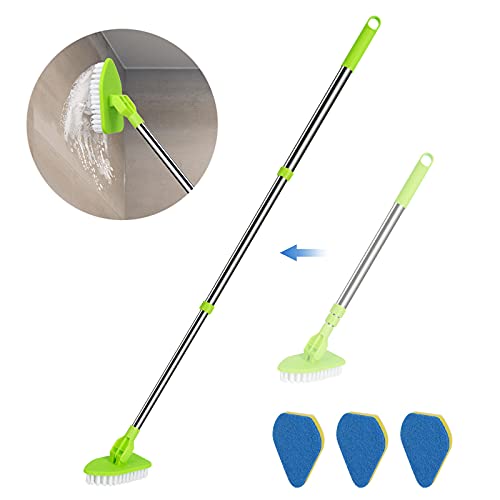
The two-position handle offers 26- or 37-inch reach rather than a single longer pole. The kit pairs one stiff-bristle brush with three double-layer sponge pads, so buyers can switch between firm brushing and softer pad cleaning. At 0.44 pound, it is the lightest of the products with a weight here. This shorter reach can suit routine tub and floor scrubbing without an oversized pole, but buyers who need to reach high walls or ceilings should select a longer-handled option.
Bottom line: Choose this for a light, compact-feeling tool with a short or medium setting.
How to choose a shower scrubber handle
Choose a handle by the highest area you must reach, not by the longest number alone. Most shower walls rise about 72 inches above the floor; a head adds several inches of reach, while the user’s height and head angle change the usable span. A telescoping pole helps adjust between floor and wall tasks, while a fixed or two-position pole is simpler when cleaning a consistent area. For floor scrubbing, a pole that lets you stand upright is more useful than extra reach overhead. A pivoting head can keep the pad flat against a wall or tub curve, but a fixed head may transfer pressure more directly. Check both extension range and whether the head locks at an angle.
Match scrub heads to shower surfaces
Match head material to the surface: stiff bristles suit grout lines and textured tile, while softer pads are safer starting points for acrylic tubs and coated glass. Glazed ceramic tile tolerates more abrasion than acrylic or fiberglass, which can dull or scratch under aggressive scrubbing. Microfiber and non-scratch pads are useful for smooth surfaces, but grit trapped in a pad can still scratch, so rinse the head before use. A squeegee removes surface water after cleaning but does not replace scrubbing around grout. Use light pressure first on a hidden area when the surface finish is uncertain, and avoid mixing cleaning chemicals; bleach and ammonia can produce hazardous fumes.
Shower brush types compared
Shower brushes generally trade surface versatility against simple, focused cleaning. Multi-head kits provide different contact materials, while floor scrubbers commonly combine stiff bristles with a scraper or squeegee. Handle reach can also change the choice: a tool with a long pole is more useful for high walls, while a shorter pole may feel easier to control at a tub rim. Use this need-to-choice guide to narrow the type before comparing individual head attachments.
| Cleaning need | Useful tool feature | Tradeoff |
|---|---|---|
| Grout and textured tile | Stiff bristles | Can be too abrasive for soft finishes |
| Glass or smooth tub | Microfiber or non-scratch pad | Needs rinsing to clear trapped grit |
| Standing water | Squeegee blade | Does not scrub grout by itself |
| High shower walls | Long adjustable pole | Long reach may be harder to control |
Keep shower scrubber heads clean
Rinse brush heads and pads after each use, then let them dry fully to limit residue and mildew growth. Damp pads stored against a shower wall stay wet longer than heads hung in moving air, so a loop or ventilated hook helps. Replace a pad when it remains discolored after rinsing, develops an odor, or loses its texture; worn bristles also clean grout less effectively. Keep abrasive heads away from glass coatings and soft acrylic unless the surface manufacturer allows them. Separate the cleaning tool from toilet-only brushes to avoid transferring bathroom bacteria between zones, and never store a wet head inside a closed container.
Frequently Asked Questions
How long should a shower scrubber handle be?
A pole around 48 to 56 inches gives many adults useful reach for shower walls while standing, but user height and head angle affect the fit. For floor-only scrubbing, a shorter pole can offer better control.
Can stiff bristles scratch a bathtub?
Yes, stiff bristles can mark acrylic or fiberglass tubs, especially when grit is caught in the brush. Start with a non-scratch pad and light pressure on a hidden area.
What brush head works best on shower grout?
Stiff nylon-style bristles are commonly used to work into grout lines, while broad pads clean tile faces faster. Avoid aggressive pressure on damaged or crumbling grout.
How often should shower scrubber pads be replaced?
Replace a pad when it smells after drying, stays visibly soiled after rinsing, or begins to shed or flatten. Drying it completely between uses helps extend its useful life.
Is a squeegee enough to clean shower glass?
A squeegee removes water and residue after cleaning, but it does not lift soap film or mineral scale on its own. Use a suitable non-abrasive cleaner and pad first, then pull the blade across the glass.