
Long Range CB Radios: 5 Models Compared by Setup

For most drivers seeking a long range CB radio, the Cobra 29 LTD Classic is the clearest fit because its mobile design has AM/FM, 4-watt output and SWR calibration. Handheld radios are more portable, but their range depends heavily on antenna placement; choose a different model if you need a handheld unit or weather scanning.
We earn a commission if you buy through links on this page. As an Amazon Associate I earn from qualifying purchases. Products are compared on manufacturer specifications, not hands-on testing.
- Best overall: Cobra 29 LTD Classic AM/FM – Mobile AM/FM operation, 4-watt output and SWR calibration suit an in-vehicle installation.
- Best handheld for vehicle use: Cobra HHRT50 Road Trip – A magnetic-mount antenna lets the handheld operate from inside a vehicle.
- Best for weather alerts: Cobra 29LX AM/FM – It combines AM/FM with weather-channel scanning and an alert system.
| Product | Best for | Radio type | Output power | Weather feature | Shop |
|---|---|---|---|---|---|
| Cobra 29 LTD Classic AM/FM | Mobile AM/FM use | Mobile | 4 W | — | Check Price on Amazon |
| Cobra HHRT50 Road Trip | Handheld vehicle use | Handheld | — | NOAA alerts | Check Price on Amazon |
| Cobra 29LX AM/FM | Weather scanning | Mobile | — | NOAA scan and alerts | Check Price on Amazon |
| Cobra 29 NW AM/FM Classic | Nighttime driving | Mobile | 4 W | — | Check Price on Amazon |
| Cobra HH50WXST Handheld | Portable monitoring | Handheld | 4 W | NOAA alerts | Check Price on Amazon |
Long range CB radios compared
The biggest practical distinction is whether the radio is installed in a vehicle or carried as a handheld unit.
Cobra 29 LTD Classic AM/FM

For a dashboard installation, this model stands apart with AM/FM operation and SWR calibration alongside 4-watt output and all 40 CB channels. Its 9-foot microphone cable gives reach across a vehicle cabin, while instant Channel 9 access supports quick emergency-channel selection. SWR calibration is useful when setting up an antenna system because a poor match can reduce effective transmission and risk radio damage. The radio does not include a magnetic roof antenna in the product features, so it suits drivers prepared to select and install a compatible external antenna rather than buyers seeking a ready-to-go handheld setup.
Bottom line: Choose this for a fixed vehicle radio when you can pair it with a well-installed antenna.
Cobra HHRT50 Road Trip

This handheld is distinct because it pairs portable operation with a magnetic-mount antenna for use from inside a vehicle. The maker says its Soundtracker system filters 90% of noise, and the radio also receives NOAA weather information. Its compact 6.3-by-2-by-1.75-inch body weighs 0.64 lb, making it easier to carry than a dashboard unit. The included antenna is the key to its vehicle-oriented use; without roof placement, handheld antenna height and nearby obstructions can limit communication distance. Choose it for portability and vehicle use, not for a permanently installed radio with AM/FM modes.
Bottom line: Choose this if you want a handheld with a roof-mount antenna for driving.
Cobra 29LX AM/FM
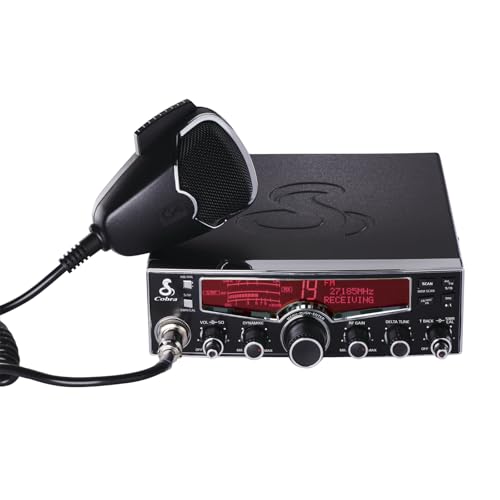
Weather scanning distinguishes this mobile model: it can scan for the strongest weather channel and provide an alert tone, alongside AM/FM CB operation. It also adds a selectable four-color LCD, auto-scan, clock and alarm functions, giving it more display and monitoring features than a basic mobile radio. The 29LX has access to NOAA weather channels, but its features do not give an output-power figure or SWR calibration. That makes it a better match for drivers who prioritize alert scanning and display functions than buyers comparing radios strictly by documented transmitter output.
Bottom line: Pick this when weather scanning and display functions matter most.
Cobra 29 NW AM/FM Classic

NightWatch illumination with a variable dimmer is the feature that sets this mobile CB apart, making its controls easier to see in a dark cabin. It otherwise brings 4-watt output, all 40 CB channels, AM/FM modes, SWR calibration and instant Channel 9/19 access. The 9-foot microphone cable supports reach around larger vehicle interiors. This is a conventional mobile unit rather than a portable radio, and no weather-channel feature appears among its product features. It suits a driver wanting familiar controls and nighttime visibility, but weather monitoring should be a separate priority.
Bottom line: Choose this for dimmable controls in a permanently installed vehicle radio.
Cobra HH50WXST Handheld

Dual Watch is the differentiator on this handheld: it can monitor two selected channels, while a 4-watt output and NOAA weather alerts support road and emergency use. Its Soundtracker system is described by the maker as filtering 90% of noise, and an earphone jack provides a private listening option. Unlike the Road Trip handheld, its features do not include a magnetic-mount antenna. As with other handheld CB radios, carrying it at low height or using it inside a vehicle can restrict range; it is most useful when portability and channel monitoring outweigh a fixed roof-antenna setup.
Bottom line: Pick this for a portable radio when two-channel monitoring is useful.
How to choose a long range CB radio
Antenna setup usually matters more to CB range than choosing between radios with the same legal power limit. CB operates in the 27 MHz band, where the US FCC limit for AM transmitter power is 4 watts; a taller, properly matched antenna generally has a clearer path than a short handheld antenna. For in-vehicle use, choose a mobile radio if you can install an external antenna, or a handheld with a vehicle-mount antenna if portability matters. SWR calibration helps assess antenna matching; an SWR reading near 1:1 is ideal, and sustained readings above 3:1 call for correcting the antenna setup before extended transmitting.
Use this decision guide to match the installation and feature priority.
| Need | Radio approach | Why it matters |
|---|---|---|
| Fixed vehicle use | Mobile radio plus external antenna | Allows a roof or other elevated antenna position |
| Handheld use in a vehicle | Handheld with magnetic antenna | Separates antenna placement from the radio body |
| Portable channel checks | Handheld with dual watch | Monitors two selected channels |
CB antenna height, placement and range
A CB antenna needs a conductive ground plane for many common mobile designs, which is why center-roof placement is a frequent choice on cars and trucks. Keep as much of the antenna above surrounding metal as practical, and route coax without sharp kinks or pinches; damaged or poorly connected coax can impair performance. A full-size quarter-wave CB antenna is about 108 inches, while shorter loaded antennas trade physical length for electrical loading and typically give up some efficiency. For a handheld radio inside a vehicle, choose an external antenna arrangement when available; with the radio’s short antenna inside the cabin, metal bodywork can block useful signal paths.
With less than about 6 inches of vertical clearance for an antenna, check the installation geometry before choosing a roof mount; a short mount still needs a sound ground plane and safe clearance from overhead obstructions.
AM, FM and CB channel use
AM and FM are different voice modes, so communicating radios need to use the same mode as well as the same channel. CB provides 40 channels, and Channel 9 is reserved for emergency communications while Channel 19 is commonly used by truckers for highway information. Emergency access features can reduce the time needed to select Channel 9, but they do not guarantee a response or improve signal reach. CB is line-of-sight at ordinary distances; terrain, buildings, antenna height and electrical noise can change how far a signal travels, so treat any “long range” label as a feature category rather than a guaranteed mileage figure.
CB radio installation and safe operation
A mobile CB radio draws power from a vehicle electrical system, so secure the radio and wiring away from pedals, airbags and hot or moving parts. Set the antenna SWR after installation and after changing antenna position; high mismatch can waste transmit power and potentially damage the radio. NOAA weather reception is a separate receive function, not a substitute for an emergency communications plan. Avoid transmitting while driving if operating controls distract you, and use a hands-free or passenger-assisted approach where appropriate. A magnetic antenna should sit on a clean, flat metal surface and be secured before travel; remove or reposition it when clearance or vehicle washing makes the mount unsafe.
Frequently Asked Questions
How far can a 4-watt CB radio reach?
A 4-watt CB radio commonly communicates over a few miles in ordinary mobile conditions, but the distance can be shorter in urban streets or longer with clear line of sight. Antenna height, terrain, obstructions and installation quality usually change range more than small feature differences between radios.
Does a longer CB antenna improve range?
A properly installed longer antenna often improves efficiency because a quarter-wave CB antenna is about 108 inches. Short loaded antennas fit more easily but generally trade some performance for compact size, and a poor antenna match can erase the benefit of extra length.
What is a good SWR reading for a CB antenna?
An SWR close to 1:1 indicates a good antenna match, while a sustained reading above 3:1 is a reason to stop transmitting and correct the installation. Check the match on multiple channels because antenna tuning can differ across the CB band.
Can a handheld CB radio work inside a car?
A handheld CB can work inside a car, but the metal body can obstruct its short antenna and reduce range. A handheld that supports an external vehicle antenna is a better choice for regular in-car use; roof placement also gives the antenna a clearer path.
Which CB channel is used for emergencies?
Channel 9 is the CB emergency channel, while Channel 19 is commonly used for highway communications. An instant Channel 9 feature helps select it quickly, but reception still depends on antenna setup and whether another station is within range.