
Longest Range Walkie Talkies: 4 Models Compared

For work crews seeking the longest range, SAMCOM FPCN30A 5W UHF is the strongest fit on paper because its maker claims 3–5 miles in open areas and coverage across 300,000+ square feet indoors. Choose Retevis RB48 FRS instead if FRS operation and rugged, waterproof construction matter more than a mileage figure.
Walkie-talkies send voice over radio frequencies, and buildings, terrain and antenna height can sharply reduce usable distance.
We earn a commission if you buy through links on this page. As an Amazon Associate I earn from qualifying purchases. Products are compared on manufacturer specifications, not hands-on testing.
- Best overall: SAMCOM FPCN30A 5W UHF – Its maker claims 3–5 miles in open areas and 300,000+ square feet of indoor coverage.
- Best for rugged use: Retevis RB48 FRS – It is an FRS radio with IP67 protection and a rechargeable 2,000 mAh battery.
- Best for two groups: Gaswei G2Pro+ 4-Pack – Dual PTT and two-channel monitoring support communication across two channels.
- Best for earpiece use: pxton 16-Channel 4-Pack – The four-pack includes earpieces and offers 16 preset channels.
| Product | Best for | Radio type | Channels | Pack size | Shop |
|---|---|---|---|---|---|
| SAMCOM FPCN30A 5W UHF | Work crews | 5W UHF | 20 | 6 radios | Check Price on Amazon |
| Retevis RB48 FRS | Rugged outdoor use | FRS | — | 2 radios | Check Price on Amazon |
| Gaswei G2Pro+ 4-Pack | Two-channel groups | — | 2 monitored | 4 radios | Check Price on Amazon |
| pxton 16-Channel 4-Pack | Earpiece users | — | 16 preset | 4 radios | Check Price on Amazon |
Longest Range Walkie Talkies Compared
Compare each radio’s capabilities with your terrain, group size and radio-service needs.
SAMCOM FPCN30A 5W UHF

For organized crew communication, this 5-watt UHF set has the clearest range claim here: SAMCOM says it reaches 3–5 miles in open areas and covers 300,000+ square feet indoors. It includes 20 channels and a group-call button designed to broadcast across teams, including teams on different channels. That makes it a fit for sites with multiple crews or indoor work areas. The manufacturer also notes that the radio frequency version was upgraded, so check compatibility with radios already in your fleet before combining them.
Bottom line: Choose this set for crew coordination when the radios can be configured compatibly.
Retevis RB48 FRS

Unlike the higher-power UHF work set, this is an FRS radio with ruggedness and weather protection as its distinguishing features. Retevis says the RB48 meets MIL-STD-810H and has IP67 dust and water protection; it also claims resistance to drops, including 1,000 drops from 2 meters. The radio has a 2,000 mAh rechargeable battery, USB-C charging and a charging station, with up to 20 hours of battery life claimed by the maker. Its 300,000-square-foot/25-floor range claim does not provide a mileage figure, so it is harder to compare directly for long outdoor routes.
Bottom line: Pick this for harsh conditions when FRS and protective construction are priorities.
Gaswei G2Pro+ 4-Pack
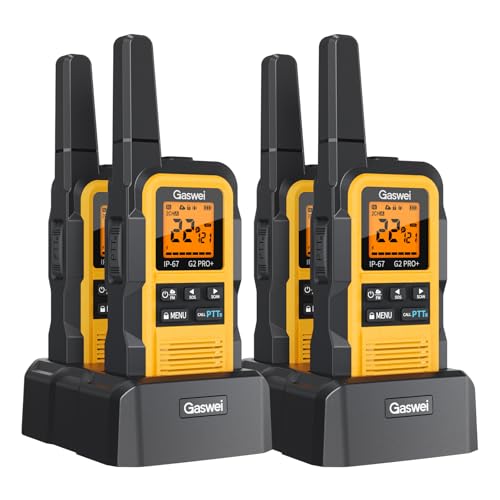
For a group split between two channels, this four-radio set offers dual PTT buttons and dual-channel monitoring. Gaswei says the design supports switching between two groups and monitoring activity on two channels. It also includes FM radio, SOS, NOAA weather and VOX features. The yellow radios are described as IP67 waterproof and floating.
Bottom line: Choose it when two-channel monitoring matters more than a distance claim.
pxton 16-Channel 4-Pack
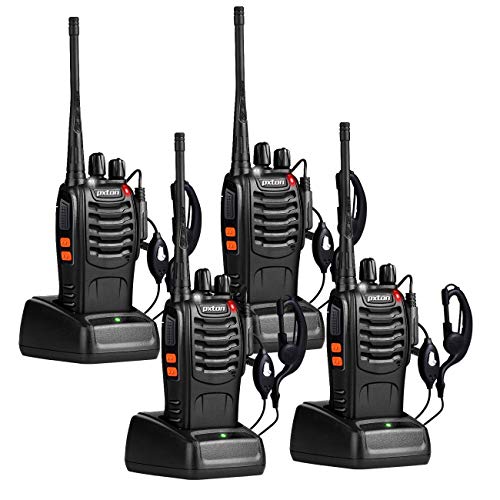
This four-pack stands out for including earpieces, which can suit users who want to communicate without holding a radio to their face. The pxton set has 16 preset channels, 165 privacy codes, VOX voice control, scanning, a low-battery alarm and a flashlight. Its maker notes that actual range depends on obstructions, with open rural, suburban or seaside areas offering better conditions than towns and cities.
Bottom line: Pick this set when included earpieces and preset channel selection are useful.
How to choose long-range walkie-talkies
Start with the radio service and terrain, not the largest range claim. Open, flat ground generally allows greater distance than dense buildings, hills or trees because obstacles weaken radio signals. Indoor coverage area and outdoor mileage are different measures. For a work site, prioritize channel coordination and compatible radios; for a remote route, test communication along the actual path before relying on it. A 5-watt UHF radio may require licensing depending on its frequencies and service, while FRS radios operate under FCC rules without an individual license. Confirm the service and authorization requirements for the exact device before transmitting.
FRS and UHF radios compared
FRS is a defined US radio service, while UHF is a radio-frequency band. The RB48 is identified as FRS; SAMCOM identifies its FPCN30A as 5-watt UHF, but UHF alone does not establish its specific FCC service or license status. FRS radios are subject to FCC power and antenna rules, while many UHF business radios use licensed frequencies. Radios do not necessarily communicate just because both are handheld or use UHF: frequency, channel programming and service must match. Use this distinction to decide what to verify before combining radio models.
| Option | Distinction | Fit |
|---|---|---|
| FRS radio | Defined radio service | Personal communication |
| UHF radio | Frequency band; service depends on frequencies | Work crews; verify authorization |
Why real-world radio range changes
Line of sight, antenna height, terrain and construction materials all affect range. Signals can travel farther across flat, open ground than through concrete, steel, hills or dense vegetation, so indoor coverage figures cannot guarantee performance in a particular building. Keep radios upright and unobstructed, then test communication from the farthest points where it is needed. For routes with valleys or tall buildings, plan check-in points rather than assuming a maximum range will hold throughout. If communication is safety-critical, use a backup method and do not treat a range claim as guaranteed coverage.
Channel matching and radio safety
Radios need compatible frequencies and channel programming to communicate; matching channel numbers alone may not be enough across different models. Privacy codes generally filter what the speaker hears, but they do not encrypt transmissions or make a channel private. For mixed fleets, verify frequency and code settings before the group separates. FCC rules govern US radio transmissions, including permitted services and power; transmitting on a frequency that requires authorization without the required license can cause interference and regulatory trouble. Set a designated channel and agree on a check-in procedure before outdoor work.
Frequently Asked Questions
How far can walkie-talkies reach in real use?
There is no single dependable distance because terrain and obstructions change signal range. Open, unobstructed areas usually support longer communication than cities, hills or buildings, so test the route you intend to use.
Do walkie-talkies work through concrete walls?
Radio signals can pass through some walls, but concrete and steel weaken them and reduce range. For indoor use, test between the actual rooms or floors; a broad coverage-area claim cannot guarantee a particular building layout.
Can different brands of walkie-talkies communicate?
Yes, when the radios use compatible frequencies, service and channel settings. Channel numbers may not correspond across models, so confirm programmed frequencies and privacy-code settings before relying on a mixed group.
Do privacy codes make walkie-talkie calls private?
No, privacy codes generally filter which transmissions a radio plays through its speaker; they do not encrypt the signal. Other users with compatible settings may still hear the transmission.