
Markers to Write on Mirrors: 4 Options Compared

For most mirror writing, CHALKY CROWN Liquid Chalk Markers, 6 mm is the clearest fit because it is made for mirrors and has a 6 mm tip with wet-wipe cleanup. Choose Celepen Window Chalk Markers, 10 mm for larger, bolder lettering or Glass Pen Window Marker, White when you want white ink and a reversible nib; test a small area first because cleanup can depend on the mirror’s surface and the ink.
We earn a commission if you buy through links on this page. As an Amazon Associate I earn from qualifying purchases. Products are compared on manufacturer specifications, not hands-on testing.
- Best overall: CHALKY CROWN Liquid Chalk Markers, 6 mm – It specifically names mirrors and combines a 6 mm tip with wet-paper-towel removal.
- Best for bold lettering: Celepen Window Chalk Markers, 10 mm – Its 10 mm rectangular nib supports wide, bold, and thin lines.
- Best for white marks: Glass Pen Window Marker, White – It is a single white marker with reversible 5 mm and 15 mm nibs.
| Product | Best for | Tip | Count | Cleanup or surface | Shop |
|---|---|---|---|---|---|
| CHALKY CROWN Liquid Chalk Markers, 6 mm | Everyday mirror notes | 6 mm reversible chisel/bullet | 8 markers | Wet paper towel | Check Price on Amazon |
| Celepen Window Chalk Markers, 10 mm | Large lettering | 10 mm rectangular 3-in-1 | 8 markers | Glass and mirror use | Check Price on Amazon |
| Bandle B. Chalk Markers, 6 mm | Multi-surface crafts | 6 mm reversible | 8 markers | Glass and nonporous surfaces | Check Price on Amazon |
| Glass Pen Window Marker, White | White mirror accents | Reversible 5 mm/15 mm | 1 marker | Washable; rain resistant | Check Price on Amazon |
Markers to Write on Mirrors
Compare tip size, color range, and cleanup claims to match the marker to your mirror project.
CHALKY CROWN Liquid Chalk Markers, 6 mm

CHALKY CROWN Liquid Chalk Markers, 6 mm stands out for naming mirrors directly and pairing that use with wet-wipe cleanup. The 8-pack has 6 mm reversible chisel and bullet tips, giving you a choice between angled strokes and rounded marks. Its water-based chalk ink is described as dustless, non-toxic, and odor-free. This set suits mirror notes, signs, and lettering where a medium-width line is useful. The main limitation is that the pack does not give a range of tip widths, so choose another option if you need a very broad stroke or a fine detail nib.
Bottom line: Choose it for mirror lettering with wet-wipe chalk cleanup.
Celepen Window Chalk Markers, 10 mm

Celepen Window Chalk Markers, 10 mm has the widest single stated nib size among these multi-marker sets: its 10 mm rectangular tip can make wide, bold, or thin lines depending on how it is held. The 8 markers use vibrant neon colors and water-based liquid chalk ink, and the set is described for cars, glass, and mirrors. It suits large messages and high-contrast designs better than small, tightly spaced writing. Its larger nib is the tradeoff for fine work; select a 6 mm or narrow-tip marker when small lettering needs more control.
Bottom line: Pick it for colorful, larger mirror messages rather than fine lettering.
Bandle B. Chalk Markers, 6 mm
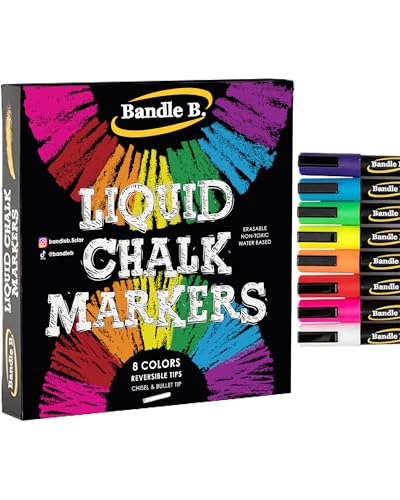
Bandle B. Chalk Markers, 6 mm is the multi-surface choice, with use described for glass and other nonporous materials including tile, plastic, and metal. The pack has 8 vibrant water-based liquid chalk markers with reversible tips, making it useful when mirror writing is part of a broader craft or sign project. Its 6 mm size places it in the middle of the choices here, rather than the extra-wide 10 mm option.
Bottom line: Choose it when you want one set for mirrors and other nonporous craft surfaces.
Glass Pen Window Marker, White
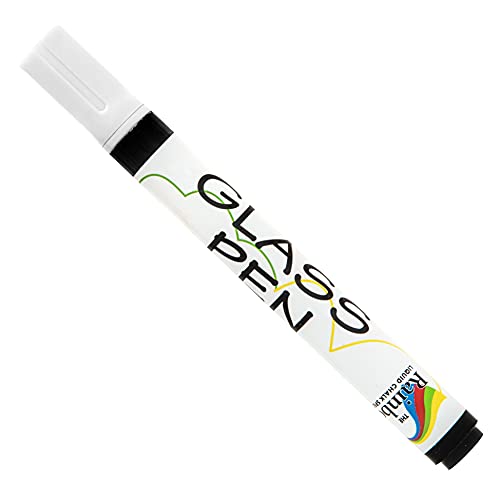
Glass Pen Window Marker, White is the dedicated single-marker option for white lettering, with a reversible nib described as 5 mm narrow or 15 mm wide. Its water-based ink is described as washable and able to resist light rain, and the marker is intended for mirrors as well as windows and other glass. That combination suits occasional white accents or a design that needs both fine strokes and broad marks. It is only one marker, not a multicolor set, and its rain resistance means removal may take more effort than a wet-wipe chalk marker; check a discreet spot before decorating extensively.
Bottom line: Pick it for white mirror designs that benefit from two line widths.
How to choose mirror markers
For most mirror lettering, choose a water-based chalk marker that explicitly names glass or mirrors and gives a removal method. Smooth glass is nonporous, so chalk-style ink sits on the surface rather than soaking in like ordinary paper-marker ink. A 6 mm tip is a useful middle ground for words and simple drawings; select a 10 mm nib for large headings or a 5 mm nib for compact writing. Before starting, wipe the mirror clean and dry, then test a small corner and erase it with the intended method. Avoid writing over mirror edges or frames that are painted, coated, or textured; their surfaces may behave differently from the glass.
Tip size and lettering scale
Tip width should match the size of the letters: use 5 to 6 mm for smaller words and a 10 to 15 mm nib for larger strokes. A reversible chisel tip changes line width when you rotate it, while a bullet tip keeps a more rounded stroke. Leave room between letters, since a broad nib can make narrow spacing look crowded. The table gives a quick starting point, not a guarantee of exact line width; pressure and the angle of a chisel nib affect the mark. If a message must remain legible from across a room, use fewer words and wider strokes rather than shrinking the lettering.
| Writing need | Starting tip width | Why |
|---|---|---|
| Small notes | 5–6 mm | More control in compact writing |
| General lettering | 6 mm | Balances readable strokes and detail |
| Large headings | 10–15 mm | Creates broader marks |
Cleaning chalk ink from a mirror
For removable chalk ink, start with a damp, soft cloth or wet paper towel and wipe without pressing hard. Product cleanup claims differ: some makers specify wet wiping, while others only describe ink as washable, so test the exact marker on a small corner before drawing across the mirror. Remove marks soon after use if you are unsure how long the ink can remain; dried residue may need repeated gentle wiping. Avoid abrasive pads and gritty cleaners, which can scratch nearby coatings or frame finishes even when the glass itself is smooth. Do not assume rain resistance means permanent ink, but expect a water-resistant formula to need more wiping than a marker promoted for easy wet removal.
Preparing a mirror for writing
A clean, dry mirror gives chalk marker ink a more even surface than one with fingerprints, cleaner film, or condensation. Wash away residue, dry with a lint-free cloth, and let the glass return to room temperature before writing; moisture can interrupt a smooth stroke. Keep the marker strokes on the glass face rather than over silicone seams or painted trim, where removal may differ. For designs near the edge, leave a small margin so ink does not transfer onto the frame when the mirror is wiped. On bathroom mirrors, wait until steam has cleared and the surface is dry before drawing, then use the marker’s removal approach on a discreet spot.
Frequently Asked Questions
Will liquid chalk markers come off a mirror?
Many water-based chalk markers are designed to wipe from nonporous glass, but the removal claim varies by formula. Test a small corner with a damp cloth or wet paper towel before covering a large area.
Should a mirror be wet before writing?
No, start with a clean, dry mirror for a smoother stroke. If the glass has condensation or cleaner residue, dry it fully before using the marker.
What marker tip works for small mirror lettering?
A 5 to 6 mm tip is a practical starting point for compact words because it is narrower than 10 to 15 mm options. Leave enough space between letters so strokes do not run together visually.
Can mirror marker writing survive bathroom steam?
Do not assume it will; water-based chalk ink is applied to the glass surface, and steam or condensation can interfere with it. Write only after the mirror is dry, and wipe the design away if moisture makes it smear.
How do I keep marker ink off the mirror frame?
Leave a small clear margin at the glass edge and avoid drawing across painted trim or silicone seams. Those materials may not clean like smooth glass, so test them separately if ink must touch them.