
Metal Roofing Shoes Non Slip: 4 Options Compared

For metal roofing, choose a spikeless rubber roofing cover with tread intended for roof surfaces; Spikeless Rubber Roofing Covers, S-M is the small-medium option, while Spikeless Roofing Covers, L-XL with Straps fits US sizes 9–12. Workers needing another size should compare the other covers’ size ranges before choosing.
Shoe covers can add traction, but they do not replace fall protection: use appropriate roof-edge protection and a fall-arrest system when required for the job.
We earn a commission if you buy through links on this page. As an Amazon Associate I earn from qualifying purchases. Products are compared on manufacturer specifications, not hands-on testing.
- Best overall: Spikeless Rubber Roofing Covers, S-M – A spikeless rubber-lug cover specifically described for metal roofing and offered in small-medium.
- Best for larger boots: Spikeless Roofing Covers, L-XL with Straps – The roofing cover is listed for US sizes 9–12 and includes straps.
- Best for winter work: Due North GripPro, L-XL – The GripPro is designed for workers moving between indoor and outdoor wet or icy conditions.
| Product | Best for | Fit | Traction style | Weight | Shop |
|---|---|---|---|---|---|
| Spikeless Rubber Roofing Covers, S-M | Small-medium footwear | Small-medium | Spikeless rubber lugs | 0.51 lb | Check Price on Amazon |
| Spikeless Roofing Covers, L-XL with Straps | Larger work boots | US 9–12 | Spikeless rubber tread | 0.68 lb | Check Price on Amazon |
| Due North GripPro, L-XL | Icy work routes | Large-extra large | 11 chevrons per aid | — | Check Price on Amazon |
| Spikeless Rubber Ice Cleats, S-M | Small winter footwear | US 5.5–8 | Textured rubber tread | 0.02 lb | Check Price on Amazon |
Non-Slip Metal Roofing Shoes
Compare roofing-specific overshoes with general-purpose traction aids, and match the size to the footwear you will wear underneath.
Spikeless Rubber Roofing Covers, S-M

For a small-medium fit, these spikeless rubber covers are the roofing-specific option among these choices. The rubber lug sole is intended for metal, wood, felt, slate, and shingle roofs, and the maker says it is designed to avoid scratching or marking surfaces. The black covers weigh about 0.51 lb. Choose them if your underlying footwear fits the size range and you want roof-oriented tread rather than metal studs.
The size label gives no numeric shoe-size range, so confirm fit against the footwear you plan to wear; a cover that shifts or stretches too tightly can interfere with footing.
Bottom line: Choose these for a small-medium fit when roof-specific spikeless tread is the priority.
Spikeless Roofing Covers, L-XL with Straps

For larger footwear, these roofing overshoes provide the clearest size range: US 9–12, with straps. Their stretch rubber construction and spikeless tread are intended for roofing and other slippery surfaces; the maker says the material is tear-resistant and remains elastic across temperatures. At about 0.68 lb, they are heavier than Spikeless Rubber Roofing Covers, S-M, and straps add another fit element to secure.
Choose this pair if your boots fall within the range and you need the larger option. The product is not a substitute for roof fall protection, and the general claim of traction does not establish a safe slope or weather limit.
Bottom line: Pick these for boots in US sizes 9–12 when straps and a roof use matter.
Due North GripPro, L-XL
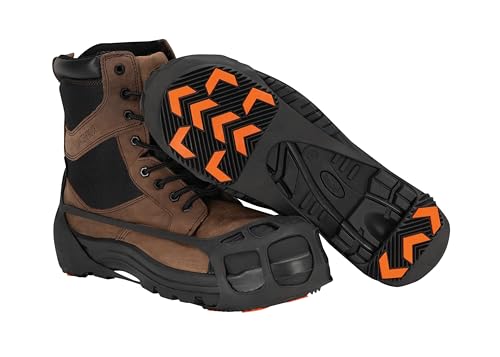
Unlike the roofing-specific covers, the Due North GripPro is aimed at workers moving between indoor and outdoor wet or icy conditions. Each aid has 11 high-visibility chevrons, 22 per pair, and the maker says the tread channels water. The slip-on design is intended to fit over boots, and the maker says it can be worn while driving, climbing ladders, and walking on grates.
This is a more relevant choice for winter routes than for metal-roof work: the maker explicitly says it is not for oil or grease, and its intended use is not specifically metal roofing. Choose it for the icy-work use rather than assuming roof compatibility.
Bottom line: Choose these for icy indoor-outdoor work routes, not as a roofing-specific option.
Spikeless Rubber Ice Cleats, S-M

These small-medium ice cleats are sized for US 5.5–8, giving a more precise fit cue than Spikeless Rubber Roofing Covers, S-M. They stretch over shoes or boots and use textured, shallow-groove tread; the maker says the rubber blend remains flexible in sub-zero temperatures. Indoor and outdoor use is described, including hard floors, so this option suits general winter traction needs beyond roofing.
The product is framed primarily as an ice cleat rather than a metal-roof shoe, and its size range is limited to smaller footwear. Choose it for winter walking when the fit matches, not as proof that a metal roof is safe to walk on.
Bottom line: Pick these for US 5.5–8 footwear when winter walking is the main need.
How to Choose Non-Slip Metal Roofing Shoes
Choose a cover built for roofing and sized to stay secure over the exact boots you will wear. Spikeless rubber tread avoids metal studs that can puncture or scratch a surface, but tread design alone cannot establish grip on every roof coating, pitch, or wet condition. Check the roof material, slope, weather, and footwear fit before access; do not treat any overshoe as fall protection. A roofing cover is the most direct match when its use includes metal roofs, while ice-oriented aids are better matched to winter walking. If your boot size is outside a product’s range, do not assume stretch rubber will make it fit safely. For work at height, use required guardrails or a personal fall-arrest system; traction aids are only one part of the safety plan.
Roof Surface, Slope, and Safety
Metal roofs can become slick with rain, dew, frost, dust, or loose debris, so a tread pattern cannot guarantee safe footing. A roof’s pitch and surface finish matter: standing-seam panels, painted panels, and corrugated sheets do not present identical contact areas. Avoid stepping on unsupported or translucent roof panels, and keep footwear clean so grit or mud does not reduce contact. OSHA construction rules require fall protection for many unprotected edges at heights of 6 feet or more; the applicable method depends on the work and site. Use a properly selected and anchored fall-protection system where required, and never rely on shoe covers to arrest a fall. Stop work when conditions exceed the crew’s safe access plan.
Roofing Covers Compared With Winter Cleats
Roofing-specific covers and winter traction aids serve overlapping but different jobs. Roofing covers here explicitly include metal roofs in their intended surface range, while the two ice-oriented aids emphasize icy or mixed indoor-outdoor work. Use the table to match the product type to the job rather than assuming all rubber tread performs alike.
| Need | Better match | Reason |
|---|---|---|
| Metal-roof work | Roofing overshoe | Roof surfaces are an explicit intended use |
| Icy indoor-outdoor routes | Winter traction aid | Designed around wet or icy transitions |
| Avoid metal studs on finished surfaces | Spikeless tread | No metal studs to puncture or scratch |
Neither category makes a slippery surface risk-free. Follow the site’s access controls and fall-protection requirements.
Fit and Care Before Roof Work
Fit the traction cover over the boots intended for the job, not over a different pair used for measuring. Check that the heel and toe remain seated, the tread lies flat, and straps or elastic do not loosen during a short ground-level walk. Remove packed mud, ice, or grit before use because debris can cover the tread. Inspect rubber for tears, permanent stretching, or hardened sections; replace a damaged cover rather than trying to secure it with improvised ties. Keep indoor floors in mind when moving from outdoors, since roof debris can be tracked inside. Store rubber dry and away from sharp tools or hot surfaces, which can damage the cover before the next shift.
Frequently Asked Questions
Can spikeless shoes grip every metal roof?
No traction aid can be assumed safe on every metal roof. Pitch, coating, moisture, frost, and debris change the available grip, so use only roofs and conditions covered by the job’s access plan.
Do roofing shoe covers replace fall protection?
No, shoe covers do not stop a fall. OSHA construction rules generally require fall protection for unprotected edges 6 feet or more above a lower level, with the appropriate method depending on the worksite.
Should I wear rubber roofing covers over boots?
Yes, these products are overshoes intended to go over existing footwear. Check the size range against the specific boots you will use and ensure the cover stays seated at the heel and toe.
Are metal-stud cleats suitable for finished roofs?
Spikeless tread avoids the puncture and scratch risk associated with metal studs. Surface condition and roof manufacturer guidance still matter, since rubber tread does not guarantee grip or prevent all surface damage.
When should I replace rubber shoe covers?
Replace a cover if it has a tear, has stretched so it no longer stays seated, or has hardened tread. Mud, ice, and grit should be cleared before use because they can obscure tread contact.