
Milwaukee Battery Adapter for Power Wheels: 4 Compared

For most Power Wheels conversions, M18 Adapter with Switch and Fuse, 1-Pack is the straightforward pick because it combines an on/off switch, 30-amp fuse and 12 AWG wire in a one-pack adapter. Choose a different option if you need two adapters, a Peg-Perego harness connection, or regulated 12V output rather than direct battery voltage.
We earn a commission if you buy through links on this page. As an Amazon Associate I earn from qualifying purchases. Products are compared on manufacturer specifications, not hands-on testing.
- Best overall: M18 Adapter with Switch and Fuse, 1-Pack – One adapter includes a switch, 30-amp fuse and 12 AWG wire.
- Best for two projects: M18 Adapter with Switch and Fuse, 2-Pack – The two-pack provides a switched, fused adapter for each setup.
- Best for Peg Perego: M18 Power Wheel Adapter with Peg-Perego Harness – Its wire harness connector is specified for Peg-Perego riding toys.
| Product | Best for | Pack count | Shop |
|---|---|---|---|
| M18 Adapter with Switch and Fuse, 1-Pack | Single toy setup | 1 | Check Price on Amazon |
| M18 Adapter with Switch and Fuse, 2-Pack | Two toy setups | 2 | Check Price on Amazon |
| M18 Power Wheel Adapter with Peg-Perego Harness | Peg-Perego toys | 1 | Check Price on Amazon |
Milwaukee Battery Adapters for Power Wheels
Compare direct battery adapters with the option that regulates output to 12 volts before choosing a setup.
M18 Adapter with Switch and Fuse, 1-Pack

M18 Adapter with Switch and Fuse, 1-Pack is a one-adapter direct connection for a single DIY ride-on conversion, with an on/off switch, 30-amp fuse and 12 AWG silicone copper wire. The ABS adapter is made for Milwaukee M18 18V batteries, including listed 48-11 series packs. It suits a builder who wants a basic fused connection without a separate voltage regulator. The main limitation is that the adapter supplies the battery’s direct voltage; buyers whose toy requires regulated 12V output should choose a step-down converter instead.
Bottom line: Pick this for one M18-powered toy when direct battery voltage is appropriate.
M18 Adapter with Switch and Fuse, 2-Pack
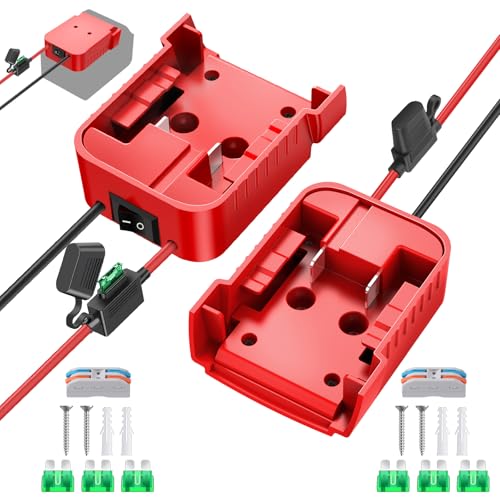
M18 Adapter with Switch and Fuse, 2-Pack differs by including two switched adapters, useful when wiring two separate projects or keeping a spare ready. Each unit is specified for M18 18V battery compatibility, uses 12 AWG wiring and includes a 30-amp fuse with a capped holder. Its close-fit connector is intended to limit loosening during use. This is still a direct-voltage adapter, not a 12V regulator, so it is a poor match when the vehicle’s electrical system requires a controlled 12V supply. Confirm the toy’s voltage requirement before connecting an 18V pack.
Bottom line: Choose this when you need two separately wired M18 connections.
M18 Power Wheel Adapter with Peg-Perego Harness

M18 Power Wheel Adapter with Peg-Perego Harness is the option here that specifically includes a wire harness connector compatible with Peg-Perego children’s riding toys. It also has a switch, 30-amp fuse and 12 AWG silicone copper wire, with an ABS adapter for Milwaukee M18 18V batteries. That harness focus may help when the toy’s existing connection differs from bare wire terminals. The specifications do not establish that the harness matches every Peg-Perego model, so verify connector fit and the toy’s voltage needs before wiring; the adapter does not claim to step voltage down.
Bottom line: Pick this for a Peg-Perego setup where its harness connector matches.
How to choose a Power Wheels battery adapter
Choose the adapter by the toy’s required voltage first, then match the connector and protection. A Milwaukee M18 pack is an 18V-class battery, while a 12V ride-on system may need a converter rather than a direct connection. Use a step-down unit when the vehicle requires regulated 12V; a direct adapter does not transform the battery output. Match current demand too: the converter here is rated for a maximum of 20 amps and 240 watts, while the direct options include 30-amp fuses. A fuse protects wiring against excessive current; it does not make an incompatible voltage safe. Never bypass a fuse or switch during a conversion.
Voltage and current fit for ride-on toys
Voltage compatibility is the first go/no-go check: connect an 18V-class source directly only when the toy’s system and components can accept it. Many children’s ride-on toys use 6V or 12V battery systems, so an M18 pack can exceed the intended voltage unless a suitable converter is used. Current capacity is a separate limit; the step-down option has a 20-amp maximum, and a load that demands more is outside its rating. Use the vehicle’s original battery label or wiring specifications to identify nominal voltage and current needs. If those values are unclear, confirm the required voltage and connector arrangement before ordering.
Direct adapters compared with step-down converters
Direct adapters connect the M18 battery to the output wiring; buck converters reduce the input voltage and regulate the output. A direct adapter is the simpler wiring choice only when the receiving equipment is compatible with the battery voltage. The converter is the better match for a 12V system, but its output capacity must cover the toy’s demand. A fuse rating and a converter current rating are different things: a 30-amp fuse is not a promise that every connected motor can safely draw 30 amps. Use this decision table to narrow the setup.
| Need | Choose | Key limit |
|---|---|---|
| Two adapter connections | Two-pack direct adapter | Direct M18 voltage |
| Peg-Perego harness connection | Harness-style adapter | Confirm model connector fit |
| Regulated 12V output | Step-down converter | 20 A maximum, 240 W |
Safe wiring and battery use
Disconnect the battery before making or changing wiring, and keep the positive and negative leads from touching; a lithium-ion tool pack can deliver enough current to overheat a shorted wire. The converter specifies yellow as positive and black as negative, so polarity must be correct. Keep the fuse installed close to the battery-side connection where practical, and use wire insulation rated for the environment rather than routing leads where wheels, steering parts or sharp edges can pinch them. Stop using the setup if a wire, connector or fuse holder becomes hot, damaged or loose. Do not leave a battery connected unattended in a child’s toy.
Frequently Asked Questions
Can an M18 battery power a 12V Power Wheels car?
An M18 pack is an 18V-class source, so use a converter when the car requires regulated 12V. The converter option has a 20-amp maximum and 240-watt output rating; confirm the vehicle’s demand is within both limits.
Do I need a fuse on a ride-on battery adapter?
A fused adapter adds over-current protection to the wiring, and the direct options here include 30-amp fuses. The fuse rating must suit the wire and connected load; a fuse does not correct a voltage mismatch.
What does 12 AWG wire mean for an adapter?
12 AWG identifies the wire’s conductor gauge, with a lower AWG number meaning thicker wire. Safe current capacity still depends on run length, insulation, bundling and installation, so gauge alone does not establish that a motor load is safe.
How do I check battery adapter polarity?
Identify positive and negative at both the battery adapter and toy before connection; reversing polarity can damage electronics. The step-down converter specifies yellow positive and black negative, and its leads should not be guessed from color on other adapters.
Can I leave a Milwaukee battery installed in the toy?
Remove or disconnect the pack when the toy is parked or stored, especially where children can reach it. A short circuit or damaged lead can create heat, and the setup should not be left unattended while connected.