
Milwaukee M18 Power Washer Options Compared by Fit

For a Milwaukee M18 power washer, the Ecarke option is the named-brand-compatible pick with a claimed 1,200 PSI and built-in water stop valve. These are handheld cordless washers rather than full-size pressure washer units, and each requires a compatible battery sold separately.
Choose another option if you need higher claimed pressure, adjustable speed levels, or a longer hose; confirm battery fit and included accessories before ordering.
We earn a commission if you buy through links on this page. As an Amazon Associate I earn from qualifying purchases. Products are compared on manufacturer specifications, not hands-on testing.
- Best overall: Ecarke 1,200 PSI Cordless Washer – Claims up to 1,200 PSI and includes a built-in water stop valve.
- Best for higher claimed pressure: 1350 PSI Handheld Washer with Touch Display – Claims 1,350 PSI and has a touch display with three speeds.
- Best for hose reach: 1100 PSI Washer with 23-Foot Hose – Includes a 23-foot hose for more distance from the water source.
| Product | Best for | Claimed pressure | Motor | Notable feature | Shop |
|---|---|---|---|---|---|
| Ecarke 1,200 PSI Cordless Washer | Trigger-stop control | 1,200 PSI | 450 W brushless | Water stop valve | Check Price on Amazon |
| 1350 PSI Handheld Washer with Touch Display | Higher claimed pressure | 1,350 PSI | 580 W | Touch display, 3 speeds | Check Price on Amazon |
| 800 PSI Brushless Handheld Washer | Three-level adjustment | 800 PSI | 380 W brushless | 8.5 L/min flow | Check Price on Amazon |
| 1100 PSI Washer with 23-Foot Hose | Longer hose reach | 1,100 PSI | 350 W brushless | 23 ft hose | Check Price on Amazon |
Milwaukee M18 Power Washer Options
Compare the claimed pressure, motor and practical features to match a handheld washer to your cleaning setup.
Ecarke 1,200 PSI Cordless Washer

The built-in water stop valve distinguishes this option: the maker says water starts with the trigger and stops when it is released. The brushless motor is rated at 450 W, and the tool is compatible with Milwaukee 18V batteries; battery and charger are not included. A 6-in-1 nozzle supports different spray patterns for cars, patios and fences.
This suits buyers who want trigger-based water control rather than a separate valve adjustment. The maker does not give a hose length or adjustable pressure settings, so those matter if your setup depends on either.
Bottom line: Choose it if trigger-controlled water flow matters more than a specified hose length.
1350 PSI Handheld Washer with Touch Display

The touch display and three speed settings set this washer apart, alongside its claimed pressure of 1,350 PSI. It has a 580 W motor, a 6-in-1 nozzle and a 16.4-foot hose. The weighted filter is designed to draw water from a bucket, pool or large tank, and a faucet adapter is included.
This model suits buyers who want source flexibility and speed selection. Battery and charger are not included, and pressure-washer safety still matters on sensitive paint: start with a wide spray, keep the nozzle moving and avoid directing a concentrated jet at trim or chipped areas.
Bottom line: Pick it for three speed levels and bucket-based water drawing.
800 PSI Brushless Handheld Washer
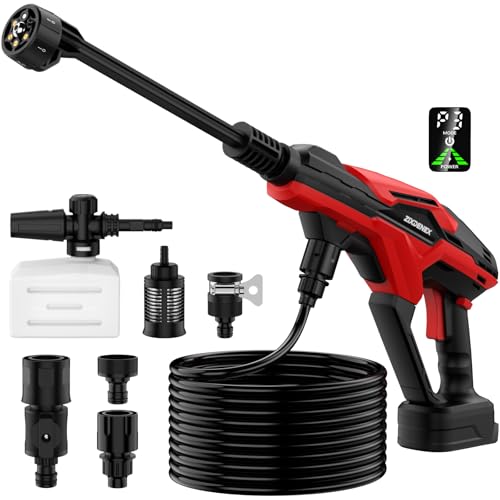
The all-metal three-cylinder plunger pump and stated 8.5 L/min flow distinguish this 800 PSI washer from the other options. Its maker also claims up to 32.8 feet of spray distance and describes a three-level pressure adjustment, with a 6-in-1 nozzle for changing spray patterns. The tool is intended for Milwaukee 18V batteries.
It may suit someone who values pump construction and selectable output for varied home cleaning. Its claimed pressure is lower than the other options here, so buyers prioritizing the highest PSI should compare alternatives. Battery and charger are not included.
Bottom line: Choose it for stated flow and three-level adjustment.
1100 PSI Washer with 23-Foot Hose

The 23-foot hose is the clearest differentiator for this 1,100 PSI handheld washer. It has a 350 W brushless motor, a 6-in-1 nozzle, three adjustable levels and a storage box. The maker positions it for everyday tasks such as dusty cars, bikes, patios, fences and outdoor furniture, and says it works with Milwaukee 18V batteries.
This is a fit for buyers who want to work farther from their water source or keep accessories together. Battery and charger are sold separately.
Bottom line: Pick it when hose reach and a storage box are priorities.
How to choose a Milwaukee M18 handheld washer
Choose by water source, spray control and task, not PSI alone. Pressure is the force at the nozzle, while flow rate—usually measured in gallons per minute—describes how much water moves; cleaning output depends on both. A concentrated jet can mark soft wood, strip loose paint or damage vehicle trim, so start with a wide spray and keep the nozzle moving. For car washing, a soap applicator and a broad fan pattern are more useful than chasing the highest pressure. A handheld washer is also not equivalent to a full-size electric pressure washer: its portability is useful for light outdoor cleaning, but sustained heavy surface cleaning is a different job.
When choosing among these options, prefer a documented hose length if your bucket or tank will sit away from the work area; prefer a trigger-stop valve if you want water flow to stop when you release the trigger.
Battery fit and cordless washer setup
Battery compatibility is essential: a tool described as compatible with Milwaukee 18V batteries still needs a battery that physically fits its connector and operates correctly with the tool. All four options here are tool-only, so a compatible battery and charger are separate requirements. Battery capacity in amp-hours affects runtime, not the washer’s pressure rating; higher-capacity packs generally provide longer operation but add weight. Check that the battery is secure and protected from spray before starting.
Portable washers commonly draw water through a hose and filter from a bucket or tank, or connect to a faucet when an adapter is supplied. Keep an intake filter submerged and clear of debris to avoid starving the pump. Never run a water-fed pump dry; interruptions in the water supply can cause overheating or damage.
Nozzle patterns, pressure and surface safety
A multi-pattern nozzle changes the spray shape, so select a broad fan for delicate surfaces and reserve narrow patterns for durable material at a safe distance. A 0-degree jet concentrates force into a small area and can cut wood, damage concrete coatings or injure skin; never aim a pressure washer at a person or animal. Start several feet away, test an inconspicuous spot, then move closer only if needed.
For a vehicle, rinse loose grit first and use a broad spray rather than directing a narrow jet at tires, seals, paint chips or electrical connectors. Pressure values are maximum claims, not a guarantee of the pressure at every setting or distance. The right choice depends on surface sensitivity and access to water as much as the advertised PSI.
Compare the pressure washer types for your job
Handheld cordless washers trade sustained output for mobility, while corded electric and gas pressure washers are larger categories often chosen for longer or heavier cleaning jobs. The ranges below are typical category context, not specifications for the four products above. Actual output differs by model, nozzle, water supply and operating conditions.
Use this guide to match the washer type to the work before comparing individual features.
| Washer type | Typical pressure range | Useful for |
|---|---|---|
| Handheld cordless | About 300–1,500 PSI | Rinsing cars, bikes and light outdoor dirt |
| Electric pressure washer | About 1,300–2,000 PSI | Routine patio, furniture and siding cleaning |
| Gas pressure washer | About 2,000–3,000 PSI or more | More demanding outdoor cleaning where mobility matters |
Frequently Asked Questions
Can a Milwaukee M18 battery power these washers?
All four tools are described as compatible with Milwaukee 18V batteries, but none includes a battery or charger. Confirm that your specific pack fits the washer’s battery interface before use.
What pressure is enough for washing a car?
A broad spray and controlled distance matter more than maximum PSI for vehicle paint. Begin several feet away, rinse loose grit, and avoid narrow jets at tires, seals and chipped paint.
Can a handheld washer pull water from a bucket?
A washer needs an intake hose and submerged filter to draw from a bucket; 1350 PSI Handheld Washer with Touch Display explicitly describes a weighted filter for drawing from a bucket, pool or tank. Keep the intake clear and do not let the pump run dry.
How long will an 18V battery run a portable washer?
Runtime depends on battery capacity, motor load and how often the trigger is used, so the 18V label alone cannot determine operating time. A pack’s amp-hour rating gives a better basis for comparing capacity, though real runtime still varies.