
Mist Coolant Lubrication Spray System: 5 Models Compared

For a mist coolant lubrication spray system, 3L Solenoid Dual-Nozzle Mist System is the named model to consider if you need two nozzles and solenoid flow control. Choose another configuration if your priority is a two-system pack, adjustable spray volume or an integrated 3-liter tank.
We earn a commission if you buy through links on this page. As an Amazon Associate I earn from qualifying purchases. Products are compared on manufacturer specifications, not hands-on testing.
- Best overall: 3L Solenoid Dual-Nozzle Mist System – Two sprayer nozzles, an integrated air filter and solenoid flow control suit multi-point machining.
- Best for dual units: CLAHJQX YS-BPV-300, 2-Pack – The package includes two spray systems and 1/4-inch or 8 mm air inlet connections.
- Best for tank supply: 3L Tank Mist Spray Pump Kit – A 3-liter water/oil tank and separate air and oil adjustments make it a tank-based option.
| Product | Best for | Nozzles or units | Air pressure or inlet | Tank capacity | Shop |
|---|---|---|---|---|---|
| 3L Solenoid Dual-Nozzle Mist System | Dual-point CNC | 2 nozzles | 2–8 kg adjustable | 3 L | Check Price on Amazon |
| CLAHJQX YS-BPV-300, 2-Pack | Two-machine setups | 2 systems | 8 mm or 1/4 in inlet | — | Check Price on Amazon |
| OriGlam Adjustable Mist Sprayer | Compact installation | — | 5–7 kgf/cm² | — | Check Price on Amazon |
| QWORK Adjustable Mist System | Coolant reduction | — | Adjustable; value — | — | Check Price on Amazon |
| 3L Tank Mist Spray Pump Kit | Integrated reservoir | — | 0.1 MPa air | 3 L | Check Price on Amazon |
Mist coolant lubrication spray systems compared
Match the air connection, fluid setup and number of spray points to your machine before choosing.
3L Solenoid Dual-Nozzle Mist System

3L Solenoid Dual-Nozzle Mist System stands apart with two sprayer nozzles, a solenoid valve and an integrated 7.68-inch air filter. The maker says the valve supports adjustable air pressure from 2 to 8 kg and automated flow management without water pressure. Its fluid options include water, coolant and alcohol, so it suits engraving or cutting setups that use different liquids. The limitation is that the maker does not identify hose connections; buyers with fixed air-line fittings should confirm compatibility before ordering.
Bottom line: Choose this when two spray points and solenoid-controlled flow matter most.
CLAHJQX YS-BPV-300, 2-Pack

CLAHJQX YS-BPV-300, 2-Pack is the only option here explicitly packaged as two complete spray systems, with 5-foot air hoses and an additional quick-connect fitting. The air inlet accepts either 8 mm or 1/4-inch tubing, and the oil inlet pipe is 4 mm. The maker says atomized spray can cool and lubricate while clearing chips during machining.
Bottom line: Pick this for a two-machine setup that uses 8 mm or 1/4-inch air tubing.
OriGlam Adjustable Mist Sprayer

OriGlam Adjustable Mist Sprayer gives the clearest pressure range among the basic adjustable sprayer options: the maker specifies 5–7 kgf/cm². Its dimensions are 180 × 135 × 20 mm, making the footprint useful to compare when space around a machine is constrained. The maker also describes an adjustable air flow and mist volume for cutting, drilling and milling applications.
Bottom line: Choose this for a compact adjustable sprayer when its pressure range fits your air supply.
QWORK Adjustable Mist System
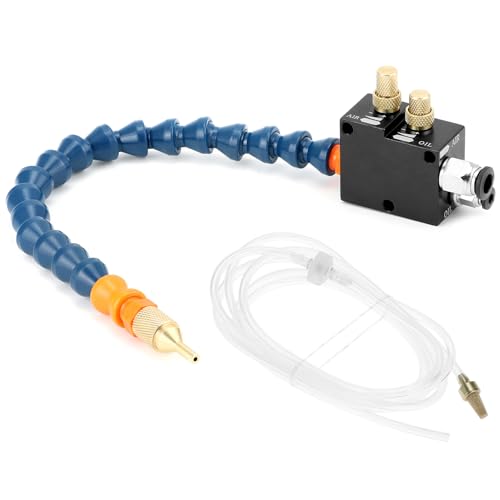
QWORK Adjustable Mist System is distinguished by the maker’s claim of over 80% coolant savings compared with traditional water-cooling systems. The system is intended for CNC, lathe, milling and drill machines, with adjustable airflow and mist volume and no liquid pressure requirement. That makes it relevant where reducing coolant use is a central goal. The percentage is a maker claim rather than a guaranteed result for every cut; users should not assume the same reduction across different materials, tooling or machining conditions. Air pressure and connection size are also not provided.
Bottom line: Pick this when coolant-use reduction is the priority and the setup can accommodate unspecified fittings.
3L Tank Mist Spray Pump Kit

3L Tank Mist Spray Pump Kit combines an integrated 3-liter water/oil tank with separate air and oil adjustment knobs. Its maker describes a negative-pressure siphon that sprays at 0.1 MPa air pressure without water pressure; the tank is industrial-grade resin, and the kit is described as IP65 rated. This format suits a machine where a dedicated reservoir and independent flow adjustment are useful. A tank-based arrangement takes space at the machine, so measure the available mounting area before choosing it.
Bottom line: Choose this when you want a 3-liter reservoir and separate air and fluid controls.
How to choose a mist coolant system
Start with the air connection and the number of spray points, then match the controls to the machining task. Air-driven mist systems use airflow to atomize liquid, so they do not need pressurized coolant at the fluid inlet; air pressure and fluid flow still need adjustment for a stable spray. For one spray location, a single adjustable unit may be enough, while two nozzles can cover separate cutting areas. If a fixed air line is already installed, check its tubing outside diameter against the inlet size before ordering. A measurable rule: choose a kit with a connection size that matches your tubing, or confirm the correct adapter is included.
Air pressure, fittings and spray adjustment
Air pressure figures are not interchangeable unless they use the same unit: 0.1 MPa equals 100 kPa, while kgf/cm² is a different unit. Air volume, nozzle position and liquid feed all affect the resulting mist, so pressure alone does not determine coverage. Keep hoses short and free of kinks, and use an airtight connection so pressure does not escape before reaching the sprayer. Where a kit offers separate air and fluid controls, adjust them independently in small increments rather than opening both fully at once. Before operation, direct the nozzle toward the cutting zone and keep the mist away from the operator’s breathing zone.
Tank-based and line-fed mist systems
A tank-based system carries its own fluid reservoir, while a sprayer without a tank may require a separate container or feed arrangement. A 3-liter tank holds about 0.79 US gallon, useful for estimating whether its footprint and refill interval fit a shop routine; actual consumption changes with nozzle setting and duty cycle. Water, water-miscible coolant and oil are not automatically interchangeable in every system, so confirm fluid compatibility and clean the feed path when changing liquids. Mist systems also do not eliminate chip hazards: wear eye protection and guard rotating tools, and never direct compressed air at skin.
Common setup mistakes with coolant misters
The most common mismatch is choosing by nozzle count without checking tubing size, reservoir placement or available air pressure. A 1/4-inch tube and an 8 mm tube are close in size but are not the same specified connection, so do not force one into a fitting meant for the other. A filter can help keep incoming air clean, but it does not replace draining water from an air line or maintaining the compressor. Start with low fluid flow, test the spray pattern over a non-cutting area, then adjust until the cutting zone is reached without flooding the work surface. Keep electrical controls and exposed electronics clear of coolant mist.
Frequently Asked Questions
Can a mist coolant system run without water pressure?
Yes, an air-driven siphon or atomizing design can draw liquid without pressurized water. The maker gives 0.1 MPa air pressure for one tank kit, but the needed pressure varies by model.
What air pressure does a coolant mister need?
The pressure depends on the sprayer: the compared specifications include 0.1 MPa and a range of 5–7 kgf/cm². Match the air supply to the specific unit rather than treating those values as equivalent.
How do I match a mister to my air hose?
Match the fitting to the hose’s outside diameter; the compared dual-system kit accepts 8 mm or 1/4-inch air tubing. Use a compatible connector and seal threaded joints to avoid leaks.
Can I use oil instead of coolant in a mist system?
Some systems are intended for oil, coolant or water, but fluid compatibility is model-specific. Confirm that the fluid suits the sprayer and machining operation before filling the reservoir.
Is coolant mist safe to breathe while machining?
Do not assume coolant mist is safe to breathe; aerosol exposure depends on the fluid and process. Use appropriate machine guarding and ventilation, and keep the spray directed at the cutting area rather than the operator.