
Motorcycle Air Pump Options Compared by Fit and Use

For most riders, AstroAI L7 Tire Inflator is the clearest fit because its motorcycle mode, cordless design and auto shut-off suit tire-pressure checks without a power cord. Choose OlarHike Dual Hose Inflator instead if you want a built-in power bank, or Lamicall Portable Tire Inflator if a compact body is the priority; a motorcycle air pump is a portable inflator for tire top-ups, not a suspension shock pump.
We earn a commission if you buy through links on this page. As an Amazon Associate I earn from qualifying purchases. Products are compared on manufacturer specifications, not hands-on testing.
- Best overall: AstroAI L7 Tire Inflator – Its motorcycle mode, cordless operation and auto shut-off match routine motorcycle tire top-ups.
- Best for power-bank use: OlarHike Dual Hose Inflator – It combines cordless inflation with a USB output for charging devices.
- Best for compact storage: Lamicall Portable Tire Inflator – Its dimensions are 6.3 by 2.7 by 2.1 inches.
| Product | Best for | Maximum pressure | Shop |
|---|---|---|---|
| AstroAI L7 Tire Inflator | Cordless tire top-ups | 150 PSI | Check Price on Amazon |
| OlarHike Dual Hose Inflator | Charging on the go | — | Check Price on Amazon |
| Lamicall Portable Tire Inflator | Small storage spaces | 150 PSI | Check Price on Amazon |
Motorcycle Air Pumps for Tire Inflation
These portable inflators differ in their presets, extra functions and published pressure limits.
AstroAI L7 Tire Inflator

AstroAI L7 Tire Inflator pairs a motorcycle preset with a cordless design and an auto shut-off feature, making it a straightforward choice for riders who want to set a target pressure before inflating. It supports PSI, bar, kPa and kg/cm², so the reading can match the unit used in your motorcycle manual. The maker says its sensor collects pressure data 200 times per second. Its 150 PSI maximum is a ceiling, not a recommended motorcycle tire pressure; riders who need a pump for suspension components should choose a dedicated shock pump instead.
Bottom line: Choose this for cordless motorcycle tire inflation with an auto shut-off feature.
OlarHike Dual Hose Inflator

OlarHike Dual Hose Inflator stands out for its USB output, which can charge a phone or another device while traveling, and its dual-hose system. Its motorcycle support, auto-stop function and four pressure units make it relevant for tire top-ups as well as other inflation tasks. The maker gives a car-tire inflation example, but that timing should not be treated as a motorcycle-tire estimate. This option suits riders who value the extra charging function; buyers comparing inflators by a published maximum pressure should confirm that limit before ordering.
Bottom line: Pick this if charging another device is useful alongside tire inflation.
Lamicall Portable Tire Inflator
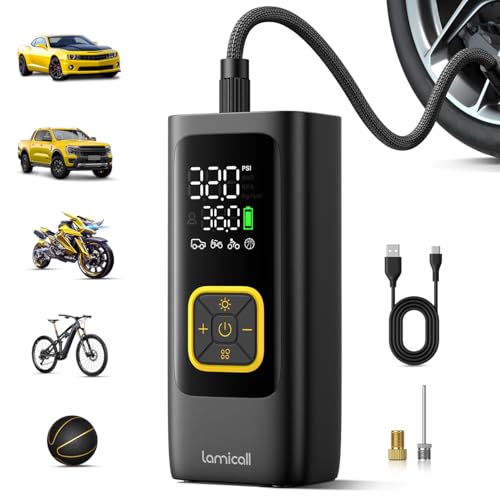
Lamicall Portable Tire Inflator is the compact-storage pick, with dimensions of 6.3 by 2.7 by 2.1 inches and a rechargeable design. Its motorcycle preset and auto-stop function support a simple set-and-inflate routine, while PSI, bar, kPa and kg/cm² give riders several ways to read pressure. The 150 PSI is the inflator’s maximum, not a pressure target for a motorcycle tire. Its feature set centers on portability and presets; riders who want a pump that also charges a device should consider a different option.
Bottom line: Choose this when compact storage and rechargeable operation are priorities.
How to Choose a Motorcycle Air Pump
Choose a motorcycle air pump by matching its functions to the tire-pressure check you need to make. A motorcycle preset can simplify entering a target, but the pressure target itself should come from the motorcycle maker, not the pump’s maximum rating. A 150 PSI ceiling describes the device’s capability, not a suitable tire setting. A digital gauge, selectable pressure units and auto-stop can make top-ups easier to control; compare those functions against how you plan to carry and power the pump. If the pump will live in a small tail bag, check its dimensions and weight before choosing. For occasional roadside use, cordless operation avoids needing a vehicle power socket.
Motorcycle Tire Pressure and Fit
Set motorcycle tire pressure using the maker’s cold-tire recommendation, usually found in the owner’s manual or on the motorcycle’s tire-pressure label. Motorcycle pressures commonly fall around 28 to 36 PSI, but the correct value varies by model, tire and load; use the specific recommendation rather than that broad range. Check pressure before riding, because warmed tires can read higher than cold tires. An air pump’s motorcycle mode does not identify your motorcycle or select a verified pressure for it. Enter the correct target yourself, and make sure the hose and valve connection fit your tire valve before relying on the pump away from home.
Portable Tire Inflators Versus Shock Pumps
Portable tire inflators and suspension shock pumps serve different jobs. Tire inflators move air quickly into tire volumes and commonly include modes for cars, bikes or balls. Shock pumps are low-volume, high-pressure tools for air-sprung forks and rear shocks; the included shock pump is rated to 300 PSI and has a bleed button for fine pressure adjustment. That high pressure capability does not make a shock pump the right substitute for a tire inflator. Use the tool designed for the component, and follow the vehicle or suspension maker’s target setting. A tire-pressure preset is not a suspension setup recommendation.
Frequently Asked Questions
What pressure should I use in motorcycle tires?
Use the cold-tire pressure specified for your motorcycle, rather than a pump’s maximum PSI. Many motorcycle tire recommendations are roughly 28 to 36 PSI, but the exact front and rear settings vary by model and load.
Should I check motorcycle tire pressure cold?
Yes, check tires before riding when they are cold. Riding warms the tires and can raise the pressure reading, so do not bleed air from a warmed tire just to match the cold recommendation.
Can a motorcycle air pump inflate a shock?
A tire inflator is not the preferred tool for an air-sprung fork or shock. Suspension components need controlled high-pressure adjustment, so use a dedicated shock pump with a bleed function and the component maker’s pressure guidance.
Does a higher PSI rating make a pump better?
No; the maximum PSI is a capability limit, not a measure of suitability for your motorcycle. Choose based on the correct pressure range, gauge readability, valve connection and the way you plan to power the pump.