
Motorcycle Tire Pressure Monitoring Systems Compared

FOBO Bike 2 TPMS is the closest match for riders who want app-based Bluetooth monitoring without a separate receiver. Choose a display-based option instead if you want readings on a dedicated screen, or a solar-assisted model if receiver charging is a priority.
A motorcycle TPMS uses sensors to report tire pressure, and some models also report temperature; it supports, but does not replace, checking tires with a gauge.
We earn a commission if you buy through links on this page. As an Amazon Associate I earn from qualifying purchases. Products are compared on manufacturer specifications, not hands-on testing.
- Best overall: FOBO Bike 2 TPMS – Bluetooth 5.0 monitoring connects to an iOS or Android app without an additional receiver.
- Best for a compact display: Sykik Rider SRTP300 – Includes a 1.5-inch monitor with a rechargeable battery.
- Best for solar-assisted charging: Solar Motorcycle TPMS with LCD – The receiver has a solar panel and magnetic charging.
| Product | Best for | Readout | Sensor setup | Power or connection | Shop |
|---|---|---|---|---|---|
| FOBO Bike 2 TPMS | App-based monitoring | Smartphone app | Wireless sensors | Bluetooth 5.0 | Check Price on Amazon |
| Sykik Rider SRTP300 | Dedicated small display | 1.5-inch monitor | Wireless sensors | Rechargeable monitor | Check Price on Amazon |
| Solar Motorcycle TPMS with LCD | Solar-assisted charging | LCD display | Two external sensors | Solar and magnetic charging | Check Price on Amazon |
| Motorcycle TPMS with LCD and Two Sensors | Two-sensor display setup | LCD display | Two external sensors | — | Check Price on Amazon |
| XiangAi Motorcycle Bluetooth TPMS | Customizable app alerts | Smartphone app | Two external sensors | Bluetooth | Check Price on Amazon |
Motorcycle Tire Pressure Monitoring Systems
Compare how each system displays readings, connects to the rider and handles power.
FOBO Bike 2 TPMS
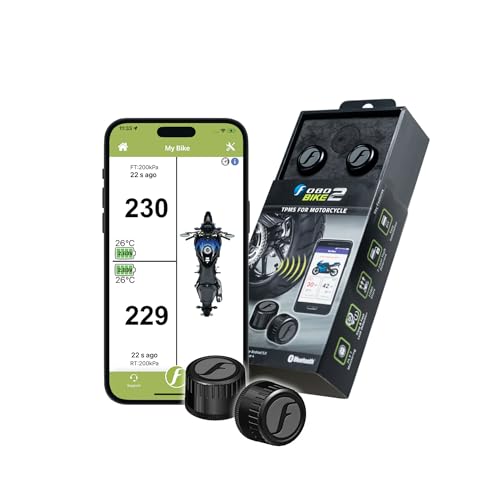
FOBO Bike 2 TPMS stands out for app-based Bluetooth monitoring without a separate receiver. The system tracks tire pressure and temperature and connects through the FOBO app on iOS or Android; the maker says it can send alerts for low pressure, slow or fast leaks and abnormal temperature, with cloud sync. It suits riders who prefer phone notifications over a dedicated screen. The trade-off is that readings and alerts rely on a compatible smartphone and app, so riders who want an always-visible standalone display should consider a monitor-based system instead.
Bottom line: Pick this if you want phone-based alerts and do not need a separate screen.
Sykik Rider SRTP300

Sykik Rider SRTP300 is the screen-focused option, with a 1.5-inch water-resistant monitor and a built-in rechargeable battery. The maker gives a 9–12 month monitor battery life and a two-year sensor battery life under normal use, and the system uses PSI and Fahrenheit by default. This suits riders who want a dedicated readout rather than app notifications. Its configuration is less flexible for riders who want alternate units, and the facts do not establish phone connectivity; confirm unit options before choosing if you need them.
Bottom line: Choose this if a dedicated monitor matters more than phone connectivity.
Solar Motorcycle TPMS with LCD

Solar Motorcycle TPMS with LCD combines an LCD readout with solar and magnetic charging for its receiver, setting it apart from app-first systems. The maker says the display shows front and rear pressure and temperature in real time, with PSI or Bar and Fahrenheit or Celsius options. It also advertises seven alarm types, including pressure, temperature, rapid air-loss, signal-loss and battery alerts. This suits riders who want a screen and multiple alerts. Solar charging depends on sunlight, so riders who cannot expose the receiver to sun should account for the magnetic charging method as well.
Bottom line: Pick this if you want an LCD, multiple alarm types and solar-assisted receiver charging.
Motorcycle TPMS with LCD and Two Sensors

Motorcycle TPMS with LCD and Two Sensors is a two-sensor LCD system that the maker says wirelessly reports pressure and temperature in real time and gives audiovisual alarms when it detects abnormalities. The IP67 waterproof and dustproof rating may appeal to riders who want a dedicated display system with an environmental rating. The available product facts do not establish its charging method, alarm thresholds or unit options, so riders who need those specifics should verify them before choosing. It is a fit for buyers prioritizing the two-sensor setup and audible-visual warnings.
Bottom line: Choose this if the two-sensor LCD setup and audiovisual alerts fit your priorities.
XiangAi Motorcycle Bluetooth TPMS

XiangAi Motorcycle Bluetooth TPMS pairs two external sensors with Bluetooth smartphone alerts, and the maker says riders can set high- and low-pressure and temperature warnings in an iOS or Android app. That customization distinguishes it from systems whose provided features center on a dedicated monitor. It suits riders who want pressure and temperature notifications on a phone. The product facts identify an app-based setup rather than a standalone screen, so riders who want to read values without opening or checking a phone should choose a display-equipped system.
Bottom line: Pick this if customizable phone alerts are more useful than a dedicated display.
How to choose a motorcycle TPMS
Choose a motorcycle TPMS by deciding first whether you want a dedicated display or phone notifications. A handlebar or receiver display gives a glanceable readout; a Bluetooth system routes alerts through a compatible phone and app. Next compare whether pressure and temperature are both monitored, what alert types are named, and how the receiver or sensors get power. An alarm count is useful only when the alert categories match your needs, such as low pressure or rapid air loss. TPMS readings are a warning aid, not a substitute for a pressure gauge: use the motorcycle maker’s cold-pressure recommendation as the target, then investigate a warning before continuing a ride.
Motorcycle tire pressure and TPMS readings
Set tire pressure using the motorcycle maker’s recommendation for the tire and load, not the maximum pressure molded on the tire sidewall. Check pressure when tires are cold—before riding, rather than immediately after a trip—because riding heats the tire and raises pressure. TPMS temperature readings can help show a change, but they do not determine the correct inflation target. A practical decision rule is to stop safely and check with a gauge if a warning indicates a pressure loss; do not try to compensate for a hot reading by bleeding air down to the cold target. Recheck pressure when the tires cool.
External sensors and motorcycle fit
External TPMS sensors replace or attach at the valve cap, so valve-stem compatibility and secure fit matter before installation. Motorcycle wheels rotate at road speed, and added mass at the valve can affect wheel balance; have balance checked if a new vibration appears after fitting sensors. Confirm that sensors clear nearby brake or wheel parts and that caps remain secure. Treat the TPMS as a monitoring aid, not a reason to skip a visual tire inspection: cuts, embedded objects, bulges and damaged valves still require attention even when pressure appears normal. Follow the sensor maker’s installation method and check for leaks after fitting.
Using alerts without relying on them alone
TPMS alerts are most useful when riders know the normal cold pressure for their bike and can distinguish a warning from an expected hot-tire reading. Before a longer ride, check cold pressures with a gauge and inspect both tires; repeat checks after a repair or sensor removal. If a system reports rapid loss, abnormal heat or sensor signal failure, pull over somewhere safe rather than staring at a display while moving. A missing reading is not proof that pressure is safe. Keep a reliable gauge available, and treat a continuing warning as a reason to inspect the tire and valve before riding on.
Frequently Asked Questions
Should I set tire pressure from the TPMS reading?
Use the motorcycle maker’s cold-pressure recommendation as the target, then use the TPMS to watch for changes. Riding heats tires and raises pressure, so do not bleed air from a warm tire just to match its cold target.
When should I check motorcycle tire pressure?
Check before riding while the tires are cold, using a reliable gauge. A TPMS can monitor pressure during a ride, but a gauge check is useful after a warning or tire service.
Can I use car tire pressure advice on a motorcycle?
No; use the motorcycle maker’s specified pressure for the motorcycle and its load. The tire sidewall’s maximum is not the bike’s recommended operating target.
Do external TPMS sensors need wheel balancing?
Added weight at the valve can affect wheel balance, so check balance if vibration begins after installing external sensors. Also make sure each sensor clears nearby wheel and brake components.
What should I do if motorcycle TPMS alerts mid-ride?
Pull over safely and inspect the tire rather than reading the display while moving. Check pressure with a gauge; a rapid-loss or abnormal-temperature alert deserves prompt attention before riding farther.