
Motul 7100 4T 10W-40: Four Oils Compared by Grade

Motul 7100 4T 10W-40 is the closest fit for riders seeking Motul 7100 4T in SAE 10W-40, with JASO MA2 wet-clutch certification and a 4-liter container. Choose a different option only if your motorcycle manual calls for another viscosity or you specifically want a racing oil.
Motorcycle oil lubricates the engine and, in many designs, the gearbox and wet clutch; the grade and clutch specification both matter.
We earn a commission if you buy through links on this page. As an Amazon Associate I earn from qualifying purchases. Products are compared on manufacturer specifications, not hands-on testing.
- Best overall: Motul 7100 4T 10W-40 – The exact 10W-40 7100 match has JASO MA2 certification and comes in a 4-liter container.
- Best for racing: Motul 300V Factory Line Road Racing 10W40 – The 300V is identified as a road racing synthetic 10W40 oil in a 4-liter container.
- Best for 10W-50: Motul 7100 4T 10W-50 – The 7100 10W-50 matches applications that call for that grade and is packaged in a 1-liter bottle.
| Product | Best for | SAE grade | Container volume | Wet-clutch information | Shop |
|---|---|---|---|---|---|
| Motul 7100 4T 10W-40 | 10W-40 street use | 10W-40 | 4 L | JASO MA2 | Check Price on Amazon |
| Motul 300V Factory Line Road Racing 10W40 | Road racing use | 10W40 | 4 L | Wet-clutch compatible | Check Price on Amazon |
| Motul 7100 4T 10W-50 | 10W-50 applications | 10W-50 | 1 L | JASO MA2 | Check Price on Amazon |
| Motul 7100 4T 10W-60 | 10W-60 applications | 10W-60 | 4 L | JASO MA2 | Check Price on Amazon |
Motul 4T Motorcycle Oils Compared
Compare the viscosity grade, container volume and clutch information before matching an oil to your motorcycle manual.
Motul 7100 4T 10W-40

For the requested 7100 10W-40 grade, this 4-liter oil is the direct match among these options. Its maker identifies it as full synthetic, API SP and JASO MA2, so it is intended for four-stroke motorcycles with compatible wet clutches. Motul says its ester technology is designed to protect the engine and gearbox under high-RPM operation. This option suits riders whose manual calls for 10W-40 and the clutch specification. Its main limitation is that it is not the right grade when the manufacturer specifies 10W-50 or 10W-60.
Bottom line: Choose this when your manual calls for SAE 10W-40 and JASO MA2 oil.
Motul 300V Factory Line Road Racing 10W40

The 300V is the racing-focused alternative in 10W40, rather than a 7100 product. It is a 4-liter, 100% synthetic 4T oil that the specifications describe as designed for high-performance wet-clutch systems and integrated gearboxes. Motul says its ESTER Core technology aims to reduce internal friction and support power response. Consider it if the racing orientation is relevant and its specifications match your motorcycle. The fields do not identify an API or JASO certification, so verify the required approval before using it in an application that calls for one.
Bottom line: Pick this for a racing-oriented 10W40 option after confirming required approvals.
Motul 7100 4T 10W-50
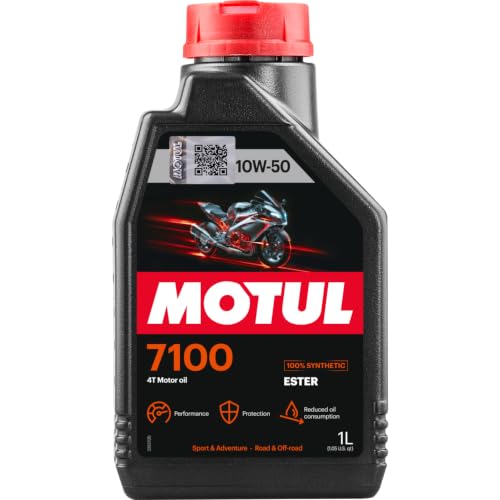
This 7100 keeps the same product family but changes the grade to 10W-50 and the container to 1 liter. Its maker identifies API SP certification and JASO MA2 wet-clutch compatibility, and the product is recommended for engines requiring SAE 10W-50. The smaller bottle may suit a top-up or a motorcycle with a modest oil capacity. Motul also says it includes an integrated pour spout. It is not a substitute for the requested 10W-40 when your manual specifies that grade; use it only where 10W-50 is an approved choice.
Bottom line: Choose this only for an application that specifies or permits SAE 10W-50.
Motul 7100 4T 10W-60

The 10W-60 version is the higher-viscosity 7100 option here, packaged in a 4-liter container. Its maker identifies a 100% synthetic ester formulation, JASO MA2 and API SP, with wet-clutch compatibility for four-stroke engines. The product is positioned for high-performance applications, including the named Indian, Moto Guzzi and MV Agusta makes. Motul says the ester formulation is designed to maintain a protective film under demanding operation. This grade is a poor match for a motorcycle that requires 10W-40; select it only if the manual permits 10W-60.
Bottom line: Choose this for a motorcycle whose approved viscosity range includes 10W-60.
How to choose motorcycle oil by viscosity
Start with the viscosity grade in your motorcycle manual; the number after the W and the number after the hyphen describe different temperature-related viscosity tests. SAE 10W-40, 10W-50 and 10W-60 are not interchangeable just because they share a 10W rating. SAE J300 defines the grades; SAE 40 has a kinematic viscosity range of 12.5–16.3 mm²/s at 100°C, while SAE 50 and SAE 60 have higher ranges. A measurable rule is simple: if the manual specifies only 10W-40, choose a 10W-40 oil rather than moving to a thicker grade. Ambient temperature and engine design can affect the approved range, so use the manual’s chart where it gives one.
What 10W-40, 10W-50 and 10W-60 change
The hot-grade number is the main difference among these choices: higher numbers correspond to higher viscosity at operating-temperature testing. The following comparison can narrow the options, but the motorcycle maker’s approved viscosity range remains the deciding rule.
| Grade | Relative hot viscosity | Choose when |
|---|---|---|
| 10W-40 | Lower of these three | Manual permits or calls for 10W-40 |
| 10W-50 | Higher than 10W-40 | Manual permits or calls for 10W-50 |
| 10W-60 | Higher than 10W-50 | Manual permits or calls for 10W-60 |
A higher grade is not automatically better protection: an unapproved viscosity can affect oil flow and engine operation. Do not choose a grade solely because riding is aggressive or the climate is hot.
Why wet-clutch oil needs the right specification
Wet clutches run in oil, so their friction behavior matters as well as engine lubrication. JASO T 903 classifies four-stroke motorcycle oils, and MA2 is a friction category associated with wet-clutch applications; check the manual for the required JASO category rather than relying only on a “motorcycle oil” label. Automotive oils can include friction modifiers that may cause clutch slip in some wet-clutch motorcycles, so do not assume a car oil is suitable. If your motorcycle has a dry clutch, the wet-clutch requirement may not apply, but the correct viscosity and other maker-required specifications still do. Match both the grade and approval, not just one.
Changing and handling motorcycle oil safely
Oil-change intervals are model-specific: motorcycles commonly use a mileage interval and sometimes a time limit, so use the owner’s manual rather than applying one universal schedule. Check the required fill quantity and level procedure there too; some engines require checking warm, while others specify a different sequence. Keep oil off tires and brakes, since contamination can compromise traction and braking. Used motor oil should not go into drains or onto soil; take it to a local used-oil collection or recycling program. Store fresh oil sealed and away from children and pets, and wipe spills promptly to reduce slip hazards.
Frequently Asked Questions
Can I use 10W-50 instead of 10W-40?
Use 10W-50 only if your motorcycle manual approves that grade. SAE 50 is more viscous at the hot-grade test than SAE 40, so the two are not automatic substitutes.
What does JASO MA2 mean for a motorcycle?
JASO MA2 identifies a friction category for four-stroke motorcycle oil used with compatible wet clutches. Check your manual for the required JASO category, since the right viscosity alone does not confirm clutch suitability.
Does a motorcycle with a dry clutch need MA2 oil?
A dry clutch does not run in engine oil, so the wet-clutch friction requirement may not apply. The engine’s viscosity and other oil specifications still need to match the manual.
How often should motorcycle oil be changed?
Use the model-specific mileage and time interval in the owner’s manual; there is no single interval for every motorcycle. Severe use or dusty conditions can make the manufacturer’s guidance especially important.
Can I mix 10W-40 and 10W-50 motorcycle oils?
Avoid mixing grades as a routine way to create a new viscosity. If oil must be added in an urgent situation, use the manual’s approved type and arrange a proper level and oil change as needed.