
Multi Outlet Wall Plug: 5 Extenders Compared

For a multi outlet wall plug with the most AC outlets and the highest surge rating, Rotating 6-Outlet Extender combines six outlets with 1,800 joules of surge protection. Choose a secured-to-wall style instead if you want a screw to help hold the extender in place while unplugging devices.
These extenders add outlets and USB charging ports directly at a receptacle; check your receptacle type before choosing a screw-secured model, since those models are specified for duplex outlets.
We earn a commission if you buy through links on this page. As an Amazon Associate I earn from qualifying purchases. Products are compared on manufacturer specifications, not hands-on testing.
- Best overall: Rotating 6-Outlet Extender – Six AC outlets, four USB ports and 1,800 joules of surge protection.
- Best for wall securing: QINLIANF 5-Outlet Extender – A center screw secures it to duplex outlets, with five AC outlets and 1,680 joules.
- Best for six outlets and securing: Teiobar 6-Outlet Extender – Six AC outlets, four USB ports and a screw-mount design for duplex receptacles.
| Product | Best for | AC outlets | USB ports | Shop |
|---|---|---|---|---|
| Rotating 6-Outlet Extender | Rotating wall plug | 6 | 4 (2 USB-C) | Check Price on Amazon |
| QINLIANF 5-Outlet Extender | Duplex wall securing | 5 | 4 | Check Price on Amazon |
| Teiobar 6-Outlet Extender | Secured six outlets | 6 | 4 (2 USB-C) | Check Price on Amazon |
| NUOZHI 6-Outlet Extender | Secured six outlets | 6 | 4 (2 USB-C) | Check Price on Amazon |
| 5-Outlet 3-Sided USB Extender | USB-A and USB-C | 5 | 4 (3 USB-A, 1 USB-C) | Check Price on Amazon |
Multi Outlet Wall Plug Extenders Compared
Compare outlet count, charging ports and mounting style to find the extender that fits your receptacle and devices.
Rotating 6-Outlet Extender

Unlike the screw-secured extenders, this model has a rotating plug that turns 90 degrees left or right, giving more flexibility at a horizontal or vertical receptacle. Its three-sided layout provides six AC outlets with space between them, plus four USB ports, including two USB-C ports. The maker specifies a 15A, 125V, 1,875W AC rating and 5V/3.1A total USB output.
Choose it when plug orientation and two USB-C ports matter. Its plug does not have the center screw used to secure the other wall-mounted models.
Bottom line: Pick this if you want a rotating plug and two USB-C ports.
QINLIANF 5-Outlet Extender
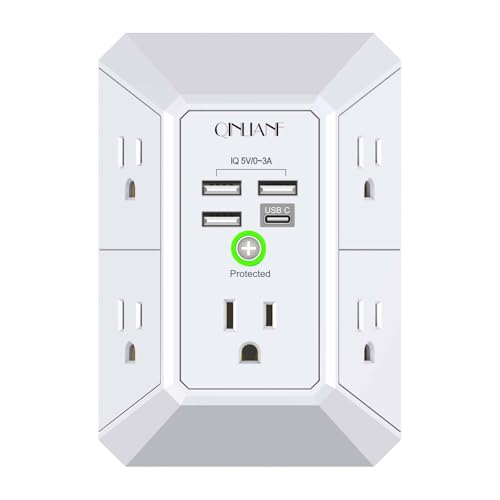
This is the only five-outlet option here, and its center screw is designed to help keep the extender attached while devices are unplugged. The three-sided arrangement includes four USB ports and a 1,680-joule surge rating; the manufacturer gives 2.1 inches of spacing between AC outlets.
The screw-secure design is intended for a standard duplex receptacle and cannot be secured to GFCI outlets, according to the specifications. Choose it for a duplex outlet when five AC sockets are sufficient; buyers needing six AC sockets should consider another option.
Bottom line: Choose it for a duplex outlet when a securing screw is important.
Teiobar 6-Outlet Extender

Among the screw-secured six-outlet options, this model is the one with a 900-joule surge rating. It has four USB ports, including two USB-C ports, and the manufacturer specifies 2.2 inches between its AC outlets. A center screw is intended to secure it to a duplex receptacle.
That mounting approach can help keep the extender in place when removing plugs, but the specifications say it cannot be secured to GFCI receptacles. Its surge rating is lower than the other secured six-outlet choices, so compare that figure if surge protection is a priority.
Bottom line: Pick it for six outlets, two USB-C ports and duplex-receptacle securing.
NUOZHI 6-Outlet Extender

NUOZHI provides a screw-secured, three-sided layout with six AC outlets and four USB ports, including two USB-C ports. Its product name gives a 1,680-joule figure, while its maker specifies a built-in 900-joule surge protector; verify which rating applies before choosing it.
The outlet spacing is specified as 2.2 inches, and the screw-secure design is meant for duplex receptacles rather than GFCI outlets. This can suit someone seeking a secured six-outlet extender, but the conflicting surge figures make it a less clear choice when surge rating is decisive.
Bottom line: Consider it if the six-outlet secured format fits; confirm the surge rating first.
5-Outlet 3-Sided USB Extender

This five-outlet extender is the only one here whose USB port split is given as three USB-A ports and one USB-C port, with separate maximum outputs of 2.4A for each USB-A port and 3A for USB-C. It converts a duplex wall receptacle to five AC outlets and includes a 1,680-joule surge rating.
The specifications describe a wall-mountable design but do not establish a screw-secure fit for a specific receptacle type. Choose it when the three-to-one USB-A/USB-C mix is useful; buyers who need two USB-C ports should select a different model.
Bottom line: Choose it when three USB-A ports and one USB-C port suit your charging mix.
How to choose a multi outlet wall plug
Start with outlet count, receptacle fit and the devices you need to power at once. A three-sided extender can spread plugs across the face and sides rather than placing every socket in one row; spacing matters when bulky adapters block neighboring outlets. Compare the AC outlet count separately from USB port count, since USB charging ports do not replace grounded AC sockets. Surge ratings here run from 900 to 1,800 joules, but a higher number alone does not tell you how much protection a particular device needs. For a screw-secured design, choose it only when the receptacle is compatible; the secured products specify duplex outlets and exclude GFCI receptacles.
Wall plug fit and receptacle compatibility
A screw-secured extender is designed to fasten through the center screw of a duplex receptacle, so receptacle layout determines whether that mounting feature can be used. The specifications explicitly exclude GFCI outlets for the secured models; verify the outlet type before selecting one of those. A rotating plug addresses a different fit issue: orientation, turning up to 90 degrees left or right for horizontal or vertical sockets. Check clearance around nearby furniture and wall plates, and avoid forcing a plug if the extender blocks adjacent receptacles. Product dimensions also differ, so measure the available wall space when the extender will sit behind furniture or in a compact area.
What surge ratings and USB ports mean
Joule ratings indicate the surge energy a protector is designed to absorb; the options here range from 900 to 1,800 joules. A surge protector is not a substitute for avoiding overloaded circuits: add the wattage of connected appliances and keep within the receptacle and circuit limits. USB port counts also hide differences in port type and shared output. The products include USB-A, USB-C or mixed ports, and one model specifies a combined USB output rather than a separate output for each socket. Match the port types to the cables and devices you use, and remember that large power supplies can occupy more physical space than their plug prongs suggest.
Outlet extender types at a glance
The main tradeoff is between adjustment, securing method and outlet count. Use the table to narrow the design before comparing individual port layouts.
| Design | Useful when | Check before choosing |
|---|---|---|
| Rotating plug | Socket orientation varies | Nearby wall clearance |
| Screw-secured, 5 outlets | Five AC sockets are enough | Duplex receptacle compatibility |
| Screw-secured, 6 outlets | Six AC sockets are needed | Duplex fit and surge rating |
Do not select by socket count alone: large adapters can cover adjacent outlets, and a screw-mounted extender can be unusable at an incompatible receptacle. Surge protection also does not make a wall outlet capable of supporting more electrical load.
Frequently Asked Questions
Can I use a screw-secured extender on a GFCI outlet?
The screw-secured models here specify duplex receptacles and say they cannot be secured to GFCI outlets. Check the outlet style before choosing a model that relies on its center screw.
How much surge protection should a wall plug have?
These extenders range from 900 to 1,800 joules, with a higher rating indicating more surge-energy capacity. Compare the rating against your protection needs, and do not treat joules as permission to exceed the circuit’s wattage limit.
Do USB-C ports replace AC outlets on an extender?
No, USB-C ports charge compatible devices but do not provide a standard AC socket for a plug-in appliance. Count the AC outlets separately when planning what will be powered at once.
Will large adapters block neighboring wall plug outlets?
They can, which is why outlet spacing and a three-sided layout matter for bulky adapters. Check the spacing measurement when given and consider the physical width of your largest power supply.
Can I plug a power strip into a wall outlet extender?
Avoid daisy-chaining power strips or extenders, since stacking them can increase overload and connection risks. Add up device wattage and use a single properly rated outlet solution within the circuit limit.