
Nail Files and Emery Boards: Compare 5 Options

For a versatile home set, the 100/180-grit 12-pack in HomeyEra 100/180-Grit Files, 12 Pack has a coarse side for acrylics and a finer side for natural nails. Choose a single-grit 180 option for natural nails, or a compact board if portability matters more than a full-length file.
Emery boards are abrasive nail files used to shape free edges and smooth their edges; grit number indicates abrasive coarseness, with lower numbers generally coarser.
We earn a commission if you buy through links on this page. As an Amazon Associate I earn from qualifying purchases. Products are compared on manufacturer specifications, not hands-on testing.
- Best overall: HomeyEra 100/180-Grit Files, 12 Pack – Its two grit levels cover coarse shaping and finer work in a 12-file set.
- Best for travel: Revlon Compact Emery Boards, 24 Count – The 3-inch boards are compact enough for a purse or beauty kit.
- Best for natural nails: Canvalite 180-Grit Wooden Files, 12 Pack – Its 180-grit surface is intended for natural nails and the set has 12 files.
| Product | Best for | Grit | Length | Pack size | Shop |
|---|---|---|---|---|---|
| HomeyEra 100/180-Grit Files, 12 Pack | Mixed nail types | 100/180 | 7.1 in | 12 | Check Price on Amazon |
| Revlon Compact Emery Boards, 24 Count | Travel kits | Coarse and fine sides | 3 in | 24 | Check Price on Amazon |
| HeeYaa 100/180-Grit Files, 10 Pack | Reusable full-size set | 100/180 | 7.05 in | 10 | Check Price on Amazon |
| Canvalite 180-Grit Wooden Files, 12 Pack | Natural nail shaping | 180/180 | 7 in | 12 | Check Price on Amazon |
| Wooden Emery Boards, 100/180-Grit, 24 Pack | Wooden file supply | 100/180 | 7.1 in | 24 | Check Price on Amazon |
Nail Files and Emery Boards Compared
Choose by grit, board length and whether you need compact or full-size files.
HomeyEra 100/180-Grit Files, 12 Pack

The dual-grit layout makes this set the most adaptable choice here: the 100-grit side is intended for acrylic or thick nails, while 180 grit is for refining natural nails. Each file measures 7.1 inches long and uses sandpaper, EVA and emery-board materials; the maker says the files are washable and reusable. This set suits someone who works with more than one nail type. Its coarse side may be too aggressive for routine shaping of thin or natural nails, so reserve that side for harder material.
Bottom line: Pick this set if you need separate coarse and finer surfaces.
Revlon Compact Emery Boards, 24 Count

At 3 inches long, these are the compact option among the sets compared, and the 24-count pack is suited to keeping spares in different kits. Revlon describes the brown side as coarse for shaping and the beige side as a buffer for smoothing nail edges; no grit numbers are given, so the set is less precise for buyers selecting by grit. The flexible boards suit basic touch-ups at home or away. Their short length gives less handle area than a 7-inch file, which can matter when shaping longer nails.
Bottom line: Choose these for portable touch-ups rather than grit-specific work.
HeeYaa 100/180-Grit Files, 10 Pack
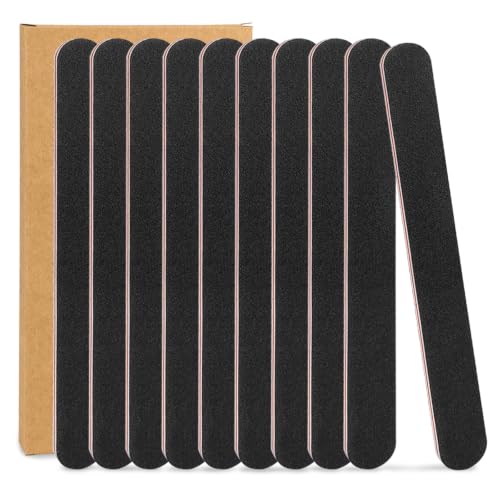
The rigid polypropylene core distinguishes this full-size set from the wooden boards: the maker says the files can be cleaned and reused and are resistant to breaking or deforming. Each file is about 7.05 inches long with 100- and 180-grit sides, making the set suitable when you want coarse and finer surfaces in a storage box. The 100-grit side is coarse for natural nails, so use a lighter touch than with the finer side. The 10-count pack is smaller than the 24-count compact set.
Bottom line: Choose this set if a reusable core and full-length shape matter.
Canvalite 180-Grit Wooden Files, 12 Pack

Unlike the dual-grit sets, both sides of these 7-inch wooden files are 180 grit, so the abrasive level stays consistent as you turn the board. The maker positions the medium-coarse grit for shaping natural nails and describes the boards as thin, at 0.07 inch thick. This set suits someone who wants one grit for everyday edge shaping rather than a coarse side for acrylics. Because it is a single-grit file, it does not offer a distinct finer surface for polishing or a coarser one for thicker enhancements.
Bottom line: Choose these for consistent 180-grit filing on natural nails.
Wooden Emery Boards, 100/180-Grit, 24 Pack

This set combines full-length 7.1-inch boards with a wooden stick core, providing a different format from the compact Revlon boards and polypropylene-core files. Each board has 100- and 180-grit sides and rounded ends. The maker says they are washable and durable; the product text is cut off before the intended use of each grit is fully explained. The dual-sided format can suit a home manicure kit, but buyers who need a particular grit for a specific nail type should verify that use before ordering.
Bottom line: Choose this if you specifically want long wooden boards in a 24-pack.
How to Choose an Emery Board Grit
Choose grit according to the material being filed: lower numbers mean a coarser abrasive, while higher numbers are finer. A 100-grit surface is coarse and commonly reserved for artificial enhancements; for natural nails, use a finer file and light pressure. A 180-grit board is a common general-purpose choice for shaping natural nail edges. Avoid using a coarse surface across the natural nail plate, where it can remove too much material. For this group, dual-sided 100/180 boards offer distinct abrasive levels, while the 180/180 set keeps the same grit on both sides. If you are unsure which side to use, start with the finer one and stop once the edge is shaped.
How to File Natural Nails
File dry nails in one direction rather than sawing back and forth; repeated back-and-forth strokes can encourage peeling or splitting. Work from the side edge toward the center, using light strokes and checking the shape as you go. A few short passes are easier to control than pressing hard with a coarse file. Round or square shapes depend on personal preference, but keep both sides balanced so the free edge does not become uneven. If a nail is thin or already peeling, avoid coarse grits and stop filing rather than trying to smooth away every irregularity. Keep the abrasive surface away from the skin around the nail.
Full-Size and Compact Emery Boards
Board length affects control and portability: a 7-inch file gives more length to hold and work with, while a 3-inch board takes less space in a small kit. The full-size options in this group range from about 7 to 7.1 inches; the compact set is 3 inches long. A larger board is not automatically better for every task, but it can be easier to grip during shaping. Use this guide to match format to where and how you file.
| Need | Suitable format | Trade-off |
|---|---|---|
| Travel touch-ups | 3-inch compact board | Less length to hold |
| Home shaping | About 7-inch board | Takes more kit space |
| Different nail materials | 100/180 dual-grit board | Coarse side requires care |
| Natural nails, one grit | 180-grit board | No distinct coarse side |
Cleaning and Replacing Nail Files
Reusable files should be cleaned between uses, and files shared between people should not be treated like personal tools; porous abrasive surfaces can retain debris. The maker describes some sets here as washable or reusable, but that does not establish that they can be disinfected for salon use. Replace a board when its abrasive surface is worn smooth, peeling or shedding, because a worn file takes more strokes and is harder to control. Wooden-core, foam-backed and plastic-core boards may respond differently to water, so do not soak a file unless its maker says that is suitable. Keep dry files stored cleanly between uses.
Frequently Asked Questions
Which emery board grit is best for natural nails?
A 180-grit file is a common choice for shaping natural nail edges. Use light, one-direction strokes, and avoid coarse 100-grit surfaces on the natural nail plate.
Should I file my nails when they are wet?
File nails when they are dry; wet nails are softer and more prone to bending or splitting during filing. Let hands dry fully before shaping.
Can I use a 100-grit file on natural nails?
A 100-grit surface is coarse and is generally better suited to artificial enhancements than natural nail edges. Choose a finer surface such as 180 grit for natural nails.
How do I stop my nails from splitting while filing?
Use a fine grit and file in one direction with light pressure rather than sawing back and forth. Stop once the edge is shaped instead of making repeated passes.
When should I replace an emery board?
Replace a file when its abrasive surface is smooth, peeling or shedding. A worn surface can require extra strokes and reduce control.