
NISPLAY Tennis Ball Machines Compared by Portability

For most players, NISPLAY L1 is the easiest NISPLAY tennis ball machine to carry between courts, weighing 13.23 pounds empty. Choose Nisplay Dual-Motor Portable Machine or Nisplay N3 Smart Portable Machine instead if you want capacity above 80 balls and a 68 mph maximum speed; Nisplay N3 Smart Portable Machine adds app control for drill adjustments.
We earn a commission if you buy through links on this page. As an Amazon Associate I earn from qualifying purchases. Products are compared on manufacturer specifications, not hands-on testing.
- Best overall: NISPLAY L1 – At 13.23 pounds empty, it is the lightest of these machines and holds up to 60 balls.
- Best for longer sessions: Nisplay Dual-Motor Portable Machine – Its capacity exceeds 80 balls and its external battery is rated for more than four hours.
- Best for app drills: Nisplay N3 Smart Portable Machine – App control adjusts speed, spin, interval and oscillation modes.
| Product | Best for | Empty weight | Ball capacity | Maximum speed | Shop |
|---|---|---|---|---|---|
| NISPLAY L1 | Lightweight carrying | 13.23 lb | Up to 60 balls | 37.3 mph | Check Price on Amazon |
| Nisplay Dual-Motor Portable Machine | Longer ball supply | 26 lb | 80+ balls | 68 mph | Check Price on Amazon |
| Nisplay N3 Smart Portable Machine | App-controlled drills | 29 lb | 80+ balls | 68 mph | Check Price on Amazon |
NISPLAY Tennis Ball Machines
Compare carrying weight, capacity and controls to match a machine to your court routine.
NISPLAY L1

At 13.23 pounds empty, the L1 is substantially lighter to carry than the two wheeled Nisplay models here. Its cylindrical backpack-style design is intended for shoulder transport, and the machine holds up to 60 tennis balls. NISPLAY says the L1 runs for 2–3 hours and delivers speeds from 6.2 to 37.3 mph, with an elevation angle of 15°–55°.
Choose it for solo practice when portability matters more than a larger ball supply or higher top speed. The 13.23-pound figure excludes balls, basket and accessories, so carrying a loaded setup adds weight.
Bottom line: Pick this for frequent carrying and practice sessions within its 60-ball capacity.
Nisplay Dual-Motor Portable Machine

The 26-pound wheeled design separates this model from the backpack-style L1: oversized wheels and a 3-foot folding handle help move it across grass, gravel and curbs. It holds more than 80 balls, uses dual motors for top- and backspin, and offers manual oscillation. NISPLAY says its external lithium battery supports more than four hours of play and its maximum ball speed is 68 mph, with elevation from 0°–50°.
This is a fit for players who prioritize longer feeding sessions and spin variety. Its 26-pound machine weight is nearly twice the L1’s empty weight, which matters when lifting it into a car.
Bottom line: Choose this for a larger ball supply, spin options and wheeled transport.
Nisplay N3 Smart Portable Machine
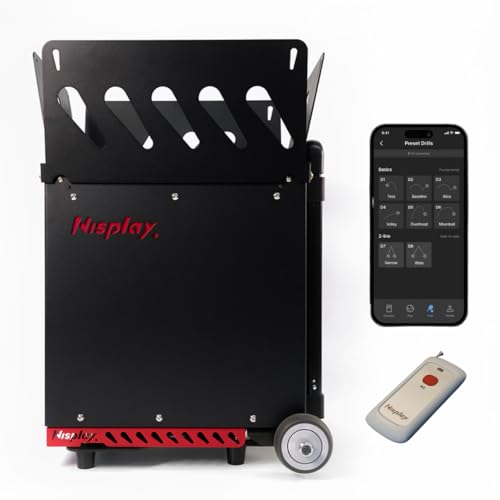
App-based drill adjustment is the N3’s defining distinction: the Nisplay app controls speed, spin, interval and oscillation modes. The machine also has built-in horizontal oscillation with narrow, wide, two-line and random modes, plus dual motors and capacity above 80 balls. NISPLAY says it reaches 68 mph and runs for more than four hours with its external lithium battery.
Choose the N3 when changing drills from a smartphone is more useful than minimizing carrying weight. At 29 pounds, it is heavier than the other two options, so frequent lifting may favor the L1 or the 26-pound model.
Bottom line: Pick this when app-adjustable drills matter more than the lightest carry weight.
How to choose a NISPLAY tennis ball machine
Choose by the tradeoff between carrying weight, ball capacity and drill control. A machine holding 60 balls needs more frequent refills than one holding over 80, while a higher maximum speed is useful only if your practice goal calls for faster feeds. Tennis balls are about 2.57–2.70 inches in diameter; use standard-size balls rather than oversized training balls unless the machine maker confirms compatibility.
| Practice priority | What to compare |
|---|---|
| Carry between courts | Empty machine weight and carrying format |
| Fewer refills | Ball capacity |
| Variable drills | Spin, oscillation and control method |
For a walk from parking to court, prioritize empty weight; for a stationary session, capacity and drill control may matter more. Include balls and accessories when estimating the weight you will actually move.
Ball speed, spin and court coverage
Match the machine’s feed range to the shots you intend to practice, not just its maximum speed. A 68 mph maximum gives more headroom than a 37.3 mph maximum, but the usable setting also depends on player level, distance from the machine and the drill. Spin changes bounce and timing: topspin generally kicks higher, while backspin tends to stay lower.
Oscillation helps vary the direction of feeds, but it is not a substitute for choosing a safe court position. Keep the machine behind the baseline and leave room to move without crossing another court’s play area. Start at a low speed and a moderate feed rate, then increase intensity only when you can return balls with control. Avoid standing in the machine’s feed path while it is running.
Battery and transport planning
Battery runtime determines how much practice can fit between charges, but actual duration can change with speed, feed interval and oscillation. A machine rated for more than four hours offers a different session profile from one rated for 2–3 hours; plan around your intended drill length rather than assuming maximum runtime at every setting.
For transport, separate empty-machine weight from loaded weight. Tennis balls add several pounds, and a basket or accessories add more; carrying a 13.23-pound empty unit fully loaded will feel different from carrying it empty. Wheeled designs can ease movement over rough approaches, while a backpack-style format favors carrying. Before choosing, measure trunk opening and storage space, and confirm the machine’s dimensions fit.
Frequently Asked Questions
How many tennis balls should a ball machine hold?
A 60-ball capacity can support a shorter drill before refilling, while capacity above 80 reduces interruptions. Each ball is roughly 2 ounces, so a full hopper adds about 7.5 pounds at 60 balls and 10 pounds at 80.
Are pressureless balls better for a tennis machine?
Pressureless balls are commonly used for machine practice because they retain bounce longer than pressurized balls. Their feel and bounce can differ from fresh match balls, so use the type you want to train with and verify the machine accepts it.
How far behind the baseline should I place a ball machine?
Start several feet behind the baseline, then adjust based on feed trajectory and court space. Keep the machine out of the player’s movement path and never stand in front of its feeding outlet while it runs.
How long should a tennis ball machine session last?
A 30- to 60-minute session is a practical starting range for focused drills, with breaks between blocks to maintain footwork and shot quality. Shorten the blocks if fatigue makes your movement or contact inconsistent.
Do tennis ball machines work with all tennis balls?
Most machines are designed around standard tennis balls about 2.57–2.70 inches in diameter. Oversized, foam or low-compression balls can feed differently, so confirm compatibility before using a nonstandard ball.