
No Drill Shotgun Scope Mounts: Fit and Features

For a compatible Mossberg with factory-drilled receiver holes, Low-Profile Mossberg Picatinny Rail is the most direct no-drill shotgun scope mount because it installs into those holes; Remington owners should choose a saddle mount that fits their receiver instead. A no-drill mount uses existing receiver ports or holes, so compatibility—not the rail alone—decides the right choice.
Choose Hammers Saddle Mount for 12/20 Gauge for listed 870, 1187 or 1100 models, and consider Hammers Skeletonized 870 Saddle Mount for a 12-gauge 870 if its skeletonized sides suit your setup.
We earn a commission if you buy through links on this page. As an Amazon Associate I earn from qualifying purchases. Products are compared on manufacturer specifications, not hands-on testing.
- Best overall: Low-Profile Mossberg Picatinny Rail – Installs into factory-drilled holes and fits several listed Mossberg series.
- Best for Remington fit: Hammers Saddle Mount for 12/20 Gauge – Its saddle design installs in existing pin ports and lists 12- and 20-gauge 870, 1187 and 1100 models.
- Best for an 870: Hammers Skeletonized 870 Saddle Mount – The 12-gauge 870 saddle mount has skeletonized side walls and a see-through tunnel under the rail.
| Product | Best for | Mounting method | Compatible models | Shop |
|---|---|---|---|---|
| Low-Profile Mossberg Picatinny Rail | Mossberg factory holes | Factory receiver holes | 500, 590, 590A1, Shockwave, 835, 930, 935 | Check Price on Amazon |
| Hammers Saddle Mount for 12/20 Gauge | Remington pin ports | Existing receiver pin ports | 12/20 gauge 870, 1187, 1100 | Check Price on Amazon |
| Hammers Skeletonized 870 Saddle Mount | 12-gauge 870 | Saddle receiver mount | 12-gauge 870 pump | Check Price on Amazon |
No Drill Shotgun Scope Mounts
Match the mount’s receiver interface and model compatibility before comparing rail layout or side-wall design.
Low-Profile Mossberg Picatinny Rail

Unlike the saddle mounts, this rail attaches to compatible Mossberg factory receiver holes. The maker says it fits the 500, 590, 590A1, 590 Shockwave, 835, 930 and 935 series, and includes set screws for installation. Its standard 21 mm Picatinny and Weaver base accepts compatible rings and optics. The low-profile construction may suit setups where a taller rail is unwanted. The fit list is specific to Mossberg models, so owners of other shotguns should choose a mount designed for their receiver rather than assume the hole pattern matches.
Bottom line: Choose this if your Mossberg model is among the fits and has factory receiver holes.
Hammers Saddle Mount for 12/20 Gauge
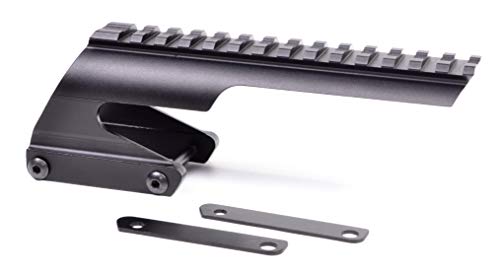
This saddle mount is the only option here explicitly listed for both 12- and 20-gauge shotguns. It straddles the receiver and installs in existing pin ports, without drilling or special tools, according to the maker. The one-piece design carries a 6-inch Picatinny rail with 14 slots, giving room to position a compatible optic. Its fit list names Remington 870, 1187 and 1100 models; it is not a universal saddle for every 12- or 20-gauge shotgun. Confirm the exact model before choosing it.
Bottom line: Pick this for a 12- or 20-gauge Remington model when you want a full-length rail.
Hammers Skeletonized 870 Saddle Mount

For a 12-gauge 870 pump, this saddle mount differs from the solid-sided option with skeletonized side walls intended to reduce weight. Its one-piece aluminum-alloy body has a Picatinny rail and a see-through tunnel underneath, which can leave the front bead visible if the shotgun has one. The maker describes installation as quick and requiring no gunsmith. The fit is limited to 12-gauge 870 pump models, so it is not the choice for a 20-gauge or another receiver pattern.
Bottom line: Choose this for a 12-gauge 870 pump if the open tunnel and slotted sides fit your priorities.
How to choose a no-drill shotgun scope mount
Choose by receiver interface first: a saddle mount uses existing receiver pin ports, while a direct rail uses factory-drilled receiver holes. These are different mounting methods, not interchangeable descriptions of a universal fit. Next, match the mount’s shotgun model and gauge; a 12-gauge 870 fit does not establish compatibility with a 20-gauge or another brand. Then compare rail length and layout against the optic’s ring spacing. For a 6-inch rail with 14 slots, the Hammers saddle offers more placement positions than a 5.5-inch rail, but rail length alone does not confirm eye relief or clearance. If the exact model or receiver pattern is uncertain, verify it before ordering.
Receiver fit and no-drill mounting styles
Receiver fit is the deciding factor for a no-drill shotgun mount: pin-port saddles and factory-hole rails attach differently. The Hammers saddle fits named Remington models by using existing pin ports; the Mossberg rail is intended for factory-drilled holes on its series. A shotgun without the correct ports or hole pattern cannot be assumed to accept either style. Use this comparison to narrow the interface, then check the exact model and gauge:
| Mount style | Existing receiver feature | Example in this group |
|---|---|---|
| Saddle | Pin ports | Remington 870, 1187, 1100 |
| Direct rail | Factory-drilled holes | Listed Mossberg series |
| Unconfirmed receiver rail | Attachment method requires verification | Mossberg 500/590/835 rail |
A matching rail standard does not establish a matching receiver mount. Confirm both before fitting an optic.
Rail length, optic position and sight clearance
Rail length affects where rings or a red dot can sit, but usable placement also depends on the optic’s eye relief and the shooter’s position. The 6-inch saddle rail has 14 slots; the Mossberg rail is 5.5 inches long, so their lengths differ by half an inch. A longer rail does not guarantee the optic will clear the receiver or provide a safe sight picture. The skeletonized 870 saddle has a tunnel beneath its rail that can preserve a view of the front bead when present. Before use, confirm the optic is secure and the sight picture is unobstructed; unload the shotgun before installing or adjusting a mount.
Installation checks before using the shotgun
A no-drill installation still needs the correct mount, sound fasteners and a secure fit. Inspect the receiver for the pin ports or factory holes required by the mount, and do not force screws into a mismatched pattern. The product features do not provide torque values, so use the mount and firearm makers’ specified fastener guidance rather than guessing. After installation, check that the mount does not shift and that the action operates normally before loading. Recheck fasteners periodically, especially after firing, because recoil can loosen poorly secured hardware. Keep the firearm pointed in a safe direction and unloaded throughout installation.
Frequently Asked Questions
Do no-drill shotgun mounts fit every shotgun?
No; a mount must match the receiver pattern and the shotgun model. Pin-port saddle mounts and factory-hole rails use different interfaces, so gauge alone is not enough to establish fit.
What is the difference between a saddle mount and a receiver rail?
A saddle mount straddles the receiver and uses existing pin ports, while a direct receiver rail fastens to factory-drilled holes. The appropriate style depends on which interface the shotgun has.
Can a shotgun scope mount hold a red dot sight?
A Picatinny rail can accept compatible red dots, but compatibility depends on the optic’s base and the mount’s rail standard. The 6-inch saddle rail, for example, provides 14 slots for positioning compatible optics.
Does a see-through shotgun rail keep the front bead visible?
A tunnel below the rail can leave a front bead visible if the shotgun has one. The sight picture still depends on the mount, optic position and the shooter’s alignment.
Should I tighten a shotgun scope mount by feel?
No; use the fastener guidance specified by the mount or firearm maker rather than guessing at torque. Keep the shotgun unloaded during installation and confirm the mount stays secure before use.