
NOCO Lithium Battery: NLP20 and Related Gear Compared

For a NOCO lithium battery comparison focused on a replacement powersports battery, NOCO NLP20 12V Group 20 is the direct match: it is a 12V, 7Ah LiFePO4 battery rated at 600A cranking power. Choose a charger, jump starter or onboard marine charger instead only if you need that separate function, not a replacement battery.
We earn a commission if you buy through links on this page. As an Amazon Associate I earn from qualifying purchases. Products are compared on manufacturer specifications, not hands-on testing.
- Best overall: NOCO NLP20 12V Group 20 – A 12V, 7Ah LiFePO4 powersports battery rated at 600A cranking power.
- Best for charging: NOCO GENIUS1 1A – A 1A smart charger supports 6V and 12V lead-acid and LiFePO4 batteries.
- Best for marine charging: NOCO GEN5X2 10A – Two independent 5A banks charge 12V batteries aboard a boat.
| Product | Best for | Type | Dimensions | Shop |
|---|---|---|---|---|
| NOCO NLP20 12V Group 20 | Powersports replacement | LiFePO4 battery | 7.83 × 7.64 × 8.15 in | Check Price on Amazon |
| NOCO GENIUS1 1A | Small-battery charging | Smart charger | 3.5 × 2.3 × 1.3 in | Check Price on Amazon |
| NOCO Boost GBX155 4250A | Emergency jump-starting | Lithium jump starter | 13.51 × 8.18 × 4.84 in | Check Price on Amazon |
| NOCO GEN5X2 10A | Onboard marine charging | Onboard charger | 9.15 × 7.2 × 5.39 in | Check Price on Amazon |
NOCO lithium battery and related products
These NOCO products serve different jobs, so match the product type to the task before comparing ratings.
NOCO NLP20 12V Group 20

Unlike the other products here, the NLP20 is a replacement powersports battery, with a 12V LiFePO4 design and 7Ah capacity. NOCO rates it at 600A cranking power and claims more than 2,000 cycles and up to 50,000 starts. Its battery management system protects against overcharge, short circuit, over-discharge and extreme temperatures, according to NOCO. The 5.05-pound battery suits buyers replacing a compatible Group 20 unit. Its dimensions are 7.83 × 7.64 × 8.15 inches, so verify fit and terminal arrangement against the vehicle’s requirements before purchase.
Bottom line: Pick this for a compatible powersports battery replacement.
NOCO GENIUS1 1A
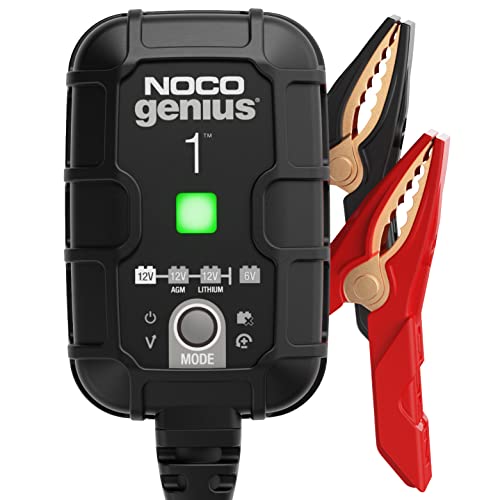
The GENIUS1 is a charger and maintainer, not a replacement battery; its 1A output makes it the small-charging option among these products. It supports 6V and 12V lead-acid types as well as LiFePO4, and its temperature sensor adjusts charging based on ambient conditions, according to NOCO. The compact 0.95-pound unit may suit maintaining a compatible powersports battery between rides. It does not provide the battery itself or the high current of a jump starter, so choose it for gradual charging and maintenance rather than starting a vehicle with a dead battery.
Bottom line: Choose this for charging or maintaining a compatible small battery.
NOCO Boost GBX155 4250A

The GBX155 is a portable jump starter rather than an installed powersports battery, and its 4,250A rating is aimed at emergency starting. NOCO says it supports gas engines up to 10.0L and diesel engines up to 8.0L, with spark-proof and reverse-polarity protection. It recharges through USB-C Power Delivery in 2.7 hours, according to NOCO, and is rated for up to 18 jump starts per charge. At 7.01 pounds, it is a separate piece of emergency equipment; it will not replace a vehicle’s battery or serve as a routine charger.
Bottom line: Pick this for portable emergency starts, not battery replacement.
NOCO GEN5X2 10A
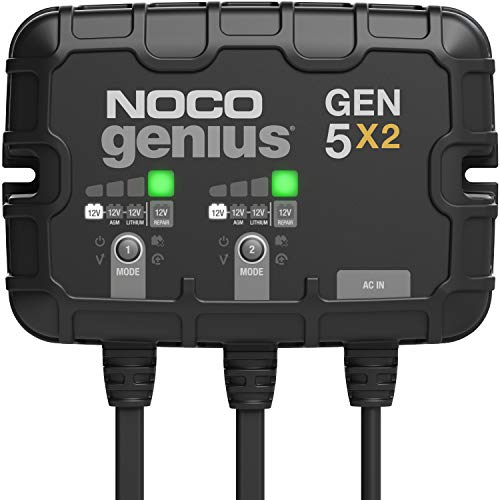
The GEN5X2 is the marine-specific option: an onboard charger with two independent banks, each delivering 5A to a 12V battery. Selectable modes include standard 12V, AGM, lithium and Repair Mode; it supports lead-acid and lithium-ion batteries. NOCO rates its enclosure IP68 waterproof, a relevant distinction for fixed marine installation. Its 4.17-pound weight and 9.15 × 7.2 × 5.39-inch dimensions suit a boat setup with space for installation, but it is not a portable battery or a substitute for the battery being charged.
Bottom line: Choose this for charging two 12V batteries in a marine setup.
How to choose NOCO lithium battery products
Start with the job: a battery stores power, a charger restores it, and a jump starter supplies temporary starting power. For a powersports replacement, check the vehicle’s battery group, voltage, terminal layout and physical clearance; matching voltage alone does not establish fit. A 12V label does not tell you whether the case or terminals will match. Select a charger by chemistry, voltage and charging current, and select a marine charger by bank count and installation conditions. Lithium charging modes are not interchangeable with lead-acid modes. For routine maintenance, use a charger that explicitly supports the battery chemistry; for emergency starting, use a jump starter with a compatible engine rating.
Battery fit and powersports dimensions
Measure the existing battery tray and compare length, width and height, including room for cables and terminal access. Group labels help identify a size family but do not guarantee identical dimensions or terminal placement across applications. Battery capacity is measured in amp-hours, while cranking amps describe starting output; a larger number in one measure does not replace the other. The NLP20’s 7Ah and 600A ratings describe distinct properties. As a practical rule, verify vehicle fit before ordering if the case is larger than the available tray clearance rather than forcing the battery in. Secure mounting matters because vibration can loosen connections or damage a battery.
Battery, charger and jump starter roles
Choose by function first; these product types are not substitutes. A battery remains installed to power and start the vehicle, a maintainer keeps a compatible battery charged between uses, and a jump starter provides temporary starting assistance. Marine onboard chargers add multiple outputs for separate batteries. A charger’s amps describe charging current, not engine-starting capability: the GENIUS1 is 1A and the GEN5X2 is 10A total across two banks. Lithium batteries require a compatible charging mode, so confirm the chemistry selection before connecting a charger. Jump starters also have engine-size limits; remain within the maker’s supported gas or diesel displacement.
| Need | Product type | What to match |
|---|---|---|
| Replace a powersports battery | LiFePO4 battery | Voltage, case and terminals |
| Maintain a battery between rides | Smart charger | Chemistry and voltage |
| Start a vehicle in an emergency | Jump starter | Engine fuel type and displacement |
| Charge batteries aboard a boat | Multi-bank onboard charger | Bank count and battery chemistry |
Charging and lithium battery safety
Use a charger mode that matches the battery chemistry and voltage; a LiFePO4 battery should not be charged using an incompatible lead-acid-only setting. Charging current affects charge time, and a 1A charger restores energy more slowly than a higher-current unit when other conditions are equal. Install batteries with the vehicle off, keep terminals from contacting metal tools, and secure the battery against movement. Lithium batteries include management electronics, but that protection does not make incorrect wiring or charging safe. For a jump start, connect clamps according to the equipment and vehicle instructions and stop if the battery is swollen, leaking or visibly damaged.
Frequently Asked Questions
Can I use a NOCO GENIUS1 with LiFePO4?
Yes, the GENIUS1 supports LiFePO4 as well as lead-acid batteries, and it is a 1A charger. Select the lithium-compatible mode for the battery being charged.
What does 7Ah mean on a powersports battery?
Seven amp-hours is a measure of stored charge capacity, not starting current. Cranking amps describe starting output, so compare both measures with the vehicle’s battery requirements.
How do I know whether a Group 20 battery will fit?
Compare the battery’s length, width, height and terminal placement with the vehicle’s tray and cable reach. Group designation alone does not guarantee that every case or terminal layout will fit.
How many banks does a marine battery charger need?
Use one bank for each battery you want to charge independently; a two-bank charger handles two batteries. Match the charger’s modes and voltage to each battery’s chemistry and system.
Can a jump starter replace a motorcycle battery?
No, a jump starter provides temporary starting power and does not replace the installed battery. Check its supported engine fuel type and displacement before relying on it for an emergency start.