
Non-Toxic Ball Pit Balls: 4 Packs Compared

For a larger play area, Amazon Basics Ball Pit Balls, 400-Pack is the strongest fit because its 400-ball pack is the largest here and its PE plastic is BPA-free, phthalate-free, lead-free and non-PVC. Choose a smaller pack if storage or pit space is limited; these balls are loose play accessories, not a standalone ball pit.
We earn a commission if you buy through links on this page. As an Amazon Associate I earn from qualifying purchases. Products are compared on manufacturer specifications, not hands-on testing.
- Best overall: Amazon Basics Ball Pit Balls, 400-Pack – Its 400-ball pack and 2.3-inch diameter suit filling a larger play area.
- Best for a 2.15-inch size: GOGOSO Soft Plastic Balls, 100-Pack – Its 100 balls have the smallest diameter in this group.
- Best for 7-color play: Hovenlay Ball Pit Balls, 100-Pack – The 100-ball pack comes in seven listed bright colors.
| Product | Best for | Ball diameter | Pack count | Material claims | Shop |
|---|---|---|---|---|---|
| Amazon Basics Ball Pit Balls, 400-Pack | Large play areas | 2.3 in | 400 | PE; BPA-, phthalate-, lead-free; non-PVC | Check Price on Amazon |
| Hovenlay Ball Pit Balls, 100-Pack | Seven-color play | 2.2 in | 100 | BPA- and phthalate-free | Check Price on Amazon |
| GOGOSO Soft Plastic Balls, 100-Pack | Smallest diameter | 2.15 in | 100 | BPA- and phthalate-free claimed | Check Price on Amazon |
| Hovenlay Ball Pit Balls, 50-Pack | Smallest pack | 2.2 in | 50 | BPA- and phthalate-free | Check Price on Amazon |
Non-Toxic Ball Pit Balls Compared
Compare ball diameter, pack size and the material claims that distinguish these play balls.
Amazon Basics Ball Pit Balls, 400-Pack
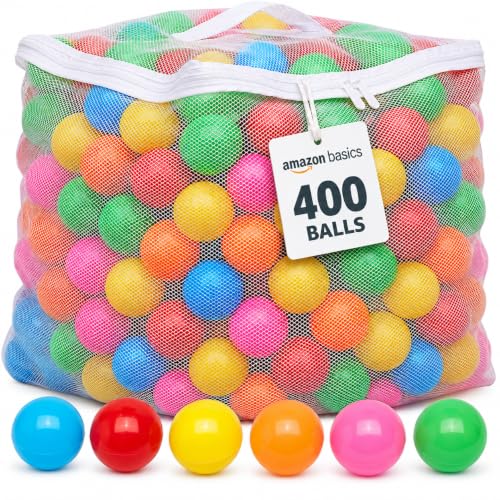
With 400 balls, this pack has the highest count here and is the clearest choice for filling a larger play area. Each ball measures 2.3 inches, and the PE plastic is BPA-free, phthalate-free, lead-free and non-PVC. A mesh storage bag with a zipper is included, and the pack weighs 4.5 pounds. The maker describes the construction as crush-proof and designs the balls for children 12 months and up. The limitation is the larger quantity: it takes more room to store and may be more than a small playpen needs.
Bottom line: Pick this pack when you need the most balls and want the material exclusions.
Hovenlay Ball Pit Balls, 100-Pack

The 100-ball pack adds seven bright colors while keeping the balls at a 2.2-inch diameter. The colors named by the maker are red, yellow, green, blue, purple, pink and orange, and a reusable storage bag comes with the set. The maker says the balls are BPA- and phthalate-free and describes them as crush-proof, withstanding over 0.141 ounces of weight. That figure is a maker claim, not a child-use load rating. With only 100 balls, this set is better suited to topping up a small pit than filling a large one.
Bottom line: Choose it for a seven-color set and a smaller 100-ball quantity.
GOGOSO Soft Plastic Balls, 100-Pack

At 2.15 inches, these balls have the smallest diameter among the compared packs, which may better suit buyers seeking a slightly smaller ball. The set contains 100 soft plastic balls in macaron colors and includes a storage bag. The maker claims the balls are non-toxic and free of BPA and phthalates, and says each can withstand over 140 pounds. That weight claim should not be treated as a safety rating or a reason to let children stand or sit on the balls. The 100-ball count is a limitation for anyone filling a larger pit.
Bottom line: Pick this set if its smaller 2.15-inch diameter is your deciding feature.
Hovenlay Ball Pit Balls, 50-Pack

This is the smallest pack here, with 50 balls at a 2.2-inch diameter, so it suits a small play area or a modest addition to balls already on hand. The set uses seven bright colors and includes a storage bag. The maker says the plastic is BPA- and phthalate-free and describes the balls as crush-proof, claiming they withstand over 0.141 ounces of weight. The low count is the main tradeoff: it will not fill a large ball pit on its own, so measure the area and plan the quantity before choosing.
Bottom line: Choose this pack for a small play space or a small top-up.
How many ball pit balls do you need
Start with the play space’s inside dimensions and the depth of coverage you want; the right count changes with both. A rough volume estimate is length × width × fill depth, then allow balls to occupy about 60% of that volume because round balls leave air gaps. For example, a 3 × 3-foot area filled 1 foot deep is 9 cubic feet, or about 1,080 ball-sized portions at 60% fill using 2.2-inch balls; this is only a planning estimate, not a precise count. For a shallow layer, buy fewer; for a deeper pit, the count rises quickly. Compare diameter as well as pack size because larger balls cover more volume per ball.
Ball diameter and child safety
These sets range from 2.15 to 2.3 inches in diameter, a narrow size band that still changes how many balls fit in a given space. Small objects can pose a choking risk to young children, and a diameter alone does not certify a toy as safe for every age. Use the maker’s age guidance, supervise play, and remove damaged or cracked balls; children under 3 should not have access to small parts that can fit through a toilet-paper tube. For this assortment, the Amazon Basics pack is designed for ages 12 months and up, while the GOGOSO set is described broadly for babies and older children without a precise minimum age. Confirm age suitability before use when a child is under 3.
What non-toxic claims mean for play balls
“Non-toxic” is a broad phrase, so compare specific material exclusions rather than treating it as a universal certification. One pack identifies PE plastic and excludes BPA, phthalates, lead and PVC; the other makers specifically claim BPA- and phthalate-free materials. Those statements are not interchangeable with a third-party safety certification. If a specific chemical restriction matters to your household, choose a pack that names it, and confirm the exact material claim before ordering. Keep balls away from heat and open flames: plastic can deform or burn, and ball pit balls are not protective equipment. Do not rely on crush-resistance claims as evidence that a ball can support a child’s body weight.
Choosing pack size and storage
Choose count by the space you intend to cover: 50 or 100 balls suit a small play zone or a top-up, while the 400-count pack is the best match in this group for a larger area. A pack count does not tell you exact fill depth because pits vary in footprint and the balls vary slightly in diameter. Storage also affects the decision: the Hovenlay sets include sturdy reusable bags, the GOGOSO set includes a storage bag, and the 400-count Amazon Basics pack includes a zippered mesh bag. Before buying, measure the inside footprint and estimate the depth; if the target is a deep fill, plan for multiple packs rather than expecting one small set to cover it.
Frequently Asked Questions
Can ball pit balls be washed safely?
Wash plastic play balls in warm water with mild soap, then rinse and air-dry fully before storage. Avoid harsh solvents or high heat, which can damage plastic.
What diameter is safest for toddlers?
No single diameter makes a ball safe without regard to a child’s age and behavior. These packs measure 2.15 to 2.3 inches, and children under 3 need close supervision around objects small enough to fit through a toilet-paper tube.
How do I estimate balls for a playpen?
Measure the inside length and width, multiply by the planned fill depth, and use that volume to estimate a quantity; balls leave air gaps, so a rough fill calculation should allow for about 60% occupancy. The exact count depends on ball diameter and the shape of the playpen.
Are BPA-free balls automatically free of phthalates?
No; BPA and phthalates are different chemical groups, so look for both claims when both matter to you. The Amazon Basics pack also names lead-free and non-PVC materials.
Can children stand on ball pit balls?
No, do not use the balls as a surface to stand or climb on. A maker’s crush-resistance or load claim is not a safety rating for supporting a child, and loose balls can shift underfoot.