
Non-Toxic Fabric Paint: 4 Sets Compared by Volume

For non-toxic fabric paint with the most paint and 18 colors, choose Shuttle Art Fabric Paint, 18 Colors; its 36 fluid ounces suit larger or repeated projects. Choose a smaller set if you only need a few colors or want tubes that take up less space.
Fabric paint is formulated to adhere to textiles, but wash and curing directions vary by formula. The non-toxic wording appears in the product names; it does not mean paint is edible or intended for skin.
We earn a commission if you buy through links on this page. As an Amazon Associate I earn from qualifying purchases. Products are compared on manufacturer specifications, not hands-on testing.
- Best overall: Shuttle Art Fabric Paint, 18 Colors – It has 18 colors and 36 fluid ounces total, the largest volume here.
- Best for tubes: Shuttle Art Fabric Paint, 15 Tubes – The 15-tube set provides 6 fluid ounces total in a compact format.
- Best for mid-size set: Colorful Fabric Paint, 14 Colors – Fourteen colors and 14 fluid ounces provide a middle ground between the largest and smaller sets.
| Product | Best for | Total paint | Colors | Container | Shop |
|---|---|---|---|---|---|
| Shuttle Art Fabric Paint, 18 Colors | Large projects | 36 fl oz | 18 | Bottles | Check Price on Amazon |
| Shuttle Art Fabric Paint, 15 Tubes | Tube format | 6 fl oz | 15 | Tubes | Check Price on Amazon |
| Colorful Fabric Paint, 12 Colors | Small crafts | 4.8 fl oz | 12 | Containers | Check Price on Amazon |
| Colorful Fabric Paint, 14 Colors | Brush included | 14 fl oz | 14 | Containers | Check Price on Amazon |
Non-Toxic Fabric Paint Sets
Compare paint volume, color count and package format to match a set to the size and style of your project.
Shuttle Art Fabric Paint, 18 Colors

For a larger supply, this Shuttle Art set has 36 fluid ounces across 18 two-ounce bottles, plus three brushes, a palette and 18 sticker stencils. The paint is ready to use and is intended for natural and synthetic fabrics, including light and deep colors. The maker says it is permanent and washer-safe without added textile medium or heat. Its large bottles suit broad designs or repeat projects; the tradeoff is that this set takes more storage space than the smaller tube options.
Bottom line: Choose this set for larger fabric designs or a broad color selection.
Shuttle Art Fabric Paint, 15 Tubes

Unlike the larger bottle sets, this Shuttle Art option puts 6 fluid ounces into 15 small tubes, with three brushes included. Fourteen colors plus an extra white give you a separate light shade for mixing or detail work. The maker says the paint is ready to use and can be gently machine-washed after 72 hours of drying; no extra textile medium or heating is needed. The smaller tube quantity is a practical fit for compact projects, but it offers much less paint overall than the bottle sets.
Bottom line: Pick this set when compact tubes and an extra white matter more than total volume.
Colorful Fabric Paint, 12 Colors
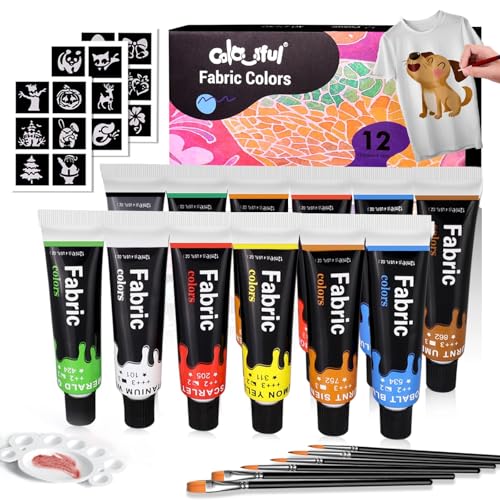
This 12-color set has the smallest total volume here at 4.8 fluid ounces, making it better suited to small designs than broad coverage. The acrylic fabric-medium colors are described as quick-drying and blendable, and the set is also intended for shoes, paper and wood. Its limited supply matters most when a project needs large filled-in areas.
Bottom line: Choose it for small crafts where a dozen colors matter more than paint volume.
Colorful Fabric Paint, 14 Colors

This Colorful set supplies 14 fluid ounces in 14 one-ounce colors and includes brushes and a palette, unlike the other Colorful option’s 12 small containers. Its acrylic fabric-medium paints are described as blendable, quick-drying and suitable for textiles, canvas, shoes, wood and paper. Fourteen ounces is less than half the volume of Shuttle Art Fabric Paint, 18 Colors, so this set is a more restrained choice for moderate projects.
Bottom line: Pick this set for a moderate amount of paint with brushes and a palette included.
How to Choose Non-Toxic Fabric Paint
Start with total paint volume and the area you plan to cover: choose a set with at least 14 fluid ounces for larger filled-in designs, while 4.8 to 6 fluid ounces better suits small motifs or accents. Color count is a separate choice; more shades can reduce the need to mix, but mixing colors can also make a smaller palette go further. Fabric paints often use acrylic binders with a textile medium to help the dried layer flex with cloth. Stretchy knits, heavily textured fabrics and slick synthetics can behave differently from woven cotton, so test a small hidden area first. For washable clothing, prioritize a set with clear drying and wash directions rather than assuming every formula cures the same way.
What Non-Toxic Means for Fabric Paint
A non-toxic label does not make craft paint edible, suitable for face painting or safe to leave within a young child’s reach. Keep paint away from eyes and mouths, wash hands after use, and supervise children; follow the product’s age guidance where provided. “Non-toxic” also does not mean that a finished painted garment can go straight into a wash: paint must dry and cure according to its formula’s directions. Keep painted fabric away from food-contact surfaces unless the paint is specifically intended for that use. If a project is for a child’s clothing, paint a small area first and ensure the dried design does not make the fabric uncomfortably stiff.
Fabric Paint Formats and Project Size
Bottles offer more volume per container, while tubes dispense smaller amounts and can be convenient for detail work. A useful volume rule is to favor 14 fluid ounces or more for larger designs and reserve 4.8 to 6 fluid ounces for small motifs or limited-color projects. The sets below also differ in accessories, so check whether brushes or a palette are included if you do not already have them. Paint coverage varies with fabric texture, color, application thickness and whether you add coats; the volume alone cannot predict the exact area covered.
| Project need | Useful amount | What to prioritize |
|---|---|---|
| Small motifs or accents | 4.8–6 fl oz | Compact containers and chosen shades |
| Moderate designs | 14 fl oz | Included brushes or palette if needed |
| Large or repeated designs | 36 fl oz | More paint and a broader color range |
Washing Painted Clothes Without Guesswork
Use the paint maker’s curing time before washing; among these sets, one specifies 72 hours of drying before gentle machine washing, while the others do not provide a specific interval in the features. Do not treat “washable” as permission to wash while paint is still wet or curing. When a formula allows machine washing, turning a garment inside out and choosing a gentle, cool cycle can reduce abrasion on the painted surface. Avoid scrubbing directly over the design. For an unfamiliar fabric or a finished garment that matters, test the paint and wash routine on a hidden scrap or seam area first.
Frequently Asked Questions
Can non-toxic fabric paint be used on skin?
No; a non-toxic label does not mean craft fabric paint is designed for skin or face painting. Use only paint specifically labeled for that purpose, and keep fabric paint away from eyes and mouths.
How long should fabric paint dry before washing?
The required time depends on the formula: one set here gives a 72-hour drying period before gentle machine washing. Check the paint’s own cure directions, since a generic drying time may not apply to every fabric paint.
Does fabric paint need heat setting?
Heat-setting requirements vary by paint formula. The maker says Shuttle Art Fabric Paint, 18 Colors and Shuttle Art Fabric Paint, 15 Tubes do not need heating, but do not transfer that direction to a different paint set.
Will fabric paint work on polyester clothing?
Some fabric paints are intended for synthetic as well as natural fibers, including Shuttle Art Fabric Paint, 18 Colors. Polyester finishes and stretch can affect adhesion, so test a small hidden area before painting the visible part.
Can I mix fabric paint colors together?
Blendable acrylic fabric paints can be mixed to create shades, but begin with a small amount so you can preserve the original colors. Test the mixed shade on a fabric scrap because cloth color and texture affect its appearance.