
NVBOTY LED Face Mask: Compare Modes and Fit

For an NVBOTY LED face mask, choose NVBOTY 4-Mode Mask, 100×4 LEDs for four named wavelengths and five timer settings, or NVBOTY 4-Mode Mask, 400 LEDs for a 400-LED design that also includes a four-color cycle. Choose a different mask if face-and-neck coverage or on-mask controls matter more than the NVBOTY name.
LED face masks use light-emitting diodes to deliver selected colors or wavelengths to the face; the products here differ in light options, coverage, and controls.
We earn a commission if you buy through links on this page. As an Amazon Associate I earn from qualifying purchases. Products are compared on manufacturer specifications, not hands-on testing.
- Best overall: NVBOTY 4-Mode Mask, 100×4 LEDs – Lists four wavelengths and five timer settings from 10 to 30 minutes.
- Best for a color-cycle mode: NVBOTY 4-Mode Mask, 400 LEDs – Adds a four-color cycle to its four-mode design.
- Best for face-and-neck coverage: 680-LED Face-and-Neck Mask – Its 680 LEDs cover the face, neck, and upper chest.
| Product | Best for | Wavelengths | LED count | Timer or coverage | Shop |
|---|---|---|---|---|---|
| NVBOTY 4-Mode Mask, 100×4 LEDs | Timer flexibility | 850, 630, 600, 460 nm | 400 | 10–30 min; remote | Check Price on Amazon |
| NVBOTY 4-Mode Mask, 400 LEDs | Cycle mode | 850, 630, 600, 460 nm | 400 | Default 10 min; remote | Check Price on Amazon |
| 680-LED Face-and-Neck Mask | Extended coverage | 850, 660 nm; 4 modes | 680 | Face, neck, upper chest | Check Price on Amazon |
| XSSNVV 272-LED Wireless Mask | On-mask controls | 850, 620, 460, 580 nm | 272 | 10 min; on-mask controls | Check Price on Amazon |
| INTEO 3-Mode 360-LED Mask | Close-fit design | 660, 850, 455–465 nm | 360 | Under 4 mm; full face | Check Price on Amazon |
NVBOTY LED Face Masks and Alternatives
Compare the named NVBOTY masks first, then consider alternatives when coverage or controls are the priority.
NVBOTY 4-Mode Mask, 100×4 LEDs
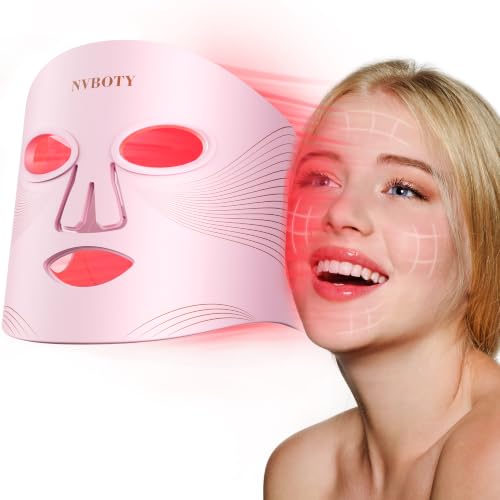
NVBOTY 4-Mode Mask, 100×4 LEDs stands out for its five timer choices, spanning 10 to 30 minutes, alongside four named wavelengths: 850 nm infrared, 630 nm red, 600 nm amber, and 460 nm blue. Its 100×4 LED arrangement is presented as 400 LEDs, and its 2000 mAh rechargeable remote allows cordless control. The combination suits someone who wants to vary session length and select among several light modes at home or while traveling. The limitation is that its modes do not include a color-cycle option, unlike NVBOTY 4-Mode Mask, 400 LEDs.
Bottom line: Choose this if timer choice and four individually named wavelengths are your priorities.
NVBOTY 4-Mode Mask, 400 LEDs

NVBOTY 4-Mode Mask, 400 LEDs differs from NVBOTY 4-Mode Mask, 100×4 LEDs by explicitly including a four-color cycle mode in addition to infrared/red, orange, and blue modes. It has 400 LEDs and a rechargeable 2000 mAh remote with a timer; the maker identifies a default 10-minute setting. That cycle option may suit buyers who prefer a combined mode rather than selecting each color separately.
Bottom line: Choose this if a four-color cycle is the deciding feature.
680-LED Face-and-Neck Mask

680-LED Face-and-Neck Mask is the coverage-focused alternative: its design extends from the face to the neck and upper chest, rather than being described as face-only. It has 680 LEDs and identifies 660 nm red and 850 nm near-infrared light among its four modes. That makes it relevant if a larger treatment area matters more than buying the named NVBOTY brand. Its fit is partial for an NVBOTY-specific search, and the maker names only two of the four wavelengths, so compare it on coverage rather than assuming all modes match NVBOTY’s options.
Bottom line: Pick this if you specifically want face, neck, and upper-chest coverage.
XSSNVV 272-LED Wireless Mask

XSSNVV 272-LED Wireless Mask replaces a separate remote with on-mask controls and specifies a 10-minute session, distinguishing it from the two NVBOTY masks with rechargeable remotes. Its four modes include 620 nm red plus 850 nm near-infrared, 460 nm blue, and 580 nm amber. A buyer who wants a direct control on the mask may favor that setup. Its LED count is 272, below the 400 LEDs named for either NVBOTY option; LED count alone does not establish the light dose reaching skin.
Bottom line: Choose this if you prefer on-mask controls over a rechargeable remote.
INTEO 3-Mode 360-LED Mask

INTEO 3-Mode 360-LED Mask differs from the NVBOTY masks with a three-mode setup and a close light-to-skin distance under 4 mm. Its modes pair 660 nm red with 850 nm near-infrared, use 455–465 nm blue, or use 585–595 nm light. The mask has 360 LEDs and coverage for the forehead, nose, cheeks, chin, and jawline, suiting buyers who want those areas called out. Its three modes offer fewer choices than the four-mode NVBOTY options, and its close-fit design makes fit and comfort especially important.
Bottom line: Pick this if full-face coverage and a close-fitting design are the priority.
How to compare LED face mask light modes
Wavelength and mode names are more useful than LED count alone when comparing LED masks. Wavelength is measured in nanometers (nm); visible red, amber, and blue are distinct bands, while near-infrared at 850 nm is outside visible light. A mask may combine wavelengths in one mode or offer separate colors, so check whether a mode is a combination or a standalone setting. LED count does not tell you irradiance at the skin or dose: dose depends on irradiance and exposure time. If a maker gives irradiance in mW/cm², multiply by session seconds and divide by 1,000 to estimate J/cm². Compare that figure only when both makers give it under comparable measurement conditions.
Choose face-only or extended coverage
Coverage should match the area you intend to illuminate: a face-only mask and a face-and-neck design are not interchangeable. 680-LED Face-and-Neck Mask names the face, neck, and upper chest; INTEO 3-Mode 360-LED Mask specifies forehead, nose, cheeks, chin, and jawline. Fit affects whether light reaches the intended area, so check that the mask sits where you need it without pressure or gaps that make wearing it uncomfortable. A practical decision rule is to choose a face-and-neck model only if you want to cover areas below the jaw; otherwise, prioritize a face-only shape that fits your face. LED count does not by itself tell you how evenly a mask covers each area.
What LED counts and controls tell you
LED count is a component count, not a measure of brightness, irradiance, or treatment dose. Compare it alongside wavelength, coverage, session length, and any irradiance figure the maker supplies; a higher count alone is not proof of stronger light at the skin. Controls also affect routine: remote operation keeps the controls separate from the mask, while on-mask buttons avoid a separate controller. Timer options range across the products here from a 10-minute session to five settings reaching 30 minutes. Use this table to match a practical need to a design feature rather than treating LED count as a ranking.
| Need | Feature to prioritize |
|---|---|
| Choose session length | Multiple timer settings |
| Cover below the jaw | Face-and-neck coverage |
| Avoid separate controls | On-mask buttons |
| Compare light output | Irradiance and exposure time |
Use LED masks with eye and skin safety in mind
Do not stare directly into bright LEDs, and use any eye protection supplied or required by the maker, particularly for blue-light modes. People with photosensitivity, an eye condition, or medication that increases light sensitivity should ask a clinician before using a light device. Start with the device’s session duration rather than extending exposure to compensate for a lower LED count; more time is not a reliable substitute for dose data. Stop if use causes discomfort or unexpected irritation. These products’ wavelengths and timer settings do not establish suitability for every skin or eye condition.
Frequently Asked Questions
Does a higher LED count mean stronger light therapy?
No; LED count alone does not show irradiance or dose at the skin. Compare irradiance in mW/cm² and session duration when both are available.
What does 850 nm near-infrared mean on a face mask?
An 850 nm wavelength is near-infrared and is not visible as a color to the eye. A mode may pair it with visible red light, so check which wavelengths operate together.
How long should an LED face mask session last?
Use the timer duration specified for the particular device rather than extending a session based on LED count. The masks here include settings from 10 to 30 minutes, depending on model.
Can I use an LED face mask without eye protection?
Avoid looking directly into the LEDs, and use eye protection if the maker calls for it or includes it. Ask a clinician first if you have an eye condition or light sensitivity.