
Olympus Mju II Zoom 80: Models Compared by Fit

The Olympus µ mju-II Zoom 80 is the closest match for this search, with a 38–80mm lens and all-weather multi autofocus named in its model description. Choose another Zoom 80 version if you want a specific feature such as date imprinting, panorama mode, or splash resistance.
These are compact 35mm point-and-shoot cameras: they expose film automatically, while the zoom range determines how wide or tightly framed a shot can be.
We earn a commission if you buy through links on this page. As an Amazon Associate I earn from qualifying purchases. Products are compared on manufacturer specifications, not hands-on testing.
- Best overall: Olympus µ mju-II Zoom 80 – Its name matches the requested µ mju-II Zoom 80 and identifies a 38–80mm lens.
- Best for date imprinting: Olympus Stylus Epic Zoom 80 QD CG – It includes date imprinting, a self-timer, and a 38–80mm zoom.
- Best for panorama mode: Olympus Stylus Epic Zoom 80 DLX – It has a panorama switch and a 35–80mm zoom.
| Product | Best for | Lens range | Standout feature | Dimensions | Shop |
|---|---|---|---|---|---|
| Olympus µ mju-II Zoom 80 | Closest model match | 38–80mm | All-weather multi AF | — | Check Price on Amazon |
| Olympus Stylus Epic Zoom 80 QD CG | Date imprinting | 38–80mm | Date imprint, self-timer | 6.1 × 3.3 × 2.5 in. | Check Price on Amazon |
| Olympus Stylus Epic Zoom 80 DLX | Panorama switching | 35–80mm | Panorama switch, splash-proof | 4.5 × 2.3 × 1.6 in. | Check Price on Amazon |
| Olympus Stylus Epic 80 Zoom | Simple 35mm shooting | 35–80mm | Built-in flash, auto film loader | — | Check Price on Amazon |
Olympus Mju II Zoom 80 Cameras
Compare the Zoom 80 versions by focal range and the features that distinguish each model.
Olympus µ mju-II Zoom 80

The Olympus µ mju-II Zoom 80 is the direct match for the model name in this search. Its name identifies a 38–80mm lens and all-weather multi autofocus, making it a fit for someone seeking that specific camera rather than a later or differently named Zoom 80 variant. The zoom covers moderate wide-angle through short telephoto framing. The model name does not identify flash modes or film-handling features, so avoid choosing it based on those; verify a specific feature if it is essential before buying.
Bottom line: Choose this if matching the µ mju-II Zoom 80 name matters most.
Olympus Stylus Epic Zoom 80 QD CG

The Stylus Epic Zoom 80 QD CG adds date imprinting and a self-timer to the 38–80mm zoom format. It is a 35mm compact point-and-shoot with autofocus, automatic film loading, advance, and rewind, plus a multi-mode flash with red-eye reduction. Those automatic film controls suit someone who wants a straightforward camera with a timer and date marking. Its silver body measures 6.1 × 3.3 × 2.5 inches and weighs 0.75 pounds, so it is the largest of the versions here with dimensions supplied.
Bottom line: Pick this if date imprinting and a self-timer are priorities.
Olympus Stylus Epic Zoom 80 DLX

The Stylus Epic Zoom 80 DLX is distinguished by its panorama switch and splash-proof design, rather than the QD CG model’s date imprinting and self-timer. Its 35–80mm zoom spans a slightly wider starting focal length than a 38–80mm version. The camera also has multiple flash modes and a compact body measuring 4.5 × 2.3 × 1.6 inches, with a weight of about 0.6 pounds. Splash-proof does not mean waterproof; keep the camera away from submersion and heavy water exposure.
Bottom line: Choose this if the panorama switch and splash-proof body fit your needs.
Olympus Stylus Epic 80 Zoom
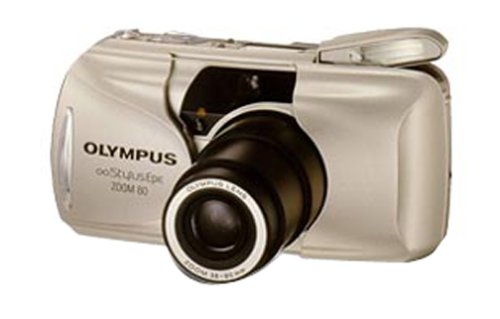
The Stylus Epic 80 Zoom pairs a 35–80mm power zoom lens with a built-in flash and automatic film loader. Its 35mm point-and-shoot format suits someone looking for basic automated film handling without a named date-imprint or panorama feature. The champagne-gold compact version is identified as renewed.
Bottom line: Pick this for a compact 35mm camera with power zoom and automatic loading.
How to choose an Olympus Mju II Zoom 80
Start with the exact model name and the features you need, because the Zoom 80 name appears across variants with different controls. A 35–80mm lens starts wider than a 38–80mm lens; at the same shooting position, the wider setting includes more of the scene. For a dated print or timed group photo, prioritize the QD CG’s date imprint and self-timer. For panorama framing, choose the DLX switch, which changes the image area rather than adding a longer lens range. If you mainly want basic automated shooting, compare the film-loading and flash features instead of assuming all Zoom 80 variants share them. These are film cameras, so also consider whether you can obtain and process 35mm film.
What the 35–80mm and 38–80mm ranges mean
A 35mm setting captures a wider view than 38mm, while both ranges reach 80mm at the telephoto end. The three-millimeter difference at the wide end is modest, but it can matter indoors or when you cannot step farther back. Neither range is an ultra-wide lens: typical wide-angle lenses for 35mm cameras often begin below 28mm, while standard lenses are near 50mm. Use the wider end for rooms, groups, and street scenes, then zoom toward 80mm for tighter framing. Zooming does not move the camera or change perspective; walking closer or farther does. Hold the camera steadily at the longer setting, since camera movement is more visible in a tightly framed image.
35mm film and exposure basics
Standard 35mm still-photo film is 35mm wide and commonly sold in 24- or 36-exposure rolls. A compact point-and-shoot advances the film between exposures and rewinds it into its canister after the roll, so confirm the rewind cycle is complete before opening the back. Film speed, marked as an ISO number such as ISO 200 or 400, affects how the film responds to light; use the camera’s supported DX coding or manual setting where available. Flash helps in dim scenes but has limited reach, often only a few yards for compact-camera flashes. For portraits, avoid placing subjects far beyond the flash’s range, and keep reflective surfaces from causing glare.
Water resistance and camera care
Splash resistance is protection from incidental splashes, not permission to submerge a camera or use it in heavy rain. Water can damage film, batteries, and electronic controls, and moisture inside the body can fog a lens. For routine care, keep dust off the lens with a clean blower or lens cloth, store the camera dry, and remove batteries if it will sit unused for a long period. A camera’s light seals and battery contacts can age, especially in older film models; inspect for sticky foam, corrosion, or a battery door that does not close firmly. Do not force a stuck film advance or rewind, since that can tear film. Before a trip, load a roll and confirm the camera advances and rewinds normally.
Frequently Asked Questions
Does a 35–80mm lens show more than a 38–80mm lens?
Yes, the 35mm end captures a somewhat wider view than 38mm from the same position. Both lenses reach 80mm for tighter framing, so the difference is mainly at the wide end.
How many pictures are on a 35mm film roll?
Common 35mm still-film rolls contain 24 or 36 exposures. The camera’s counter tracks the frames, and automatic rewind should return the exposed film to its canister at the end.
Can a splash-proof film camera go underwater?
No, splash-proof means it can handle incidental splashes, not submersion. Keep the camera dry during swimming or heavy rain because water can reach the film compartment or electronic controls.
What film speed should I use in a compact camera?
ISO 200 or 400 is a practical general-purpose choice for daylight and ordinary indoor scenes with flash. Higher ISO film is more light-sensitive, but confirm the camera supports the film’s DX speed or permits manual ISO selection.
When should a film camera use its built-in flash?
Use flash indoors or when a nearby subject is shaded, and keep the subject within a few yards because compact flashes have limited reach. In bright daylight, flash can also brighten a nearby face against a brighter background.