
Outboard Motor Kill Switches Compared by Fit

For a named Yamaha 2-stroke engine from 6 to 40 hp, UanofCn Yamaha 6E9-82575 Kill Switch is the clearest fit because its replacement reference and horsepower range are specified. Choose a different option if you need a multi-key lanyard or a switch body rather than a replacement lanyard assembly.
A kill switch stops the engine when its safety tether is pulled, helping cut ignition if the operator is separated from the controls.
We earn a commission if you buy through links on this page. As an Amazon Associate I earn from qualifying purchases. Products are compared on manufacturer specifications, not hands-on testing.
- Best overall: UanofCn Yamaha 6E9-82575 Kill Switch – Matches a specified Yamaha replacement reference and 6–40 hp 2-stroke range.
- Best for stretch reach: Cunyuer 2-Pin Kill Switch with Tether – Its lanyard stretches to 50 inches and includes a 2-pin female plug.
- Best for multiple switch keys: TXRXIZ 7-Key Safety Lanyard – Includes seven keys intended to fit various kill switches.
| Product | Best for | Connection or reference | Engine fit | Shop |
|---|---|---|---|---|
| UanofCn Yamaha 6E9-82575 Kill Switch | Yamaha replacement | 6E9-82575 references | Yamaha 2-stroke, 6–40 hp | Check Price on Amazon |
| Cunyuer 2-Pin Kill Switch with Tether | Long tether reach | 2-pin female plug | Most outboards | Check Price on Amazon |
| TXRXIZ 7-Key Safety Lanyard | Multiple key styles | 7 interchangeable keys | Mercury, Yamaha, Honda, Tohatsu, and others | Check Price on Amazon |
Outboard Motor Kill Switches
Match the connection and engine fit before choosing a cutoff switch or tether.
UanofCn Yamaha 6E9-82575 Kill Switch

The Yamaha-specific replacement reference sets this option apart from general-purpose tethers: it cites OEM numbers 6E9-82575-02-00, -00-00, -01-00 and -09, plus Sierra 18-65450. The maker says it fits Yamaha 2-stroke engines from 6 to 40 hp and also describes broader compatibility with brands including Honda and Tohatsu. Its materials are polyurethane, rubber, ABS and brass. This is the strongest match when the engine model falls within that range; buyers with another Yamaha generation or a different connector should verify the part reference before ordering.
Bottom line: Choose this when your Yamaha 2-stroke falls within the horsepower range and part references.
Cunyuer 2-Pin Kill Switch with Tether
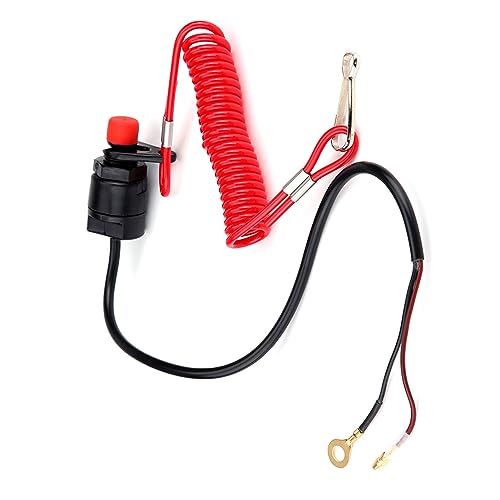
The measurable reach distinguishes this switch assembly: its tether stretch length is 50 inches, with a 19.7-inch cable and a 2-pin female plug. The maker says it suits most outboard engines, and describes a tool-free handle installation and a plastic, waterproof switch. Pulling the tether is intended to stop the running engine. This general-fit option may suit a boat owner replacing a compatible two-pin control switch, but the broad compatibility claim does not identify engine models. Match the existing plug and mounting position before choosing it.
Bottom line: Pick this for a compatible two-pin setup where a longer stretching tether is useful.
TXRXIZ 7-Key Safety Lanyard
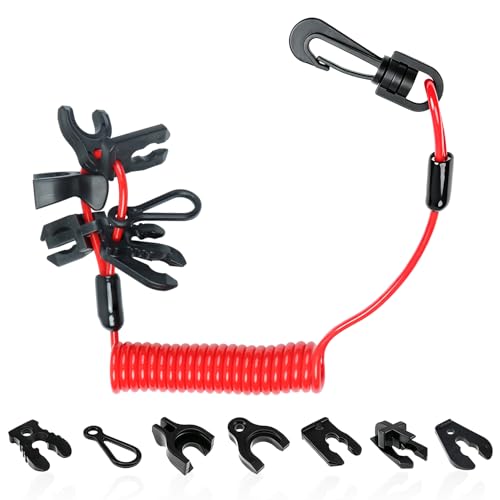
Seven included keys make this tether different from the single-configuration options: the maker says they can be installed on a range of kill switches. Named compatibility includes Mercury, Yamaha, Honda, Tohatsu, Johnson, Evinrude and Suzuki, as well as jet skis. The cord is elastic PU rope with an ABS plastic clip. This is a lanyard-focused choice if the boat already has an engine cutoff switch and the included key shapes match its switch. It is not the best fit for someone seeking a complete wired switch body, since the product is presented as a safety lanyard.
Bottom line: Choose this when you need several key styles for an existing compatible cutoff switch.
How to match a kill switch to an outboard
Match the switch connection and engine application before comparing tether length. Outboard cutoff controls commonly use either a lanyard that engages a switch on the control, or a wired switch assembly that connects into the ignition circuit; a tether alone cannot replace a failed switch body. The Yamaha replacement here identifies part references and a 6–40 hp two-stroke range, while the two-pin assembly specifies its plug style. For any replacement, compare the old switch’s plug, mounting location and key shape. If the existing control uses a 2-pin female connection, choose a matching plug; if the connector differs, do not assume “universal” means plug-compatible.
What tether length and key style matter
Choose a tether that reaches the operator’s normal control position without snagging or restricting movement. Stretch length and cable length measure different things, so the 50-inch stretch dimension should not be treated as the length of the switch cable. Key style matters just as much: an assortment of seven keys offers more chances of matching an existing switch, but does not guarantee fit for every control. Before installing, make sure the clip seats securely and the lanyard pulls the cutoff mechanism as intended. Keep the tether attached to the operator whenever the motor is running; a lanyard is an emergency cutoff, not a substitute for safe operation.
Kill switch safety and installation checks
An engine cutoff lanyard is designed to stop the motor when the operator is separated from the helm, so confirm its shutdown action before heading out. With the boat secured and the engine off, install the compatible switch or tether according to the control’s service instructions; then follow the maker’s procedure for checking that pulling the clip disables ignition. Do not run an engine in an enclosed space: exhaust contains carbon monoxide, which can be fatal. Keep the lanyard clear of steering and throttle movement, and replace a cord or clip that is cracked, stretched out or unable to hold its connection. Verify the correct engine connector before ordering a replacement assembly.
Outboard cutoff types at a glance
The right choice depends on whether the existing switch works and only the tether needs replacing. This quick guide separates a replacement lanyard from switch assemblies and model-specific parts.
| Need | Type to choose | Check first |
|---|---|---|
| Replace tether only | Safety lanyard | Key or clip match |
| Replace switch body | Wired kill switch assembly | Plug and mounting fit |
| Replace a named engine part | Model-specific assembly | Engine range and part number |
Frequently Asked Questions
How does an outboard motor kill switch work?
A kill switch interrupts ignition when its tether clip is pulled from the switch. Attach the lanyard to the operator while the engine runs so separation from the controls triggers shutdown.
How often should a boat kill switch lanyard be replaced?
Replace a lanyard when its clip, cord or attachment point is cracked, frayed or no longer holds securely. Inspect it before each outing because UV exposure, saltwater and repeated stretching can wear flexible materials.
Can a universal outboard kill switch fit every motor?
No universal label guarantees connector or key compatibility across every engine. Compare the existing plug, mounting style and key shape, and match a model-specific part reference when one is available.
Should an outboard kill switch stop the motor immediately?
The cutoff should disable ignition when the tether is pulled, though the propeller and boat may continue moving after the engine stops. Test the cutoff only with the vessel secured and follow the control maker’s procedure.
Can I use an outboard motor in a closed garage?
No; never run an outboard in an enclosed garage or other closed space because exhaust can build up carbon monoxide. Use the engine only outdoors with adequate ventilation and follow its operating instructions.