
Outdoor Pipe Cover Box Options Compared by Fit

For most buyers seeking an outdoor pipe cover box, Dekorra Model 301 BG Insulated Box is the strongest fit because it is a rigid insulated enclosure with R-13 insulation. Choose a different style if you need a specific 16-by-20-inch cover, a decorative resin rock, or an underground valve box instead.
Outdoor pipe covers range from rigid landscape enclosures to flexible insulated wraps; match the style and inside clearance to the equipment you need to cover.
We earn a commission if you buy through links on this page. As an Amazon Associate I earn from qualifying purchases. Products are compared on manufacturer specifications, not hands-on testing.
- Best overall: Dekorra Model 301 BG Insulated Box – A rigid backflow enclosure with R-13 insulation and a landscape-friendly shape.
- Best for two-way access: RICHIE 2-Way Backflow Cover – Its cover has two-way openings and measures 16 inches wide by 20 inches high.
- Best for a natural look: Orbit Granite Resin Rock Box – Rotomolded resin has a simulated granite or sandstone surface.
| Product | Best for | Cover type | Dimensions | Insulation | Shop |
|---|---|---|---|---|---|
| Dekorra Model 301 BG Insulated Box | Rigid insulated cover | Rigid enclosure | 21 in L × 8 in D top | R-13 | Check Price on Amazon |
| RICHIE 2-Way Backflow Cover | Two-way access | Insulated flexible enclosure | 16 in W × 20 in H | 5-layer; maker claims protection to 5°F | Check Price on Amazon |
| Orbit Granite Resin Rock Box | Decorative landscape cover | Rotomolded resin rock cover | 19.5 in H × 21 in W × 25 in D | — | Check Price on Amazon |
Outdoor Pipe Cover Box Options
Compare rigid boxes, decorative covers, and insulated wraps by their construction and stated dimensions.
Dekorra Model 301 BG Insulated Box

Unlike the flexible covers, this is a rigid backflow protection box with R-13 insulation and a dual-tab design for padlocking. Its natural color and smooth shape are intended to blend into landscaping, and the material is described as ultra UV-proof. It may suit buyers who want an enclosure that can be secured. Measure the backflow equipment and compare it with the enclosure dimensions before choosing; its tapered footprint differs between the top and bottom.
Bottom line: Choose this if you want a rigid, lockable enclosure with R-13 insulation.
RICHIE 2-Way Backflow Cover
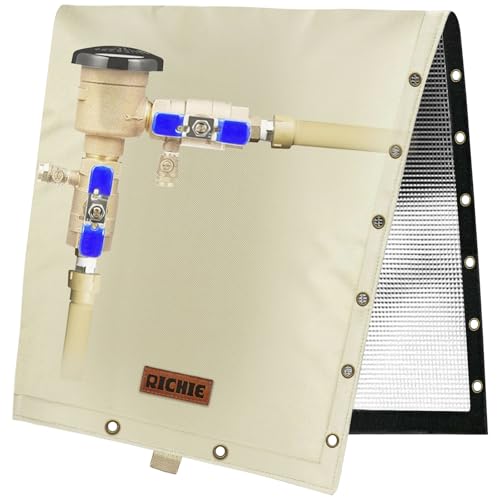
The two-way openings distinguish this insulated enclosure from the rigid boxes and single-opening wrap. Its outside dimensions are 16 inches wide by 20 inches high, and the maker says its five-layer construction provides freeze protection down to 5°F. The beige cover is intended for backflow preventers, sprinkler valves, and well-water pumps. It is only a fit for equipment that leaves room for the cover’s thickness; the maker recommends adding 2 to 3 inches to both measurements.
Bottom line: Choose this for compatible equipment when two-way access matters.
Orbit Granite Resin Rock Box

The simulated granite or sandstone finish makes this resin cover look more like a landscape feature than a utility enclosure. Its hollow interior is designed to conceal irrigation and plumbing equipment, and the rotomolded resin resists fading and warping. At 19.5 inches high, 21 inches wide, and 25 inches deep, it needs a clear footprint around the equipment. The rock-style cover is not an insulated winter enclosure, so buyers concerned about freezing should consider a different type of protection.
Bottom line: Choose this when a decorative, hollow landscape cover is the priority.
How to choose an outdoor pipe cover box
Start with the equipment and the kind of protection it needs: a rigid box shields equipment physically, while an insulated fabric cover wraps around it. Measure the widest and tallest points, including valves or fittings that project outward, then allow clearance for the enclosure wall and access openings. If the equipment is wider than a cover’s opening or its clearance, choose a larger enclosure rather than compressing the cover around the hardware.
Use a decorative resin cover when concealment is the priority, and an insulated enclosure when seasonal cold is the concern. A buried valve box serves a different purpose: it protects underground irrigation components while preserving access.
Rigid boxes, rock covers, and insulated wraps
Rigid landscape enclosures and flexible covers differ in structure, access, and intended use. A hollow resin rock cover conceals equipment without claiming insulation; an insulated fabric cover is sized to wrap around a particular device. The Dekorra enclosure is a rigid insulated box with R-13 insulation. These distinctions matter more than the word “cover” in a product name.
The table separates the main types by what they are designed to do. It is a starting point, not a substitute for measuring the equipment and its clearance.
| Type | Primary use | Fit decision |
|---|---|---|
| Rigid insulated box | Enclose backflow equipment | Compare device size with the top and bottom footprint |
| Decorative resin rock | Conceal irrigation or plumbing equipment | Confirm the hollow interior clears fittings |
| Insulated fabric cover | Wrap equipment against weather | Leave extra room; fabric may not stretch |
| Underground valve box | Protect buried irrigation fixtures and allow access | Match the box to the valve installation |
Measuring for outdoor plumbing covers
Measure the full outside width and height of the equipment, including elbows, handles, and fittings, rather than measuring only the pipe. Covers can also have different interior space from their outside measurements because walls and insulation take up room.
For a tapered enclosure, measure the footprint at both the top and bottom. The Dekorra box has different top and bottom length and depth dimensions, so a device that fits one end may still interfere at the other.
Cold-weather limits and common mistakes
Outdoor insulation slows heat loss but does not create heat; an enclosure alone cannot guarantee that water-filled plumbing will not freeze. Water freezes at 32°F, and exposure time, wind, pipe location, and trapped water affect risk.
A common mistake is treating a decorative rock cover as an insulated box, or buying a fabric cover too small to close around valves. Match the product type to the task, maintain clearance around fittings, and drain or winterize systems that should not remain water-filled in freezing conditions.
Frequently Asked Questions
How much clearance should a pipe cover have?
For the RICHIE model, its maker recommends 2 to 3 inches beyond width and height.
Can an insulated cover stop pipes from freezing?
Insulation slows heat loss but does not supply heat, so a cover cannot guarantee freeze prevention in every condition. Water freezes at 32°F; drain or winterize vulnerable plumbing when freezing weather is expected.
How do I measure a backflow cover?
Measure the widest and tallest parts of the complete device, including fittings and handles. For tapered rigid boxes, check clearance at both the top and bottom because those footprints can differ.
Is a resin rock cover insulated?
The Orbit rock cover is described as a hollow rotomolded resin cover for concealing irrigation and plumbing equipment, not as an insulated enclosure. Choose a product with insulation if cold-weather protection is required.
What is an underground valve box used for?
An underground valve box sits over irrigation fixtures and gives access for maintenance while helping shield them from dirt, traffic, and lawn-care equipment. It is not designed as a cover for exposed outdoor plumbing.