
Paint Markers for Walls: 5 Options Compared by Tip

For wall lettering and broad strokes, Coogert 8-Color Jumbo Poster Markers is the closest fit because its 15 mm tip and stated surface uses include walls. Choose a different option if you need fine details or a larger color selection rather than a wide marker.
Paint markers apply pigmented ink through a nib, making them useful for drawing or lettering; wall texture and paint finish can change how cleanly a line appears.
We earn a commission if you buy through links on this page. As an Amazon Associate I earn from qualifying purchases. Products are compared on manufacturer specifications, not hands-on testing.
- Best overall: Coogert 8-Color Jumbo Poster Markers – The 15 mm wide tip and stated wall use make it the closest match for broad wall marks.
- Best for adjustable strokes: 14-Color Jumbo Acrylic Paint Markers – Its chisel tip is described as producing lines from 2 mm to 15 mm.
- Best for fine detail: ARTISTRO 36-Color Brush and Fine Markers – It pairs a 1 mm fine tip with a flexible brush tip of 1–5 mm.
| Product | Best for | Tip width | Color count | Stated wall use | Shop |
|---|---|---|---|---|---|
| Coogert 8-Color Jumbo Poster Markers | Broad wall strokes | 15 mm | 8 | Yes | Check Price on Amazon |
| 14-Color Jumbo Acrylic Paint Markers | Variable line width | 2–15 mm | 14 | No | Check Price on Amazon |
| ARTISTRO 36-Color Brush and Fine Markers | Fine wall details | 1 mm and 1–5 mm | 36 | No | Check Price on Amazon |
| ARTISTRO 36-Color Fine and Dot Markers | Dot patterns | 1 mm and 1–5 mm | 36 | No | Check Price on Amazon |
| AYSIP 12-Color Jumbo Markers | Extra-wide marks | 15 mm | 12 | No | Check Price on Amazon |
Paint markers for walls
Compare the tip styles and stated surface uses to find a marker suited to your wall project.
Coogert 8-Color Jumbo Poster Markers
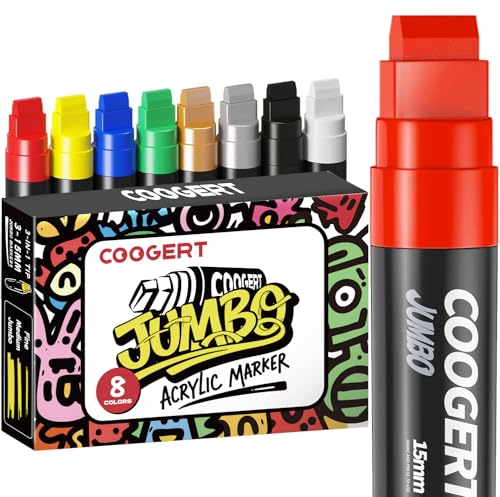
Among these options, this set is the one whose uses explicitly include walls, and its 15 mm tip is suited to broad strokes rather than tiny lettering. It contains eight colors and is described as a permanent acrylic marker for posters, banners, fabric, wood, glass, and other surfaces. That makes it a plausible choice for large lettering or simple graphics on a wall. A wide tip can be difficult to control on narrow lines, so choose a finer marker if your design includes small text or intricate outlines. Try a discreet patch first to check the appearance on your wall finish.
Bottom line: Pick this set for large wall marks where an explicitly stated wall use and a broad tip matter most.
14-Color Jumbo Acrylic Paint Markers
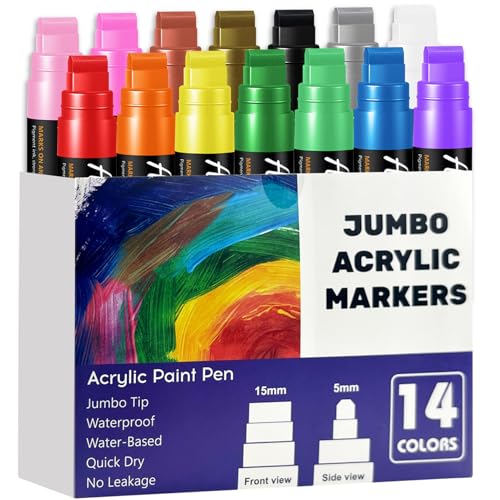
The adjustable chisel tip separates this set from the fixed wide-tip options: the maker describes line widths from 2 mm to 15 mm, so one marker can make narrower strokes as well as broad fills. The set includes 14 colors, including gold and silver, and the acrylic ink is described as quick-drying and water-resistant. Its uses include poster, rock, fabric, glass, wood, stone, and ceramic projects, but do not specifically name walls. Consider it for wall art only after checking the ink on a hidden area; choose another option if explicit wall use is important.
Bottom line: Choose this set when adjustable stroke width and 14 colors outweigh the lack of an explicit wall-use claim.
ARTISTRO 36-Color Brush and Fine Markers

Fine outlines and expressive brush strokes are the distinction here: each marker combines a 1 mm fine tip with a flexible brush tip spanning 1–5 mm. The 36-color set uses water-based acrylic paint and a cotton nib, with uses across materials including wood, rock, ceramic, glass, and metal. Those features make it more appropriate for detailed lettering or small illustrations than for filling large wall areas. The surfaces do not specifically include walls, so test a small, hidden section before committing to a design, especially if the wall is textured.
Bottom line: Pick this set for small wall illustrations or lettering where a fine tip and brush strokes are useful.
ARTISTRO 36-Color Fine and Dot Markers

Dot patterns are the defining feature of this set: its 1 mm fine tip handles details, while the 1–5 mm dot tip makes decorative accents. The water-based acrylic markers have pre-activated cotton tips, so they are ready to use without pump action; the maker recommends gently shaking before first use. The set has 36 colors, but the surface uses name fabric, rock, glass, and wood rather than walls. Choose it for small dots or patterns only after a discreet test on the intended wall; a dot nib is less versatile for broad, even coverage than a wide tip.
Bottom line: Choose this set for a wall pattern built around dots and fine marks, after checking the surface first.
AYSIP 12-Color Jumbo Markers

This 12-color set combines a 15 mm jumbo tip with a three-in-one nib described as fine, medium, and jumbo, giving it a broader range than a single-width marker. Its water-based acrylic ink is described as quick-drying and permanent, with uses including rock, fabric, glass, wood, plastic, and paper. Walls are not among those named uses, so this is a related wide-tip option rather than a wall-specific pick. The jumbo width favors large strokes and can overwhelm small lettering; test for adhesion and appearance on a hidden patch before using it on a finished wall.
Bottom line: Pick this set for large decorative marks if its 15 mm width and three-in-one nib suit the design.
How to choose paint markers for walls
Choose a marker by the narrowest line your design needs, then check whether wall use is explicitly included. Fine tips around 1 mm suit small lettering and outlines; tips around 15 mm are better for broad strokes, while a chisel tip can vary line width with its angle. Wall texture affects the result: raised texture can interrupt a narrow line, and a broad nib may bridge small dips unevenly. Water-based acrylic paint is a common marker medium, but a marker’s surface claims do not guarantee the same appearance on every wall coating. Test a small, hidden patch for color, opacity, drying, and whether the ink marks the finish as intended. Use a narrower tip for detail and a wider one for large shapes.
Wall finish and surface preparation
A clean, dry, smooth wall generally gives marker nibs a more predictable path than a dusty or textured surface. Wipe away dust and grime, let the wall dry fully, and avoid drawing over loose or peeling paint; a marker cannot make an unstable coating sound. Flat paint can absorb ink differently from a slick or glossy finish, so color and edge behavior may change between rooms. Fresh paint also needs time to cure: paint can feel dry well before it reaches full cure, so check the wall-paint manufacturer’s cure guidance before marking it. If the design must be removable, confirm removability on a hidden spot first; permanent and water-resistant marker claims suggest that cleanup may be difficult.
Marker tip widths and wall tasks
Match the nib to the mark, not just the color count. A 1 mm fine tip is suited to detail lines, a 1–5 mm brush or dot tip handles varied strokes or patterns, and a 15 mm nib covers much larger areas but is harder to steer around small lettering. Chisel tips can make a narrow line when held on an edge and a wider stroke when laid flatter. The table gives a practical starting point; wall texture and nib shape still affect the finished mark.
| Wall task | Starting tip width | Why |
|---|---|---|
| Small lettering or outlines | About 1 mm | More control in tight spaces |
| Decorative dots or variable strokes | About 1–5 mm | Useful for accents and medium marks |
| Large lettering or broad fills | About 15 mm | Covers more area per stroke |
Common mistakes when marking walls
The most common mistake is choosing a broad nib for small lettering: if the narrowest mark is under 4 mm, choose a fine-tip marker instead. Another is assuming that a marker suitable for wood or glass will behave the same on painted drywall; coatings differ in porosity, sheen, and texture. Do not start a large design before checking a sample patch, since drying can alter how opaque or dark a color appears. Permanent or water-resistant formulas can be difficult to remove, so plan the design and test cleanup before marking a visible area. Keep marker caps closed when not in use and work with ventilation, particularly during a long session indoors.
Frequently Asked Questions
Can paint markers be used on painted drywall?
Some markers can mark painted walls, but results depend on the wall coating and texture. Test the marker on a hidden patch and let it dry before starting a visible design.
What marker tip works for wall lettering?
A tip around 1 mm is a useful starting point for small lettering and outlines. For lettering larger than a few inches, a wider or chisel tip can reduce the number of strokes, though its line is harder to keep narrow.
Will acrylic paint markers come off walls?
Do not assume acrylic marker ink will wash off: permanent or water-resistant formulas may be difficult to remove. Test the intended cleanup method on an inconspicuous patch before drawing on a visible wall.
Should I mark a newly painted wall?
Wait until the wall paint has fully cured, not merely until it feels dry. Cure time varies by paint and conditions, so check the paint maker’s cure guidance and test a small patch before applying marker.
How do I keep wall marker lines even?
Use a straightedge for long lettering guides and keep the nib angle and pressure consistent. Textured walls can break up narrow lines, so test a sample and use a wider tip if the design permits.