
Palmer’s Dark Spot Corrector: 5 Formulas Compared

Palmer’s Skin Success Fade Serum is the closest match for most shoppers seeking Palmer’s dark spot corrector: it is a 1-ounce serum with niacinamide and vitamin E. Choose a cream instead if you prefer a moisturizer format, or the nighttime formula if you specifically want retinol.
Dark spot correctors are topical skincare products intended to address uneven-looking tone; daily sun protection matters because UV exposure can contribute to dark spots.
We earn a commission if you buy through links on this page. As an Amazon Associate I earn from qualifying purchases. Products are compared on manufacturer specifications, not hands-on testing.
- Best overall: Palmer’s Skin Success Fade Serum – A 1-ounce serum combines niacinamide and vitamin E.
- Best for concentrated serum: Palmer’s Extra Strength Tone Correcting Serum – The formula features 10% niacinamide and amino acid.
- Best for nighttime use: Palmer’s Skin Success Nighttime Fade Cream – The nighttime cream pairs retinol with niacinamide.
- Best for daily moisturizing: Palmer’s Cocoa Butter Formula Eventone Fade Cream – The cream is identified as a daily moisturizer with niacinamide.
| Product | Best for | Format | Size | Featured ingredients | Shop |
|---|---|---|---|---|---|
| Palmer’s Skin Success Fade Serum | Serum routine | Serum | 1 fl oz | Niacinamide, vitamin E | Check Price on Amazon |
| Palmer’s Extra Strength Tone Correcting Serum | Higher-strength serum | Serum | 1 oz | 10% niacinamide, amino acid | Check Price on Amazon |
| Palmer’s Anti Dark Spot Face Cream | Face cream format | Face cream | 2.7 oz | Vitamin E, niacinamide | Check Price on Amazon |
| Palmer’s Skin Success Nighttime Fade Cream | Night routine | Night cream | 2.7 oz | Retinol, niacinamide | Check Price on Amazon |
| Palmer’s Cocoa Butter Formula Eventone Fade Cream | Daily moisturizer | Face cream | 2.7 oz | Niacinamide, cocoa butter | Check Price on Amazon |
Palmer’s dark spot correctors
Compare the serum and cream formats by size, featured ingredients, and intended place in a skincare routine.
Palmer’s Skin Success Fade Serum

As the standard Skin Success fade serum, this option pairs niacinamide with vitamin E in a 1-ounce facial serum. Palmer’s says the formula targets dark spots, age spots, sun damage, and uneven-looking tone, and may help with suppleness and the appearance of fine lines. Its serum format suits someone who prefers a separate treatment step over a face cream. The specifications do not give an application schedule, so avoid assuming this is interchangeable with the nighttime cream or a moisturizer; choose it for the serum format and its named ingredients.
Bottom line: Choose this if you want a niacinamide-and-vitamin-E serum rather than a cream.
Palmer’s Extra Strength Tone Correcting Serum

Unlike the other serum, this Extra Strength formula specifies 10% niacinamide and amino acid, with vitamins A, B3, C, and E also named. Palmer’s says it targets uneven tone, dark spots, and post-acne marks, and helps improve firmness and the appearance of pores and fine lines. The 1-ounce size suits buyers seeking a serum with a niacinamide concentration. The ingredient list here is not complete, and the fields give no use frequency; anyone sensitive to active skincare ingredients should introduce a new face product cautiously rather than layering several new treatments at once.
Bottom line: Pick this if a 10% niacinamide concentration is your deciding factor.
Palmer’s Anti Dark Spot Face Cream
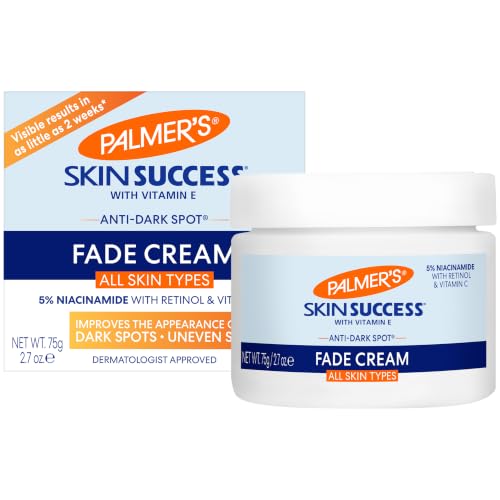
This is the standard face-cream option, unlike the separate treatment serums. Palmer’s says it targets dark spots, age spots, and uneven tone while helping improve suppleness and the appearance of fine lines. The 2.7-ounce container is larger by labeled product size than the 1-ounce serums, and the formula is identified as suitable for all skin types. Its exclusions include hydroquinone, parabens, phthalates, sulfates, MI, and dyes.
Bottom line: Choose this if you prefer a face cream and want the ingredient exclusions.
Palmer’s Skin Success Nighttime Fade Cream

Retinol makes this the nighttime-specific cream among these choices; the other cream options are presented as face or daily moisturizers. Palmer’s says the formula targets dark spots, uneven tone, and the appearance of fine lines and wrinkles. It is a 2.7-ounce cream and is described as suitable for all skin types, with no hydroquinone, parabens, phthalates, sulfates, MI, or dyes. Retinol can irritate skin, so people new to retinoids should start conservatively and avoid introducing multiple irritating actives together.
Bottom line: Pick this if you want a nighttime cream that names both retinol and niacinamide.
Palmer’s Cocoa Butter Formula Eventone Fade Cream

This cream stands apart by combining its Eventone name and cocoa butter formula with a daily-moisturizer role. At 2.7 ounces, it shares a labeled size with the other cream choices, but it is the one explicitly framed as a daily moisturizer. Its exclusions include hydroquinone, parabens, phthalates, sulfates, MI, and dyes.
Bottom line: Choose this if you want the cocoa butter formula in a product framed as a daily moisturizer.
How to choose a dark spot corrector
Start with the format and active ingredient you want, then fit it into a routine that protects skin from sun exposure. These five choices include two serums and three creams; one serum names a 10% niacinamide concentration, while the nighttime cream names retinol and niacinamide. For prevention of additional UV-related darkening, choose a broad-spectrum sunscreen labeled SPF 30 or higher for daytime use. Apply enough to cover exposed skin and reapply at least every 2 hours outdoors, and after swimming or sweating, according to FDA sunscreen guidance. A treatment product without an SPF claim cannot stand in for sunscreen. If you are already using a retinoid or exfoliating acids, add only one new active at a time to make irritation easier to spot.
Serum versus cream formats
Serums are separate treatment steps, while creams combine the product format with a face-cream or moisturizer role. In this group, the serum options are both 1 ounce; the face and nighttime creams are 2.7 ounces. Product size alone does not establish how long a package lasts, since that depends on how much and how often it is applied. Use the table to narrow the format first, then choose by the named ingredient or routine role; it does not predict which formula will work better for an individual.
| Need | Format or feature to choose | Products |
|---|---|---|
| Separate treatment step | Serum | Palmer’s Skin Success Fade Serum or Palmer’s Extra Strength Tone Correcting Serum |
| Stated niacinamide amount | 10% niacinamide | Palmer’s Extra Strength Tone Correcting Serum |
| Retinol in a nighttime formula | Night cream | Palmer’s Skin Success Nighttime Fade Cream |
| Daily moisturizer framing | Cocoa butter formula | Palmer’s Cocoa Butter Formula Eventone Fade Cream |
For a first purchase, decide whether you want a serum or cream before comparing package size; the format affects where the product fits into the routine.
Using dark spot products with sun protection
Daily broad-spectrum SPF 30 or higher is a core companion to a routine aimed at uneven tone because UV exposure can darken existing spots and contribute to new ones. Use sunscreen on exposed skin during the day, and reapply every 2 hours when outdoors, as well as after swimming or sweating. A face product described as a fade cream or serum is not automatically sunscreen; look for a labeled SPF and broad-spectrum claim before relying on any product for UV protection. Retinol-containing skincare can make irritation a concern, so avoid stacking it immediately with other new active products. If persistent redness, burning, or swelling occurs, stop using the product and seek medical advice.
Introducing a new face treatment
Introduce one new treatment at a time and patch test it before applying it broadly. Apply a small amount to a discreet area of skin, then watch for irritation over 24 to 48 hours; a patch test cannot guarantee that a product will never cause a reaction. Retinol is the ingredient-specific caution among these options, and a lower frequency at first can help reveal whether skin tolerates it. Do not use an irritating product on broken skin or near the eyes unless its label specifically directs that use. For pregnancy or nursing, ask a clinician before using retinol products; topical retinoids are generally avoided during pregnancy as a precaution.
Frequently Asked Questions
How long do dark spot correctors take to work?
Visible changes from topical tone products commonly take several weeks, and a full assessment may take 8 to 12 weeks of consistent use. Sun exposure and irritation can undermine progress, so keep daytime sun protection in the routine.
Can I use a dark spot serum with sunscreen?
Yes, a serum can be part of a daytime routine, but sunscreen is the UV-protection step. Choose broad-spectrum SPF 30 or higher and reapply every 2 hours outdoors.
Should I use retinol dark spot cream every night?
Not necessarily; people new to retinol often begin on two or three nights per week and increase only if skin tolerates it. Stop or reduce use if persistent burning or peeling develops.
Can I combine niacinamide with retinol?
Niacinamide and retinol can be used in the same routine by many people, but introducing both at once makes irritation harder to trace. Start one new active at a time, especially if your skin is sensitive.
Do dark spot creams replace sunscreen?
Use broad-spectrum SPF 30 or higher on exposed skin and reapply at least every 2 hours outdoors.