
Peanut Shaped Yoga Ball: 3 Options Compared by Fit

For a general-purpose peanut shaped yoga ball, Peanut Exercise Ball, 90 × 45 cm is the closest match because it is a 90-by-45-centimeter exercise ball with a pump and plug. Choose SURPZON Peanut Ball, 90 × 45 cm if you want a ball presented for children’s therapy; choose Gaiam Kids Peanut Ball Chair instead for a kids’ active seat rather than a workout ball.
We earn a commission if you buy through links on this page. As an Amazon Associate I earn from qualifying purchases. Products are compared on manufacturer specifications, not hands-on testing.
- Best overall: Peanut Exercise Ball, 90 × 45 cm – A 90-by-45-centimeter exercise ball includes a pump and plug.
- Best for kids’ therapy: SURPZON Peanut Ball, 90 × 45 cm – Its use includes child training and physical therapy.
- Best for classroom seating: Gaiam Kids Peanut Ball Chair – Its 39.4-inch length and kid-focused active-seat design suit flexible seating.
| Product | Best for | Dimensions | Intended use | Shop |
|---|---|---|---|---|
| Peanut Exercise Ball, 90 × 45 cm | General workouts | 35.4 × 17.7 in | Exercise and therapy | Check Price on Amazon |
| SURPZON Peanut Ball, 90 × 45 cm | Child therapy | 35.4 × 17.7 in | Therapy and training | Check Price on Amazon |
| Gaiam Kids Peanut Ball Chair | Kids’ seating | 39.4 × 19.7 in | Active seating | Check Price on Amazon |
Peanut Shaped Yoga Balls Compared
Compare each option’s size and intended role before choosing a ball for exercise, therapy or seating.
Peanut Exercise Ball, 90 × 45 cm

For a general workout ball, Peanut Exercise Ball, 90 × 45 cm pairs a 90-by-45-centimeter peanut shape with a pump and plug. Its maker says the thick PVC has an anti-burst honeycomb structure and supports up to 300 kilograms; the maker also describes it for exercise, posture training, pregnancy and labor support. Purple color and medium size identify this option. The capacity is a maker claim, not a reason to use the ball beyond its intended setting. The limitation is that the size may not suit every user or exercise, so check fit before choosing it for a specific routine.
Bottom line: Pick this if you want a general-purpose exercise ball with an included pump and plug.
SURPZON Peanut Ball, 90 × 45 cm
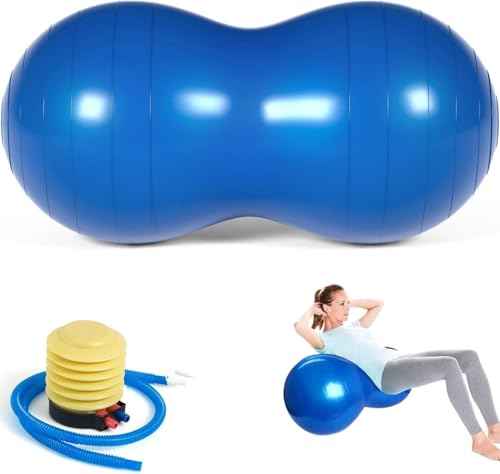
For a peanut ball explicitly presented for child training, SURPZON Peanut Ball, 90 × 45 cm has the same 90-by-45-centimeter dimensions as Peanut Exercise Ball, 90 × 45 cm and includes a pump. Its maker says the ball has an anti-burst component and describes uses including physical therapy, yoga and child training. Blue is the color. The manufacturer also promotes it for sensory activities, but that is not a substitute for guidance from a qualified clinician when selecting equipment for a child.
Bottom line: Choose this for a therapy-oriented ball when its size suits the intended user and activity.
Gaiam Kids Peanut Ball Chair

For a child’s seat rather than a standard workout ball, Gaiam Kids Peanut Ball Chair is designed for flexible classroom or home seating and is labeled for ages 4–10. Its dimensions are 39.4 inches long by 19.7 inches wide, making it longer than the 90-by-45-centimeter exercise balls. The maker says children can straddle and bounce on it, and presents it for desk or computer seating. Orange is the color. This option is not the closest match for someone seeking a conventional yoga or therapy ball, and its suitable load is not supplied.
Bottom line: Pick this when the main need is a peanut-shaped active seat for a child.
How to choose a peanut shaped yoga ball
Choose by the activity first: a workout ball, a therapy-oriented ball and an active seat are not interchangeable just because all have a peanut shape. A peanut profile has two rounded lobes joined at a narrower center; that shape constrains rolling side to side compared with a round ball. The two exercise options here measure 90 by 45 centimeters, or about 35.4 by 17.7 inches, while the seating option is 39.4 inches long. For seated exercise, use a position where the user’s feet can rest flat and knees are near hip height; if that fit is not possible, select another size rather than forcing the posture. For child therapy, let the treating professional determine whether a ball is suitable and how it should be used.
Ball dimensions and fit
Compare length and width, not just a label such as medium: a peanut ball’s two dimensions affect how much space it takes up and how the user can position across its lobes. The workout balls are 35.4 inches long and 17.7 inches wide; the kids’ seat is 39.4 inches long and 19.7 inches wide. Allow clear floor space around the ball so a user can get on and off without contacting furniture, and check doorways or storage space if the ball will be moved. A seated user should reach the floor securely; if feet dangle or knees sit well above the hips, the fit is poor for desk seating. For floor exercises, choose dimensions that allow the intended movement without the ball contacting nearby objects.
Exercise balls versus active seating
Exercise balls are generally used for floor-based movement, balance work or supported positions, while active seats are intended to provide movement during sitting. The distinction matters: a chair-style ball may be shaped to stay in place, but that does not establish that it suits yoga or therapy exercises. Conversely, an exercise ball is not automatically a suitable desk chair for a child. Use this quick guide to match the product type to the task.
| Need | Choice | Fit cue |
|---|---|---|
| General exercise | Exercise ball | Choose by body position and dimensions |
| Child therapy activity | Therapy-oriented ball | Confirm suitability with the clinician |
| Flexible classroom seating | Kids’ active seat | Feet should reach the floor |
Do not treat a product’s intended-use wording as proof that every exercise or seating setup is appropriate for every person.
Inflation, care and safe use
Set up an exercise ball on a level, uncluttered surface and keep it away from sharp edges, heat sources and objects that can puncture PVC. Inflate gradually and evenly; a ball that is overfilled can feel taut and change its shape, while an underfilled ball may not provide the intended support. The included pump with an exercise ball makes inflation easier, but the final size should be checked against the intended dimensions. Inspect the surface and plug before each session, and stop using the ball if it develops a tear, leak or deformation. Keep children supervised around bouncing or balance activity, and do not use a ball as a substitute for a stable chair when sitting still is necessary.
Frequently Asked Questions
How big is a 90 by 45 centimeter peanut ball?
A 90-by-45-centimeter ball measures about 35.4 by 17.7 inches. Compare those dimensions with the user’s body position and the open floor area before use.
How should a peanut ball fit for seated exercise?
The user should be able to place both feet flat on the floor, with knees near hip height. If the feet dangle or the knees rise well above the hips, choose a different size or setup.
Can a child use a peanut ball for therapy?
A child can use a ball only when it is appropriate for the planned activity and supervised. Ask the child’s clinician to determine size, positioning and whether the exercise is suitable.
Is a peanut ball stable enough for classroom seating?
A peanut shape can limit side-to-side rolling compared with a round ball, but it does not make a ball a fixed chair. For active seating, ensure the child’s feet reach the floor and supervise bouncing.
How do you care for an inflatable exercise ball?
Keep the PVC away from sharp objects and heat, and inspect for leaks, tears or changes in shape before each session. Inflate evenly and stop using the ball if it is damaged.