
Perfect Cast Casting Material: 5 Powders Compared

Perfect Cast casting material suits mold pours for sculptures, jewelry, and models because it is a water-mixed powder sold in a 5-pound bag. Choose a different material if you need to take a body impression or want a complete hand-casting kit rather than powder for a mold.
We earn a commission if you buy through links on this page. As an Amazon Associate I earn from qualifying purchases. Products are compared on manufacturer specifications, not hands-on testing.
- Best overall: Perfect Cast Casting Powder, 5 lb – A 5-pound water-mixed powder intended for mold casting across sculptures, jewelry, and models.
- Best for body impressions: Cavex CleverCast Alginate, 500 g – Alginate is formulated to make impressions of hands, feet, faces, and other body parts.
- Best for hand keepsakes: LTDSOAR Hand Casting Kit – The kit combines molding and casting powders with a barrel, wooden base, and decorating supplies.
| Product | Best for | Material type | Amount | Mixing guidance | Shop |
|---|---|---|---|---|---|
| Perfect Cast Casting Powder, 5 lb | General mold casting | Casting powder | 5 lb | Add water; ratio not given | Check Price on Amazon |
| Resin Casting Powder, 3,000 g | Pigmented mold casts | Gypsum casting powder | 6.61 lb | 3:1 powder to water by weight | Check Price on Amazon |
| Falling in Art Plaster of Paris, 5 lb | Quick craft casts | Plaster of Paris | 5 lb | 3 lb water to 4 lb plaster | Check Price on Amazon |
| Cavex CleverCast Alginate, 500 g | Body impressions | Alginate impression powder | 1.10 lb | 1:1 to 1:4 powder to water | Check Price on Amazon |
| LTDSOAR Hand Casting Kit | Couple hand keepsakes | Hand molding and casting kit | 4 lb total powder | Includes powders; ratios not given | Check Price on Amazon |
Perfect Cast casting material and alternatives
Match the powder or kit to whether you are pouring a mold, making an impression, or creating a hand keepsake.
Perfect Cast Casting Powder, 5 lb

Perfect Cast is the direct match for a general-purpose mold casting powder, with a 5-pound bag for projects such as sculptures, jewelry, miniatures, and ornaments. The maker says the water-based powder is non-toxic, fast-curing, and suited to fine detail; it gives no mixing ratio, so plan a small test pour before a detailed mold. The powder format suits makers who already have a mold and want casting material rather than an all-in-one keepsake kit. Its limitation is that the guidance does not quantify cure time, which matters if a project has a firm demolding schedule.
Bottom line: Choose this for varied mold pours when you want a 5-pound casting powder.
Resin Casting Powder, 3,000 g
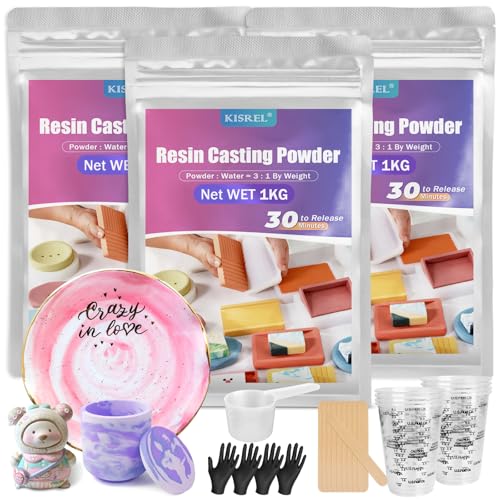
This gypsum casting powder stands apart by giving a specific starting ratio: 3 parts powder to 1 part water by weight, with pigments stirred in before pouring. It is sold in a 3,000-gram package and is intended for mold casting, so it is a related alternative to Perfect Cast rather than the same named material. The maker describes a 20-to-30-minute setting window in the product name and says the finish dries opaque white. The starting point is useful for repeatable batches, but the formula is adjustable, so account for consistency changes when adding water or colorants.
Bottom line: Pick this when a starting ratio and color additives matter.
Falling in Art Plaster of Paris, 5 lb

Falling in Art is conventional Plaster of Paris, a different mold-casting material with a 3-pound-water-to-4-pound-plaster mix. The maker says it solidifies in 3 to 4 minutes and dries hard in 30 minutes, making it suited to craft casts and projects where rapid initial setting is useful. A 5-pound package keeps the quantity familiar beside Perfect Cast, while the plaster formulation makes it a distinct choice rather than a substitute in every mold or workflow. The very short solidifying window is its key limitation: prepare the mold and tools before mixing, especially for larger pours.
Bottom line: Choose this for craft casts when you can work within a short setting window.
Cavex CleverCast Alginate, 500 g

Cavex CleverCast is an alginate impression material, not a powder for casting directly into a finished sculpture mold. Its role is to capture a hand, foot, face, or other body part; a separate casting material is needed for the final solid reproduction. The maker gives flexible powder-to-water ratios from 1:1 or 1:2 for small impressions to 1:3 or 1:4 for larger ones, and describes high elasticity and tear strength. That flexibility suits body-impression work, but the 500-gram package and impression-making purpose make it a poor choice for general craft pours.
Bottom line: Choose this when the first step is molding a body part.
LTDSOAR Hand Casting Kit

LTDSOAR differs from loose casting powders because it is a hand-keeping kit built around both molding and casting stages. It includes 2.2 pounds and 0.11 pound of casting powder, 0.88 pound and 0.11 pound of molding powder, plus a barrel, wooden base, stirring tools, paints, brushes, and sandpaper. The maker says the materials are intended for two adult hands or children and can preserve fine lines and fingerprints. This all-in-one approach suits a keepsake activity, but it is not a general-purpose bulk powder for unrelated molds.
Bottom line: Pick this for a guided hand keepsake project with supplies included.
How to choose a mold casting powder
Choose by the job the powder must do: make a solid cast from an existing mold, capture a body impression, or provide a full keepsake activity. Perfect Cast, gypsum casting powder, and Plaster of Paris are casting materials; alginate makes a flexible impression mold, so it needs a separate casting material afterward. Hand casting kits combine both stages and accessories. For repeatability, prefer a powder with a weight ratio; for example, a 3:1 powder-to-water ratio means weighing 3 ounces of powder for each 1 ounce of water. If you are new to a formula or using a detail-heavy mold, make a small trial batch before committing the full pour.
Mixing ratios and working time
Weighing powder and water is more repeatable than measuring by volume, because loose powders pack differently in a scoop. The gypsum powder here gives a 3:1 powder-to-water ratio by weight, while the Plaster of Paris mix uses 4 pounds plaster to 3 pounds water. Those are different formulas and should not be transferred from one powder to another. Plaster of Paris is said to solidify in 3 to 4 minutes, so have the mold ready and mix only a batch you can pour promptly. Perfect Cast’s guidance gives no ratio or numeric cure window; test a small amount first if precise timing is essential.
When alginate or a hand casting kit fits
Alginate is for taking a negative impression of a body part, not for the final solid object. CleverCast offers ratios from 1:1 or 1:2 powder to water for small impressions and 1:3 or 1:4 for larger impressions, so choose the range that suits the amount being mixed. Keep the person and container positioned before mixing: once the material begins to set, repositioning can distort the impression. A hand casting kit is a different route because it includes molding powder, casting powder, and finishing supplies. Choose the kit when the goal is a hand keepsake rather than a batch of versatile casting powder.
Prepare the mold before pouring
Prepare the mold, mixing vessel, and tools before combining powder and water; a fast-setting plaster can solidify within minutes. Follow the exact product ratio by weight where one is supplied, and avoid borrowing a ratio from another material. Pour steadily into the lowest part of the mold so material can rise through fine recesses rather than trapping pockets of air. For an impression involving a person, use an alginate product formulated for body impressions and keep the subject still while the material takes shape. Remove casts only when the material is ready, since early demolding can damage fine edges or fingerprints.
Frequently Asked Questions
Can Perfect Cast be used for jewelry molds?
Yes, Perfect Cast is intended for projects including jewelry molds, as well as sculptures and models. Use a mold designed for casting and test a small pour when fine detail or timing is important.
How much water does casting powder need?
The ratio depends on the specific powder, so do not apply one formula to every material. One gypsum powder here calls for 3 parts powder to 1 part water by weight, while the Plaster of Paris formula uses 4 pounds plaster to 3 pounds water.
How long does Plaster of Paris take to set?
The Plaster of Paris powder here is said to solidify in 3 to 4 minutes and dry hard in 30 minutes. Have the mold and tools ready before mixing because the initial setting window is short.
Is alginate the material used for the final hand cast?
No, alginate forms the impression mold, while a separate casting material makes the solid hand reproduction. For small impressions, the alginate ratio can be 1:1 or 1:2 powder to water; larger impressions use 1:3 or 1:4.
How much casting powder is in a five-pound bag?
A 5-pound bag contains 5 pounds of powder, regardless of the casting formula. The amount of water needed is separate and should be calculated from that specific powder’s mixing ratio.