
Physical Therapy Parallel Bars: 5 Models Compared by Fit

7-Foot Adjustable Steel Parallel Bars suits most buyers seeking physical therapy parallel bars because it offers a 7-foot walking span, adjustable height and width, and a 440.92-pound capacity. Choose another model if you need folding storage, a fixed 24-inch width, or a freestanding option that does not require drilling.
Parallel bars are paired handrails used to support standing, balance work, and gait practice; the right choice depends on the user’s fit, available floor space, and secure installation.
We earn a commission if you buy through links on this page. As an Amazon Associate I earn from qualifying purchases. Products are compared on manufacturer specifications, not hands-on testing.
- Best overall: 7-Foot Adjustable Steel Parallel Bars – Its 7-foot length, four height settings, three width settings, and stated 440.92-pound capacity cover several fitting needs.
- Best for fixed-width setup: 6-Foot Fixed-Width Freestanding Bars – It has a 24-inch fixed width and is freestanding, with optional wood plates for added stability.
- Best for storage: VivaComfort 7-Foot Folding Parallel Bars – Its folding design can be stored away, while height and width adjust for different users.
| Product | Best for | Length | Height adjustment | Width | Shop |
|---|---|---|---|---|---|
| 7-Foot Adjustable Steel Parallel Bars | Adjustable training | 7 ft | 43.31, 46.06, 48.82, 51.18 in | 27.56, 31.89, 36.61 in | Check Price on Amazon |
| 6-Foot Fixed-Width Freestanding Bars | Fixed-width setup | 6 ft | 32–39 in | 24 in fixed | Check Price on Amazon |
| VivaComfort 7-Foot Folding Parallel Bars | Folding storage | 7 ft | — | Adjustable | Check Price on Amazon |
| HUDABAIDI 6.57-Foot Suction-Cup Bars | Smooth-floor setup | 6.57 ft | 19.68–40.15 in | More than 23.62 in | Check Price on Amazon |
| Adjustable Non-Slip-Base Gait Training Bars | Non-slip-base | — | 29–41 in | Adjustable | Check Price on Amazon |
Physical therapy parallel bars compared
Compare the walking span, adjustment range, and width before matching a set to the user and the room.
7-Foot Adjustable Steel Parallel Bars
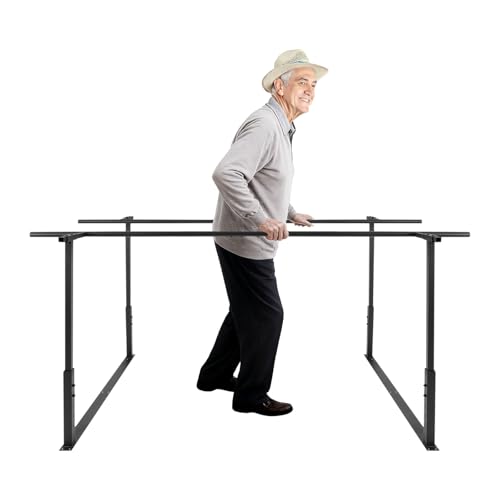
These bars stand out for offering three width positions as well as four height positions across a 7-foot walking span. The steel frame has a sprayed and baked-paint finish, and the load capacity is 440.92 pounds. The drilling installation makes this a fit for buyers prepared to secure the unit to the floor rather than move it between rooms. Its discrete settings may not match every user’s preferred handrail position, so measure the intended fit before installation.
Bottom line: Choose these if you want several rail-height and width settings and can use a drilled installation.
6-Foot Fixed-Width Freestanding Bars
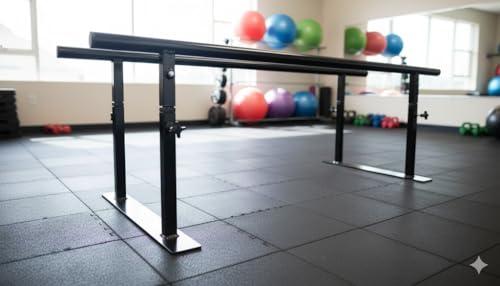
The defining tradeoff here is a fixed 24-inch width: the rails adjust from 32 to 39 inches high, but the spacing does not change. Two 6-foot, two-piece steel handrails have a 1.5-inch grip diameter, and the set is freestanding rather than requiring floor bolts. Two wood plates are included and can be mounted to the bars for added stability. Choose this configuration when its fixed spacing suits the user; buyers needing width adjustment should consider another set.
Bottom line: Pick these if a 24-inch rail spacing fits and freestanding installation matters more than width adjustment.
VivaComfort 7-Foot Folding Parallel Bars

Folding storage is the distinguishing feature of this 7-foot design, which adjusts in both height and width. It has double stiffening rails, heavy-duty steel uprights, one-piece stainless-steel handrails, and a 350-pound capacity. The 83.9-inch length provides a long path for walking practice, while the foldable construction is useful where floor space needs to be reclaimed after sessions. The specifications give no adjustment measurements, so buyers who need a precise rail height or spacing should confirm those dimensions before ordering.
Bottom line: Choose these if reclaiming floor space is important and the adjustable range can be confirmed for the user.
HUDABAIDI 6.57-Foot Suction-Cup Bars

Unlike a drilled installation, this set uses enlarged suction-cup bases and is intended for smooth surfaces. Its 6.57-foot length, five height settings spanning 19.68 to 40.15 inches, and width greater than 23.62 inches give buyers adjustable positioning. Soft armrests are also included. The suction-cup mounting limits where the bars can be used: the floor must provide the smooth surface the base is designed for. Check the floor contact and stability before any walking or balance practice.
Bottom line: Pick these for a smooth-floor location where suction-cup mounting is appropriate and the lower height range is useful.
Adjustable Non-Slip-Base Gait Training Bars

The non-slip PVC base distinguishes these bars from designs specified with drilling or suction cups. The frame is steel with an electrostatic powder-coated finish, and the height adjusts from 29 to 41 inches; width is adjustable, but no measurement is provided. The use includes standing, squatting, and gait training in home or professional rehabilitation settings. This can suit buyers prioritizing a non-slip-base, but those who must fit the rails to a particular shoulder or walking width should verify the adjustment span first.
Bottom line: Choose these if a non-slip-base and a 29-to-41-inch height range suit the setup.
How to choose physical therapy parallel bars
Start with the user’s fit, then match the bar footprint and mounting style to the room. Handrails should let the user stand upright with relaxed shoulders and slightly bent elbows; a therapist can help set an appropriate rail height for an individual. Measure the usable walking path before choosing length: a 6-foot set needs at least 72 inches of clear rail run, while a 7-foot set needs 84 inches, plus room to approach and turn. Compare rail spacing as well as length, since width-adjustable bars accommodate more positioning choices than fixed-width models. Make a shortlist by measuring floor space, user’s comfortable hand position, and space between the hands; do not select on length alone.
Installation and floor fit for parallel bars
Mounting method determines which floor and room can safely support the setup. Drilled bars require a floor and installation location suitable for anchoring; suction cups are intended for smooth surfaces and depend on sound contact across the base. Freestanding does not mean tip-proof, so verify the installed structure is stable before a person loads the rails. Keep the walking path level, dry, and clear of rugs, cords, and furniture. For a buyer’s decision rule, avoid a suction-cup model if the floor is textured, porous, or uneven; choose a mounting approach compatible with that surface instead. A physical therapist or qualified installer can help assess fit and setup when the user cannot safely test the rails independently.
Parallel bar dimensions and adjustment ranges
Rail height and width need to fit the person, not just the room. Common parallel-bar setups allow height and spacing to be adjusted, while some home units use fixed widths; compare the full adjustment range against the user’s comfortable stance before assembly. Length controls how much straight walking practice fits between turns: 6 feet is 72 inches and 7 feet is 84 inches. Use this table to screen configurations, then check the model’s actual settings and floor footprint. Leave clearance at both ends so the user can enter and exit without stepping around an obstruction. Adjustment counts alone do not guarantee a suitable fit if the available positions miss the user’s needs.
| Need | Dimension to check | Selection cue |
|---|---|---|
| Longer walking run | Rail length | Measure clear floor run; 7 ft is 84 in |
| Specific stance width | Rail spacing | Prefer adjustable width when a fixed span does not fit |
| Nonstandard hand position | Height range | Confirm the range includes the therapist-set height |
Safe use and common setup mistakes
Parallel bars support balance and gait practice, but a load capacity does not establish that a setup is correctly installed or appropriate for every user. Check that the frame is stable, all adjustment points are locked, and the walking surface is dry before each session. Do not pull or lean hard on a rail until the base or anchors are secure; an unstable rail can shift during a step. Keep a therapist or trained helper nearby when a user has a fall risk or is beginning mobility practice. Avoid assuming a larger capacity makes a loose installation safe. Stop using the bars if a rail moves, a base loses contact, or a fastener loosens, and correct the setup before resuming.
Frequently Asked Questions
How long should physical therapy parallel bars be?
A 6-foot set provides a 72-inch rail run, while a 7-foot set provides 84 inches. Measure the clear path plus approach and exit space before choosing.
How high should parallel bars be set?
Set the rails to the user’s comfortable standing hand position, generally with relaxed shoulders and slightly bent elbows. A physical therapist can help identify the position, then compare it with the bar’s adjustment range.
Can parallel bars stand on any floor?
No; mounting style matters. Suction cups need smooth, even contact, while drilled models need a floor suitable for secure anchoring; keep the walking surface dry and unobstructed.
Are freestanding parallel bars safe without anchors?
Freestanding construction does not guarantee stability under every user’s weight or movement. Check the base and all adjustment locks before use, and do not use the bars if they shift under light loading.
What should I measure before installing parallel bars?
Measure the clear straight walking path, floor footprint, and the user’s comfortable rail height and spacing. Allow extra room at both ends for safe approach and exit.