
Polar Vision Clip On Glasses: 5 Options Compared

For the named Polar Vision clip-on search, Solar Shield Polar Optics Amber Clip-On is the closest match: it is an amber polarized clip-on, while the other options focus mainly on yellow-tinted night driving. Choose a yellow-lens model instead if low-light driving is your priority, but yellow lenses can reduce the light reaching your eyes.
We earn a commission if you buy through links on this page. As an Amazon Associate I earn from qualifying purchases. Products are compared on manufacturer specifications, not hands-on testing.
- Best overall: Solar Shield Polar Optics Amber Clip-On – Amber polarized lenses and a 51 Oval 2 size make this the closest match to the search.
- Best for two locations: Each Cool Yellow Night Clip-On 2-Pack – The two-pack is designed for keeping one clip-on at home and one in the car.
- Best for flip-up use: SAMNI Flip-Up Yellow Clip-On 2-Pack – The hinged design can be raised or lowered without removing the clip-on.
| Product | Best for | Lens tint | Pack count | Fit or size | Shop |
|---|---|---|---|---|---|
| Solar Shield Polar Optics Amber Clip-On | Amber daytime tint | Amber | 1 pair | 51 Oval 2 | Check Price on Amazon |
| Each Cool Yellow Night Clip-On 2-Pack | Two-place storage | Yellow | 2 pairs | 57 × 40 mm | Check Price on Amazon |
| SAMNI Flip-Up Yellow Clip-On 2-Pack | Flip-up convenience | Yellow | 2 pairs | Adult | Check Price on Amazon |
| Flip-Up Yellow Night Vision Clip-On 2-Pack | Flip-up two-pack | Yellow | 2 pairs | Standard/compact | Check Price on Amazon |
| yayaboqu Yellow Clip-On Night Driving Glasses | Lightweight screen use | Yellow | — | One size | Check Price on Amazon |
Polar Vision Clip On Sunglasses Compared
These options range from an amber daytime-style clip-on to yellow-tinted designs aimed at night driving.
Solar Shield Polar Optics Amber Clip-On

Unlike the yellow night driving options, this model uses amber polarized lenses and comes in a 51 Oval 2 size. The maker says its lenses reduce glare, enhance contrast, and block 100% of UVA and UVB rays; the PC frame is described as impact- and scratch-resistant. Metal hinges and rubber temple tips allow adjustment, and a microfiber bag and cleaning cloth are included. The size is useful if your eyewear matches that shape, but shoppers seeking a flip-up design or a pair for low-light driving should consider another option.
Bottom line: Choose this if an amber polarized tint and 51 Oval 2 size match your needs.
Each Cool Yellow Night Clip-On 2-Pack
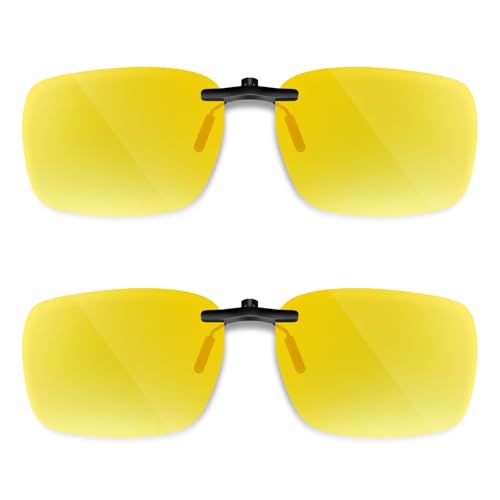
The two-pair format separates this option from the single clip-ons, and its yellow lenses are aimed at dusk, dawn, and night driving rather than daytime amber tint. The maker says the lenses are polarized and intended to improve contrast and reduce reflections in conditions such as light rain or fog; the frame size is 57 × 40 mm. It clips over glasses, but the product name’s compact size label should not be treated as proof of fit for every prescription frame, so compare the dimensions before choosing.
Bottom line: Choose this if you want two yellow clip-ons for separate locations.
SAMNI Flip-Up Yellow Clip-On 2-Pack

SAMNI distinguishes itself with a flip-up lens design, so the tinted lenses can be raised without taking the clip-on off. It includes two pairs, uses yellow lenses, and is described as fitting a range of frame shapes, including oval, square, rectangular, and cat-eye styles. The maker also claims UV400 protection and says the lenses are intended for night driving and screen use. Those broad fit claims are not a substitute for checking the clip-on against your frame dimensions; choose another style if a specified lens measurement is important.
Bottom line: Choose this if you value a hinged flip-up design and broad frame-shape compatibility.
Flip-Up Yellow Night Vision Clip-On 2-Pack

This yellow clip-on combines a flip-up format with a two-pack, while SAMNI Flip-Up Yellow Clip-On 2-Pack also offers flip-up convenience but describes a wider range of frame shapes. The maker says the lenses are flexible and scratch-resistant, with silicone cups and a metal-alloy clip; UV400 protection is also claimed. The fit label spans standard and compact, and the dimensions are about 5.51 inches long by 1.57 inches wide by 0.79 inches high. Shoppers with larger prescription frames should verify coverage before relying on the broad fit description.
Bottom line: Choose this if you want a flip-up pair and need the dimensions to compare.
yayaboqu Yellow Clip-On Night Driving Glasses

At 5 grams, this is the lightest option with a weight, and its feature claims extend to computer and gaming use as well as night driving. The maker says the polarized yellow lenses reduce glare and block 100% of blue light in the 380–500 nm range; the clip is described as fitting most metal, plastic, full-frame, and rimless glasses. The one-size label offers no frame measurement, so this is less useful when precise coverage is the deciding factor. Pick another option if you want a flip-up hinge or a two-pair set.
Bottom line: Choose this if low weight and screen-use claims matter more than a specified fit.
How to choose a polarized clip-on
Start with when you will wear the clip-on, because tint and light transmission matter more than a broad glare claim. Darker sunglass lenses are for bright conditions; yellow night driving lenses are marketed for contrast, but tint does not make dark roads brighter. The American Academy of Ophthalmology advises against wearing yellow night driving glasses because they reduce the amount of light reaching the eye. For a daytime clip-on, match the lens shape and width to the eyeglass lenses, then check whether the clip interferes with a bridge or nose pads. If your priority is driving after dark, a clear lens or prescription eyewear is a safer direction than a tinted overlay.
Also distinguish a fixed clip from a flip-up hinge. A fixed design has fewer moving parts; a flip-up design lets you raise the tint without removing the clip-on.
Match clip-on size to your glasses
Frame fit depends on the prescription lens width and height, not simply the frame shape name. Measure the lens opening at its widest and tallest points in millimeters, then compare those measurements with any clip-on lens dimensions; allow a small margin so the clip covers the lens without striking the frame. A nominal label such as oval or adult is not a complete measurement. Nose-bridge shape, brow angle, and whether the frame is rimless can also change how the clip sits. A useful rule is to reject a clip-on whose lens is narrower or shorter than the eyeglass lens it needs to cover. Check clearance around the bridge and hinges before relying on a universal-fit claim.
Flip-up clips add a hinge above the lens, which can raise the center of gravity and affect how securely a clip sits on thin frames.
Yellow lenses and night driving safety
Yellow lenses do not increase the light available on an unlit road; every tinted lens filters some incoming light. The American Academy of Ophthalmology cautions that yellow night driving glasses can make it harder to see by reducing light reaching the eye. For night driving, keep the windshield clean inside and out, aim headlights correctly, and replace worn wiper blades because glare often comes from scattered light on dirty or wet glass. Avoid a clip-on that obscures peripheral vision or slips when you look toward mirrors. If glare is persistent, especially with halos or sudden vision changes, consult an eye-care professional rather than relying on a tinted lens.
Use this distinction when selecting a tint:
| Use case | Practical choice | Tradeoff |
|---|---|---|
| Bright daytime | Dark polarized sun clip-on | Removes some light |
| Night driving | Clear lenses and a clean windshield | Does not tint headlight glare |
| Dusk or rain | Prioritize clear visibility | Yellow tint can reduce light |
Care and common fit mistakes
Rinse grit off lenses before wiping, since dry dust can scratch coatings; use a clean microfiber cloth rather than paper towels or clothing. Store a clip-on in a case or soft pouch so the lens and clip do not rub against keys or other objects. Avoid leaving eyewear on a hot dashboard, where heat can stress lenses, coatings, and frame parts. A frequent fit mistake is choosing by frame style alone: two oval or rectangular glasses can have very different lens dimensions and bridge geometry. A second mistake is treating UV400 as proof that a lens is suitable for night driving; UV protection addresses ultraviolet light, not whether the tint blocks too much visible light.
Frequently Asked Questions
Are yellow clip-on glasses safe for night driving?
Yellow lenses filter some visible light, so they can make it harder to see in low-light conditions. The American Academy of Ophthalmology advises against yellow night driving glasses; clear lenses and a clean windshield are a better starting point.
How do I measure glasses for clip-ons?
Measure each eyeglass lens opening at its widest width and tallest height in millimeters. Choose a clip-on with lens coverage at least as large, and check bridge and hinge clearance because frame shape alone does not establish fit.
Do polarized clip-ons block ultraviolet rays?
Polarization reduces reflected glare, while UV protection is a separate lens property. Look for an explicit UV claim such as UV400 or UVA/UVB protection rather than assuming polarization alone guarantees it.
Can clip-on sunglasses scratch prescription lenses?
A clip or its contact points can rub against prescription lenses, especially if grit is trapped between them. Keep the contact surfaces clean and make sure the clip sits without pressing or sliding across the lenses.
When should I clean clip-on sunglass lenses?
Rinse away dust and grit before wiping to reduce scratching, then use a clean microfiber cloth. Avoid paper towels and clothing, which can drag particles across the lens surface.