
Rabbit Ears for TV: Four Indoor Antennas Compared

For most indoor setups, Philips SDV8201B/27 Rabbit Ears is a practical rabbit ear choice because its adjustable dipoles and UHF loop target both VHF and UHF broadcasts. Choose Philips SDV7114A/27 Rabbit Ears or GE 33675 Modern Loop Rabbit Ears if you want a 30-mile range, or Wideskall Universal Dual-Loop Rabbit Ear if longer extendable elements matter more than 4K-ready compatibility.
Rabbit ears are indoor antennas with adjustable elements for receiving free over-the-air TV signals; reception depends on signal conditions and placement, not just the antenna label.
We earn a commission if you buy through links on this page. As an Amazon Associate I earn from qualifying purchases. Products are compared on manufacturer specifications, not hands-on testing.
- Best overall: Philips SDV8201B/27 Rabbit Ears – Its adjustable dipoles and UHF loop cover both broadcast bands, and it includes a 5-foot coaxial cable.
- Best for stated range: Philips SDV7114A/27 Rabbit Ears – The maker says it receives VHF and UHF channels from up to 30 miles and provides 15-inch dipoles.
- Best for longer elements: Wideskall Universal Dual-Loop Rabbit Ear – Its extendable antenna reaches 24 inches and supports up to 1080i broadcasts and FM radio.
| Product | Best for | Extendable elements | Coaxial cable | Broadcast support | Shop |
|---|---|---|---|---|---|
| Philips SDV8201B/27 Rabbit Ears | VHF and UHF | — | 5 ft | 4K/8K-ready; ATSC 3.0 compatible | Check Price on Amazon |
| Philips SDV7114A/27 Rabbit Ears | Range claim | 15 in | 4 ft | 4K/8K-ready; up to 30 miles | Check Price on Amazon |
| Wideskall Universal Dual-Loop Rabbit Ear | Long elements | Up to 24 in | 3 ft | Up to 1080i; FM radio | Check Price on Amazon |
| GE 33675 Modern Loop Rabbit Ears | GE 30-mile claim | 15 in | 4 ft | 4K/8K-ready; up to 30 miles | Check Price on Amazon |
Rabbit Ears for TV Compared
Compare the antenna elements, cable reach and broadcast support before choosing a tabletop model.
Philips SDV8201B/27 Rabbit Ears

The Philips SDV8201B/27 combines adjustable dipoles with a circular UHF loop, making it a fit for viewers seeking one tabletop antenna for both broadcast bands. Its included coaxial cable is 5 feet long, longer than the 4-foot cables on the other Philips and GE models here. The maker says it is compatible with ATSC 3.0 and 4K/8K-ready TVs. It is a sensible pick when band coverage and cable reach matter more than a specified reception distance; the features do not give a dipole length or range claim.
Bottom line: Choose this if you want a VHF/UHF tabletop design with a 5-foot cable.
Philips SDV7114A/27 Rabbit Ears
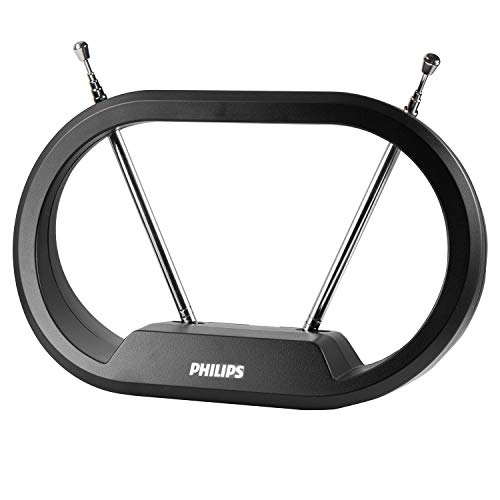
The Philips SDV7114A/27 stands out for its range: the maker says the antenna receives VHF and UHF broadcasts from up to 30 miles. It has 15-inch extendable dipoles, an adjustable loop and a 4-foot coaxial cable for a flat-surface indoor setup. The maker also says it is 4K/8K-ready. This fits buyers who want a range claim and a clear dipole measurement; reception still depends on local signal conditions, so a 30-mile claim does not guarantee every channel at that distance.
Bottom line: Pick this if the maker’s 30-mile range claim and 15-inch dipoles suit your setup.
Wideskall Universal Dual-Loop Rabbit Ear

The Wideskall Universal Dual-Loop is the option with the longest extendable elements, reaching up to 24 inches. It has a 3-foot coaxial cable and supports up to 1080i HDTV broadcasts as well as FM radio broadcasts. That makes it a fit when element extension and FM reception matter more than a 4K/8K-ready claim. Its TV support tops out at 1080i, so buyers specifically seeking a product described as 4K/8K-ready should compare another model.
Bottom line: Choose this when 24-inch extendable elements and FM reception are priorities.
GE 33675 Modern Loop Rabbit Ears
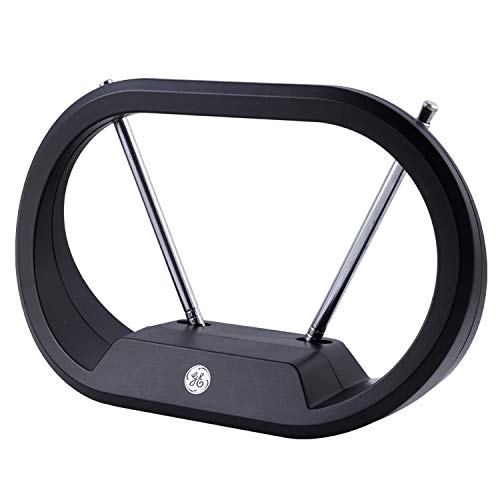
The GE 33675 offers a similar core setup to the Philips 15-inch model: a loop with adjustable 15-inch dipoles, a 4-foot cable and a maker-stated range of up to 30 miles for VHF and UHF. The maker also says it is 4K/8K-ready. Its appeal is a straightforward tabletop antenna with those stated measurements and compatibility claims. The cable is shorter than the 5-foot lead included with Philips SDV8201B/27 Rabbit Ears, so measure the route from the TV connector to the intended antenna position before choosing.
Bottom line: Pick this for 15-inch dipoles and a maker-stated 30-mile range.
How to Choose Rabbit Ears for TV
Choose by the channels you need, the available placement and the cable route—not by a range figure alone. U.S. full-power TV uses VHF channels 2–13 and UHF channels 14–36, so an antenna designed for both bands may suit a broader set of local stations. Rabbit ear dipoles receive VHF, while a loop commonly targets UHF. A 15-inch element extends farther than a compact fixed element, but a longer element does not guarantee better reception if the signal is blocked. If you need to place an antenna more than 4 feet from the TV, favor a cable at least that long or plan a suitable coaxial extension.
Where to Place an Indoor TV Antenna
Place an indoor antenna near a window and as high as practical, then rescan channels after moving or re-aiming it. Walls, metal surfaces and nearby electronics can weaken or alter reception; even moving an antenna a few feet can change which channels lock in. Rotate or extend the dipoles in small increments, and adjust the loop separately when the design allows it. A room facing the broadcast towers is often a better starting point than a basement or a room behind several exterior walls. For a reliable decision, check local station directions and signal conditions before buying, especially when the nearest transmitter is far away or terrain blocks the path.
VHF and UHF Reception Explained
VHF and UHF are different broadcast frequency bands, so antenna shape and placement can affect channels differently. Rabbit ear rods are commonly used to tune VHF, while loop elements are commonly used for UHF; combination designs include both forms. TV channel numbers do not always match the frequency a station uses, because digital stations can display a virtual channel number. A channel scan on the television refreshes its saved stations after each meaningful antenna adjustment. If a station disappears, check whether its signal is VHF or UHF and reposition the corresponding element before assuming the antenna cannot receive it.
What Range Claims Mean for Indoor Antennas
A reception range is a maker claim, not a guarantee that every station within that distance will be watchable. Terrain, buildings, transmitter power, antenna height and the direction of the signal all affect reception. A clear line toward a tower can work better than a shorter distance through hills or dense construction. Use a range figure as a screening clue, then compare your location and the stations you want to receive. For any indoor antenna, rescan after changes and test several positions; a small placement shift can improve one station while making another less stable.
Frequently Asked Questions
Do rabbit ears receive both VHF and UHF channels?
Combination rabbit ear antennas can receive both bands when they include dipoles and a loop or another UHF element. U.S. TV channels 2–13 are VHF and 14–36 are UHF, so check local station bands when selecting an antenna.
How far should rabbit ears extend for TV reception?
The products here include 15-inch dipoles and elements extendable up to 24 inches, but the right extension depends on the signal. Extend and reposition the elements gradually, then run a fresh channel scan after each meaningful change.
Does a 30-mile antenna range guarantee reception?
No; 30 miles is a maker-stated range, not a promise of every channel at that distance. Terrain, buildings, antenna height and tower direction can change reception substantially.
Why does an indoor antenna lose some channels?
A channel can drop when walls, metal objects or a change in antenna orientation weakens its signal. Move the antenna a few feet or closer to a window, adjust its elements, and rescan the TV.
Can rabbit ears receive FM radio too?
Some models support FM radio; the Wideskall model here states FM broadcast support alongside TV reception up to 1080i. Check that the radio or tuner has an antenna input compatible with its coaxial connection.