
Radio Electronics DIY Kits: 5 FM Projects Compared

For a radio electronics DIY kit with both auto and manual tuning, a spectrum display and a clock, choose MIOYOOW FM Radio Kit. Pick another kit if you want a project aimed at younger learners, a separate speaker build or two power options.
These kits turn electronic components into working FM radios, with soldering required for some builds. Check the project’s age guidance and whether you have the tools and supervision needed for soldering before choosing.
We earn a commission if you buy through links on this page. As an Amazon Associate I earn from qualifying purchases. Products are compared on manufacturer specifications, not hands-on testing.
- Best overall: MIOYOOW FM Radio Kit – Combines auto/manual tuning, a spectrum LED display, a clock and a headphone jack.
- Best for a speaker build: STEM Radio and Speaker Kit – Includes parts to build both a radio and a stereo speaker.
- Best for power flexibility: Gikfun EK1989 FM Radio Kit – Supports USB power or a battery case.
| Product | Best for | Tuning or display | Dimensions | Shop |
|---|---|---|---|---|
| MIOYOOW FM Radio Kit | Display and clock | Auto/manual; spectrum LED | 4.5 × 1.5 × 3 in. | Check Price on Amazon |
| Diymore FM Radio Kit | Transparent case | Digital display versions | 4.5 × 2.8 × 3.5 in. | Check Price on Amazon |
| Poraxy Wooden FM Radio Kit | Younger learners | Auto search; 87–108 MHz | 4.25 × 1.69 × 2.79 in. | Check Price on Amazon |
| STEM Radio and Speaker Kit | Radio plus speaker | Radio and stereo speaker | 8.26 × 5.11 × 1.96 in. | Check Price on Amazon |
| Gikfun EK1989 FM Radio Kit | Power choice | FM 87–108 MHz | 4.33 × 0.9 × 2.75 in. | Check Price on Amazon |
Radio Electronics DIY Kits Compared
Compare the build features and practical differences before choosing an FM radio project.
MIOYOOW FM Radio Kit

Unlike the simpler display-focused kits, this MIOYOOW build combines auto and manual tuning with a spectrum LED display and a 12/24-hour clock. The finished radio also has a retractable antenna, headphone jack and rotary controls, offering several ways to interact with the build. Those features suit adults, teens and beginners who want a soldering project with everyday radio functions. The dimensions are 4.5 × 1.5 × 3 inches. If battery or USB operation is essential, confirm the power source before choosing.
Bottom line: Choose this if the display, clock and tuning choices matter more than a documented power option.
Diymore FM Radio Kit

The transparent case distinguishes this Diymore kit, letting the assembled circuit remain visible rather than enclosed in wood. It uses a double-sided epoxy circuit board and includes a speaker; versions are offered with a basic setup, digital display, or digital display plus charging module. The button controls handle channel switching, volume, clearing and rescan or preset storage. Its 4.5 × 2.8 × 3.5-inch dimensions make it a defined-size project for a desk or classroom. Choose the version carefully: the charging module and digital display depend on the version selected, and the available power source is not established here.
Bottom line: Choose this if seeing the board through a clear case is part of the appeal.
Poraxy Wooden FM Radio Kit
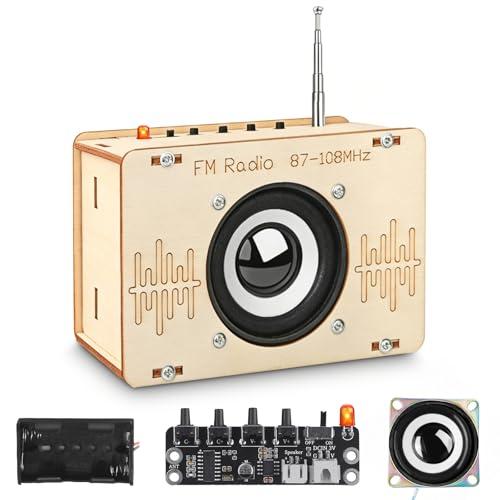
Poraxy is the clearest age-oriented choice in this group, with the product aimed at children and teens and a wooden case rather than a transparent or purple PCB design. Its radio automatically searches stations in the 87–108 MHz range, and the retractable antenna is part of the build. At 4.25 × 1.69 × 2.79 inches, the finished unit has a compact footprint. The feature set emphasizes curiosity and learning rather than advanced tuning controls or a clock, so choose another model if manual tuning or a visual spectrum display is central to your project.
Bottom line: Choose this for a wood-case radio project aimed at younger builders.
STEM Radio and Speaker Kit

This kit adds a separate stereo-speaker build, making it the only option here that explicitly combines a radio and speaker project. The set uses circuit boards, a speaker and wooden panels; the product is aimed at children ages 8–13 as well as older learners and adults. Its overall dimensions are 8.26 × 5.11 × 1.96 inches. That broader build is a fit for a parent-child or classroom project where assembling more than a standalone radio is the goal. The feature set does not give a tuning range or power method, so it is less suitable if either specification is a deciding requirement.
Bottom line: Choose this when building a radio and a stereo speaker is the priority.
Gikfun EK1989 FM Radio Kit
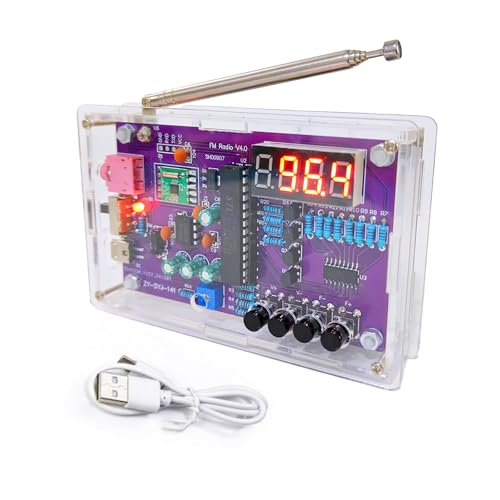
The Gikfun EK1989 stands apart by offering two power methods: a USB power cable and a battery case. It tunes across 87–108 MHz and includes a headphone jack, with a purple PCB that makes this a soldering-practice project for beginners, adults or school use. The assembled unit measures 4.33 × 0.9 × 2.75 inches. Choose it when switching between USB and battery operation matters more than a clock or speaker-building project.
Bottom line: Choose this if you want a documented choice between USB and battery-case power.
How to Choose a Radio Electronics DIY Kit
Choose by the build experience you want: extra controls, a visible circuit, youth-oriented learning, a second speaker project or power flexibility. In the United States, FM broadcast spans 87.5–108 MHz; a kit covering 87–108 MHz covers nearly all of that band but omits the lowest 0.5 MHz. Auto search is useful for scanning stations, while manual tuning offers direct control when the kit supports it. A clock, display or headphone jack adds a distinct function, but does not by itself indicate how difficult soldering will be. For first-time builders, prioritize clear assembly instructions and appropriate supervision, then confirm the power method if portability matters.
FM Radio Kit Tuning and Frequency Fit
FM station frequency is measured in megahertz, and U.S. broadcast stations occupy 87.5–108 MHz. A kit advertised for 87–108 MHz covers most of the band, while a kit with auto search may reduce the need to step through frequencies manually. Radio reception also depends on local station signals, antenna placement and nearby obstructions; extend a telescoping antenna and reposition it if reception is weak. A headphone jack changes the listening option, not the radio’s frequency coverage. If access to stations at the bottom of the U.S. band is essential, verify that the kit covers 87.5 MHz before buying.
Soldering Safety for DIY Radio Builds
Soldering irons commonly operate around 350–400°C, hot enough to cause serious burns, so use a stable stand and keep the hot tip away from hands, cords and flammable materials. Work in a ventilated area and avoid breathing soldering fumes; wash hands after handling solder, especially before eating. Children should build only with age-appropriate adult supervision, and the supervising adult should manage hot tools. Trimmed wire leads can be sharp, so collect offcuts rather than leaving them on the work surface. A first-time builder should practice joints on scrap electronics board before starting the radio, since a solder bridge between neighboring PCB pads can prevent correct operation.
Common DIY Radio Kit Selection Mistakes
Do not assume every FM radio kit uses the same tuning interface or power supply: some emphasize auto search, others add manual tuning, and a USB cable or battery case is a separate practical distinction. Also compare project scope, not just the word “radio”; a kit that includes a speaker build may take a different kind of workspace and assembly time than a standalone receiver. Check physical dimensions against the intended work area, and leave room for soldering tools and component organization. If a kit is for a child, use the age guidance as a starting point, not a substitute for adult judgment about soldering readiness.
Frequently Asked Questions
What FM frequencies do DIY radio kits receive?
U.S. FM broadcast stations use 87.5–108 MHz. Check a kit’s tuning range if you need coverage at the bottom of that band.
Are DIY FM radio kits suitable for children?
Some are marketed for children, but soldering requires adult supervision and an age-appropriate setup. Keep hot irons on a stand and work in a ventilated space.
What tools are needed to solder a radio kit?
A soldering iron, solder, a stable iron stand and basic wire cutters are common for through-hole electronics kits. A temperature-controlled iron set around 350–400°C is typical for many lead-free soldering tasks.
Why does a finished DIY radio have weak reception?
FM reception depends on station signal strength, antenna position and nearby obstructions. Extend and reposition the antenna, and expect indoor reception to vary by location.
Can a DIY FM radio kit use batteries?
Only kits with a compatible battery case or specified battery power can be assumed to run from batteries. Confirm the battery type and power method before choosing a portable build.