
ResCare Water Softener Cleaner: 5 Options Compared

Pro Products ResCare RK02B 1-Gallon Refill suits buyers who want three gallon refills and a cleaner whose maker says it meets NSF/ANSI/CAN Standard 60 for drinking water additives. Choose another format if you need less product at once or prefer premeasured 4-ounce bottles.
ResCare is a liquid resin cleaner used in water softeners; the products here differ mainly in container size, pack count and dosing directions.
We earn a commission if you buy through links on this page. As an Amazon Associate I earn from qualifying purchases. Products are compared on manufacturer specifications, not hands-on testing.
- Best overall: Pro Products ResCare RK02B 1-Gallon Refill – Three 1-gallon refills offer the largest total quantity, and the maker provides a 4-ounce-per-cubic-foot dosing direction.
- Best for premeasured doses: Pro Products Res Care 4-Ounce Bottles – Four 4-ounce bottles are intended to be added whole before regeneration.
- Best for a smaller refill: GDM HOME ResCare RK64N 64-Ounce Cleaner – One 64-ounce bottle is a smaller single-container option than the multi-gallon packs.
| Product | Best for | Container size | Pack count | Use method | Shop |
|---|---|---|---|---|---|
| Pro Products ResCare RK02B 1-Gallon Refill | Bulk refills | 128 fl oz | 3 | 4 oz per cubic foot; brine well | Check Price on Amazon |
| Res Care Liquid Cleaner 1-Gallon Bottle | Single gallon | 128 fl oz | 1 | Half-cup for most residential systems | Check Price on Amazon |
| GDM HOME ResCare RK64N 64-Ounce Cleaner | Single bottle | 64 oz | 1 | — | Check Price on Amazon |
| Pro Products Res Care 4-Ounce Bottles | Premeasured doses | 4 fl oz | 4 | One bottle before regeneration | Check Price on Amazon |
| ResCare RK03B 64-Ounce Refill, 3-Pack | Mid-size refills | 64 fl oz | 3 | 4 oz per cubic foot; brine well | Check Price on Amazon |
ResCare water softener cleaner options
Compare container formats and the dosing directions supplied for each cleaner before choosing a quantity.
Pro Products ResCare RK02B 1-Gallon Refill

Pro Products ResCare RK02B 1-Gallon Refill is the largest package here by total volume: three 1-gallon refill containers. The maker says the cleaner removes buildup, helps restore efficiency and flow, and extends resin bead and control valve life; it also says the formula meets NSF/ANSI/CAN Standard 60 for drinking water additives. Its directions call for 4 ounces per cubic foot poured into the brine well, followed by a manual regeneration. This format suits owners who want a larger supply and are comfortable measuring each dose. It takes more storage space than the single-container options.
Bottom line: Choose this if you want three gallon refills and measured dosing.
Res Care Liquid Cleaner 1-Gallon Bottle

Res Care Liquid Cleaner 1-Gallon Bottle comes as one 1-gallon container rather than a multi-bottle pack. Its maker describes it as a cleaner for resin fouled by metallic and organic compounds, including iron and manganese, and says it can be poured into the brine well or salt tank. The directions say a half-cup treats most residential softeners. This is a fit for buyers seeking a single large container and a general dose rather than measuring by cubic foot. The half-cup guidance is described for most systems, so confirm the needed dose for your softener before use.
Bottom line: Pick this if one gallon and a half-cup general dose suit your routine.
GDM HOME ResCare RK64N 64-Ounce Cleaner

GDM HOME ResCare RK64N 64-Ounce Cleaner is a single 64-ounce bottle, making it a more compact quantity than the gallon containers and the multi-bottle packs. That makes it a straightforward choice when the key requirement is a one-bottle 64-ounce format. Buyers who need a specific dose or a detailed application routine should check the softener and cleaner instructions before using it; do not assume another product’s dosage applies.
Bottom line: Choose this for a single 64-ounce ResCare container.
Pro Products Res Care 4-Ounce Bottles

Pro Products Res Care 4-Ounce Bottles is the only option in premeasured 4-ounce bottles: the package contains four, and its directions call for adding one entire bottle before each regeneration. The maker says the cleaner targets residue including iron, manganese, silt and metal particles, and says it works with any water softener. This format suits owners who value a ready-sized dose over pouring from a larger refill. Each container supplies one dose under the directions, so the four-pack is a limited supply compared with the 64-ounce and gallon formats.
Bottom line: Pick this if you want individual 4-ounce doses before regeneration.
ResCare RK03B 64-Ounce Refill, 3-Pack
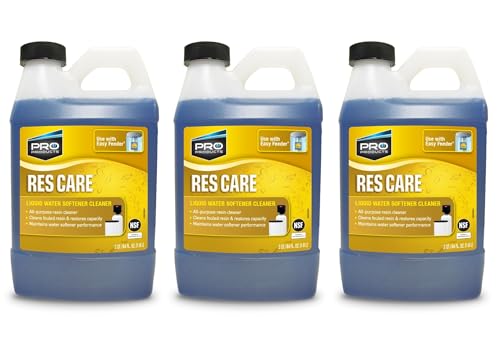
ResCare RK03B 64-Ounce Refill, 3-Pack pairs three 64-ounce refill bottles with directions to pour 4 ounces per cubic foot into the brine well and manually regenerate the softener. The maker says the cleaner restores efficiency and flow rates, removes buildup, extends resin bead and control valve life, and meets NSF/ANSI/CAN Standard 60 for drinking water additives. This is a middle ground for buyers who want multiple bottles but less liquid per container than a gallon refill. It requires measuring each dose, unlike the four-pack of 4-ounce bottles.
Bottom line: Choose this for three 64-ounce refills with cubic-foot dosing.
How to choose a ResCare cleaner format
Choose by total quantity and dosing style first: these products range from four 4-ounce bottles to three 1-gallon refills. A water softener uses resin beads to exchange hardness minerals for sodium or potassium ions; regeneration uses brine to recharge the resin. Cleaner is a separate maintenance aid, not a replacement for the normal brine regeneration cycle. The product directions differ: some use a measured dose based on resin volume, one gives a half-cup for most residential systems, and one packages individual 4-ounce doses. If you do not know your softener’s resin volume, do not guess at a cubic-foot dose; verify the unit capacity in its manual. Pick premeasured bottles when avoiding measurement matters more than minimizing packaging.
Where to add water softener cleaner
Follow the application route on the specific cleaner: the products here direct use into a brine well or, in one case, either the brine well or salt tank. A brine well is the narrow tube inside the brine tank that houses the float assembly; keeping cleaner out of unrelated plumbing avoids applying it at the wrong stage. The brine tank holds salt and water used to make brine for regeneration, while the resin tank contains the beads that soften water. Do not pour a cleaner into the resin tank unless its directions say to do so. After adding cleaner, the included product directions call for manual regeneration where applicable; consult the softener manual for how to start that cycle on your control valve.
Why resin cleaner dosing varies
Dose according to the specific cleaner directions and the softener’s resin volume, not simply the size of the brine tank. One product gives 4 ounces per cubic foot of resin, while another recommends a half-cup for most residential softeners and the premeasured format directs one 4-ounce bottle per regeneration. A cubic foot equals 7.48 gallons of volume, but resin capacity in grains is not the same measurement as resin volume. Confusing grain capacity with cubic feet can lead to an incorrect dose. Before choosing a measured-dose cleaner, find the resin volume or the dosing instructions for your exact unit. A ready-sized bottle simplifies measuring, but only when its directions match the intended cleaning cycle.
When resin fouling calls for cleaner
Iron and manganese can foul softener resin and interfere with ion exchange; cleaners are formulated to address deposits on resin surfaces and pores. The exact cause matters: hard-water scale, sediment, iron deposits and a salt bridge are different maintenance issues. A salt bridge is a hard crust over hollow space in the brine tank that can prevent brine formation; breaking it up addresses a different problem from cleaning resin. If softened water changes suddenly, check for adequate salt, a bridge, control settings and regeneration first rather than assuming cleaner alone will fix it. For persistent iron or sediment, use cleaner only as directed and consider whether pretreatment or service is needed for the underlying water condition.
Frequently Asked Questions
How often should I clean water softener resin?
There is no single interval that fits every system because iron and other contaminants vary by water supply. Use cleaner when the softener maker recommends it or when fouling is suspected, and keep routine salt-based regeneration separate from resin cleaning.
Can I pour ResCare into the salt tank?
One ResCare product here allows pouring into either the brine well or salt tank, while others direct users to the brine well. Use the route printed for the specific cleaner and avoid pouring it into the resin tank unless its directions explicitly say so.
How do I find the resin volume for dosing?
Check the softener manual or unit specifications for resin volume in cubic feet; grain capacity is not interchangeable with cubic feet. The 4-ounce-per-cubic-foot direction requires resin volume, so do not estimate from the brine tank size.
What is the difference between resin cleaner and regeneration salt?
Regeneration salt dissolves to make brine that recharges resin during the softener’s normal cycle; resin cleaner is a separate product intended to help remove contaminants or buildup. Cleaner does not replace salt or normal regeneration.
Can water softener cleaner fix a salt bridge?
No, a salt bridge is a crusted layer of salt that can block water from dissolving the salt below it, rather than resin fouling. Break up the bridge carefully according to the softener maker’s guidance, and keep cleaner dosing as a separate maintenance step.