
Sans Air Purifier: Models Compared by Filtration

For most people seeking a Sans air purifier, Sans Mini HEPA Air Purifier, Midnight is the clearest fit because it pairs 490-square-foot coverage with a H13 HEPA filter and a pound of activated carbon. Choose Sans Mini HEPA Air Purifier, White if you prefer its white finish; consider a different brand if you need a larger stated coverage area or independent performance verification.
Room air purifiers draw air through filters to reduce particles and, with suitable carbon, some odors; sizing depends on room area and how often the unit circulates air.
We earn a commission if you buy through links on this page. As an Amazon Associate I earn from qualifying purchases. Products are compared on manufacturer specifications, not hands-on testing.
- Best overall: Sans Mini HEPA Air Purifier, Midnight – Pairs 490-square-foot coverage with H13 HEPA filtration, one pound of carbon and a 25 dB operation.
- Best for white finish: Sans Mini HEPA Air Purifier, White – The white Sans Mini has 490-square-foot coverage and a compact 14 × 9 × 8-inch form.
- Best for larger stated coverage: Levoit Core 300-P Air Purifier – The Core 300-P claims coverage up to 1,073 square feet and cites AHAM verification.
| Product | Best for | Coverage | Filter setup | Dimensions | Shop |
|---|---|---|---|---|---|
| Sans Mini HEPA Air Purifier, Midnight | Carbon filtration | 490 sq ft | H13 HEPA, 1 lb carbon | 14 × 9 × 8 in | Check Price on Amazon |
| Sans Mini HEPA Air Purifier, White | White finish | 490 sq ft per hour | 3-in-1 HEPA filtration | 14 × 9 × 8 in | Check Price on Amazon |
| Levoit Core 300-P Air Purifier | AHAM verification | Up to 1,073 sq ft | HEPA-grade in Sleep Mode | 14.2 × 8.7 × 8.7 in | Check Price on Amazon |
| PuroAir 240, Two-Pack | Two-room coverage | 1,000 sq ft per unit per hour | Pre-filter, HEPA, carbon | 20.5 × 10.6 × 10.6 in | Check Price on Amazon |
Sans Air Purifiers and Alternatives
Compare the Sans Mini options with alternatives by coverage, filtration and physical size.
Sans Mini HEPA Air Purifier, Midnight

For odor-focused buyers, Sans Mini HEPA Air Purifier, Midnight stands out for its one-pound activated-carbon layer alongside H13 HEPA filtration. The Sans Mini covers up to 490 square feet, monitors air quality and automatically adjusts fan speed; the maker says it operates at 25 dB. Its pre-filter and carbon layer are also intended to capture pet hair, dander and household smells. At 14 × 9 × 8 inches, it fits a smaller footprint than the taller PuroAir pair. The main limitation is its 490-square-foot stated coverage, so buyers with a larger room should compare the room’s area and required circulation before choosing it.
Bottom line: Choose this if carbon capacity and automatic adjustment matter in a room up to 490 square feet.
Sans Mini HEPA Air Purifier, White
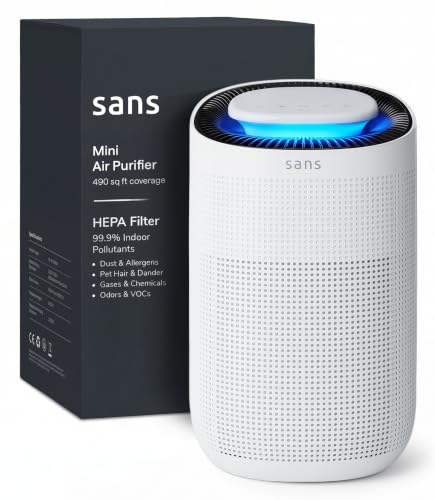
Sans Mini HEPA Air Purifier, White is the white-finish Sans Mini, with a 490-square-foot coverage claim and a three-in-one HEPA filtration system. Its 14 × 9 × 8-inch dimensions and 7-pound weight make the unit easy to place on a stable surface where its air intake and outlet remain clear. The maker says its HEPA technology captures up to 99.9% of particles, but the maker does not identify the particle size for that figure. That makes it harder to compare directly with a micron-specific claim; choose this option for the color and stated footprint rather than assuming its capture figure is directly interchangeable with another purifier’s.
Bottom line: Pick this when the white finish and compact stated dimensions suit your room.
Levoit Core 300-P Air Purifier

Levoit Core 300-P Air Purifier differs from the Sans Minis with a coverage ceiling of 1,073 square feet and a 143 CFM clean-air delivery rate. The maker identifies its filter as HEPA-grade while operating in Sleep Mode and says the model is AHAM VERIFIDE for air-cleaning performance and energy efficiency. Its 56-watt motor and 14.2 × 8.7 × 8.7-inch dimensions help distinguish it from the smaller Sans units. The limitation is that its HEPA-grade claim is specifically tied to Sleep Mode, so buyers prioritizing a particular filtration mode should check that condition against their intended use.
Bottom line: Choose this if the higher coverage and cited AHAM verification fit your priorities.
PuroAir 240, Two-Pack
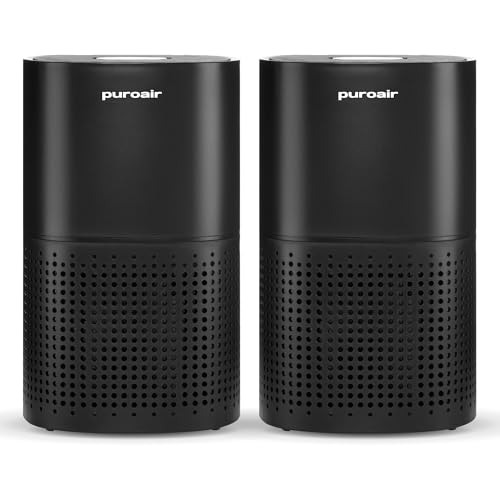
PuroAir 240, Two-Pack is a two-unit set, making it distinct for buyers who want to place purifiers in separate rooms rather than rely on one compact device. The maker says each unit cleans up to 1,000 square feet in an hour and uses a pre-filter, HEPA filter and activated carbon layer. The dimensions are about 20.5 × 10.6 × 10.6 inches per unit. Its larger height and two-unit format require more placement space than either Sans Mini. The coverage depends on the maker’s testing conditions, so compare room size and circulation needs rather than treating the figure as a guarantee for every layout.
Bottom line: Pick the pair if you want separate units for multiple rooms and can accommodate their larger size.
How to Size a Sans Air Purifier
Match the purifier’s clean-air delivery to room area, not just the maximum square footage printed in a product name. A common sizing rule for a standard 8-foot ceiling is a smoke CADR of at least two-thirds of the room’s area; for a 300-square-foot room, that is about 200 CFM. Higher ceilings, open doorways and heavy particle sources call for more capacity or longer operation. Coverage figures can reflect different air-change assumptions, so compare CADR when available and look for the conditions behind a coverage claim. If the room is larger than the capacity, use a second unit or choose a model with greater measured delivery rather than assuming a small purifier will clean the entire space evenly.
HEPA and Carbon Filtration Differences
HEPA filters target airborne particles, while activated carbon adsorbs some gases and odors; the layers address different pollutants. A widely used HEPA benchmark is at least 99.97% removal of 0.3-micron particles under specified test conditions, but the claim’s wording and test basis matter when comparing models. Carbon performance depends on both the amount and type of media, and odor removal can decline as the media becomes saturated. A thin carbon coating and a substantial carbon bed are not equivalent for odor-focused use. Choose particle filtration for dust and pollen concerns, and prioritize a meaningful carbon layer when household odors or some gases are the main concern.
Placement and Everyday Use
Place a purifier where air can move freely around its intake and outlet; blocking either with a wall, curtain or furniture can reduce circulation. Keep the unit on a firm, level surface and avoid placing it where spills or condensation can reach electrical components. For whole-room cleaning, leave the door open only if the purifier has enough capacity for the combined area. Auto mode can respond to a sensor, but a sensor reading represents air near the unit rather than every corner of the room. Run the purifier consistently when particle control is the goal, and consider a higher fan setting when the room has a temporary source such as cooking smoke.
Filter Replacement and Fit Checks
Most portable air purifiers use a washable or replaceable pre-filter plus a main filter, but replacement timing varies with dust load and operating hours. Check the filter’s condition regularly and replace it when the maker’s interval or a filter indicator calls for service; clogged media can restrict airflow. Carbon media may lose odor-adsorbing capacity before the particle filter looks visibly dirty. Before buying, confirm the replacement filter is available for the exact model and that the purifier can fit with clearance for its air openings. Keep the unit and cord away from wet areas, and do not open or service powered components while the purifier is plugged in.
Frequently Asked Questions
How big a room can a 490-square-foot purifier clean?
A 490-square-foot rating is a coverage claim, not a guarantee of equal cleaning in every room. Ceiling height, open adjoining areas and the number of air changes required affect the capacity needed.
What does a HEPA filter capture in an air purifier?
A HEPA filter captures airborne particles, with a common benchmark of at least 99.97% of 0.3-micron particles under specified test conditions. Check whether a product’s percentage names the particle size and filtration mode.
Does activated carbon remove household odors?
Activated carbon can adsorb some odor-causing gases, but its effectiveness depends on the quantity and type of carbon and how saturated it is. A particle filter alone does not perform the same odor-adsorption job.
Where should I place an air purifier in a bedroom?
Place a bedroom purifier on a stable, dry surface with its intake and outlet unobstructed. Leave space around the openings and keep cords away from walkways and water sources.
How often should an air purifier filter be replaced?
Replacement timing depends on the filter design, use and dust load; many portable purifiers use a service interval of several months rather than a universal schedule. Inspect the pre-filter regularly and use the model’s interval or filter indicator for the main filter.