
Rib Membrane Removal Tools Compared by Grip and Design

For a familiar stainless steel rib membrane remover with a defined size, Pit Boss’s 8.27-inch tool is the clearest fit. Choose a different design if you want a specified rubber grip or deep-groove jaws, since those features distinguish other options.
A rib membrane removal tool is a hand tool for loosening and pulling the thin membrane from ribs before cooking; some designs also include a fat-trimming edge.
We earn a commission if you buy through links on this page. As an Amazon Associate I earn from qualifying purchases. Products are compared on manufacturer specifications, not hands-on testing.
- Best overall: Pit Boss 41065 Rib Membrane Remover – The stainless steel tool has stated dimensions of 8.27 by 2.24 by 0.94 inches.
- Best for jaw grip: XuanShiTangMen 304 Stainless Steel Remover – Its deep-groove jaws are designed to grip slippery membrane.
- Best for rubber grip: Extended 304 Stainless Steel Rib Tool – The product specifies a full-rubber grip and a curved serrated edge.
- Best for compact prep: Stainless Steel Dual-Function Rib Prep Tool – The product pairs a curved membrane tip with a fat-trimming edge.
| Product | Best for | Material | Length | Grip or working edge | Shop |
|---|---|---|---|---|---|
| Pit Boss 41065 Rib Membrane Remover | Measured dimensions | Stainless steel | 8.27 in | Membrane remover | Check Price on Amazon |
| XuanShiTangMen 304 Stainless Steel Remover | Slippery membrane grip | 304 stainless steel | 8.5 in | Deep-groove jaws | Check Price on Amazon |
| Extended 304 Stainless Steel Rib Tool | Rubber handle grip | 304 stainless steel | 1 in | Full-rubber grip; curved serrated edge | Check Price on Amazon |
| Stainless Steel Dual-Function Rib Prep Tool | Textured handle | Food-grade stainless steel | 0.1 in | Textured handle; curved tip | Check Price on Amazon |
| Arc-Clamp Stainless Steel Rib Prep Tool | Non-slip grip | Food-grade stainless steel | 1 in | Arc clamp; non-slip grip | Check Price on Amazon |
Rib Membrane Removal Tools
Compare these designs by their working edge, handle and stated dimensions before choosing a prep tool.
Pit Boss 41065 Rib Membrane Remover

Among these options, Pit Boss 41065 Rib Membrane Remover has the most complete set of stated dimensions: 8.27 inches long, 2.24 inches wide and 0.94 inches high. The stainless steel construction keeps the design focused on membrane removal rather than a specified second trimming edge or special jaw profile. Pit Boss says the tool removes rib membrane and is dishwasher safe.
Choose this if a familiar, measured stainless steel tool suits your prep routine. Its dimensions can help with storage planning, but they do not describe the handle shape or working-edge geometry; buyers who prioritize a specific grip or jaw design may prefer another option.
Bottom line: Pick this if you want stated dimensions and a straightforward stainless steel tool.
XuanShiTangMen 304 Stainless Steel Remover

Unlike the blade-focused designs, XuanShiTangMen 304 Stainless Steel Remover uses deep-groove jaws intended to hold slippery silver skin while it is pulled away. Its 304 stainless steel construction and 8.5-inch height are specified, as are a non-slip grip and dishwasher-safe cleanup. The maker says the jaws are designed for pork and beef ribs.
This design suits cooks who want a gripping jaw rather than relying mainly on a sharp or curved edge. The dimensions give the height but not the width or length, so choose it for its jaw style rather than assuming a particular storage footprint.
Bottom line: Choose this if gripping slippery membrane is your main priority.
Extended 304 Stainless Steel Rib Tool

Extended 304 Stainless Steel Rib Tool stands apart with a full-rubber grip and a curved serrated edge, while the other options emphasize a textured handle, jaws or more complete dimensions. The product identifies its blade material as thickened food-grade 304 stainless steel and pairs the curved edge with a sharp side for trimming fat. The maker says it is dishwasher safe.
This model suits cooks seeking a rubber-covered handle and dual-purpose blade. Its dimensions show a 1-inch length, which is not enough to judge the tool’s full storage fit; those who need a reliable overall size for a drawer should compare a model with a clearer length measurement.
Bottom line: Pick this if a rubber grip and curved serrated working edge matter most.
Stainless Steel Dual-Function Rib Prep Tool
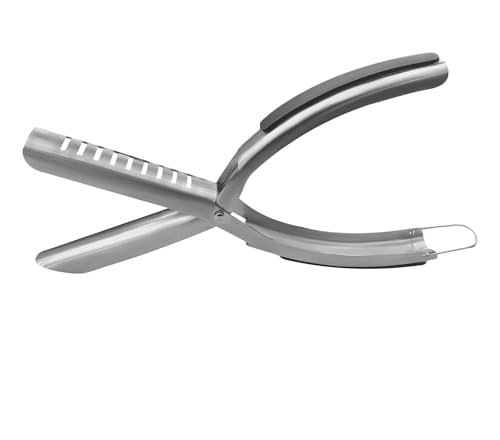
Stainless Steel Dual-Function Rib Prep Tool combines a contoured, textured handle with a curved membrane tip and a separate sharp edge for trimming fat. That mix distinguishes it from the jaw-style design and from models that specify a rubber handle. Its weight is about 0.22 pounds; the dimensions of 0.1 inch for length, width and height do not provide a useful full-size measurement.
Choose this if a textured handle and two prep functions match your routine. The unclear overall dimensions matter if you need to confirm drawer or utensil-crock fit before ordering. The maker says the tool is dishwasher safe.
Bottom line: Choose this if you prefer a textured handle and want a trimming edge as well.
Arc-Clamp Stainless Steel Rib Prep Tool

Arc-Clamp Stainless Steel Rib Prep Tool is the option that specifies an arc-clamp along with a non-slip grip, rather than deep-groove jaws or a full-rubber handle. Its maker says the stainless steel tool has a sharp side for fat and a curved tip for fascia. The given 1-inch length does not establish the tool’s full size.
This design may suit cooks who want a clamp-style approach to rib prep. The short dimension supplied makes storage fit hard to assess, and the specifications do not establish whether the clamp opens to a particular width; prioritize a model with a more complete measurement if either factor is important.
Bottom line: Pick this if an arc-clamp style and non-slip grip suit your prep preference.
How to choose a rib membrane removal tool
Choose a working edge that can get beneath the membrane without cutting into the meat: a curved tip is made for lifting an edge, while gripping jaws are designed to hold the loosened sheet during the pull. Rib membranes are thin and slippery, so a textured or non-slip handle can help maintain control. If you also want to trim fat, a dual-edge tool adds a sharp surface, but that blade needs extra care during handling and washing. Start by matching the tool’s main action—lifting, gripping, or trimming—to the part of prep you want help with.
A practical decision rule is to choose jaws if holding a slippery flap is your main difficulty, and a curved tip if you mainly need help starting beneath the membrane. For storage, use the tool’s overall length rather than a single dimension; an approximately 8-inch utensil needs a drawer or crock with at least that much usable space.
| Prep need | Design to consider |
|---|---|
| Grip a loosened flap | Grooved jaws |
| Lift the membrane edge | Curved tip |
| Trim fat as well | Dual-edge design |
How to remove membrane from ribs
Work from an end of the rack, where the membrane edge is easiest to lift. Slide a blunt utensil or curved tool tip under a small section, then grasp the loosened flap and pull steadily along the bones. A paper towel can help grip a slick flap, and slower, even pressure can reduce tearing. If the sheet breaks, lift another edge rather than forcing a sharp blade toward your hand.
Racks differ in membrane toughness and how firmly it clings, so there is no single pull force that suits every rack. Keep the rack stable on a cutting board, with fingers out of the tool’s path; if a design has a sharp trimming edge, point it away from your supporting hand. Removing the membrane is a texture and seasoning preference, not a step required to make ribs safe to cook.
Cleaning and storing rib prep tools
Clean a rib prep tool promptly after it contacts raw meat: wash it with hot, soapy water, rinse it, and dry it before storage. Raw meat residue can transfer to hands, counters, or ready-to-eat food, so wash those contact surfaces too. Dishwasher suitability varies by tool; use a dishwasher only when the maker identifies the tool as dishwasher safe.
Store a sharp-edged tool with its working edge protected or positioned so it cannot catch a hand reaching into a drawer. Stainless steel resists corrosion, but it is not a reason to leave a tool wet or food-soiled. Check the edge and handle before each use; stop using a tool if the handle is loose or the working edge is damaged, since either condition can reduce control during a slippery task.
Frequently Asked Questions
Should the membrane be removed from beef ribs?
Removing the thin membrane from the bone side can make seasoning and eating easier, but it is a prep preference rather than a food-safety requirement. Loosen one edge first, then pull steadily so the sheet is less likely to break.
Can a rib membrane tool trim fat too?
Some dual-function designs have a separate sharp edge intended for fat trimming. Keep the blade directed away from your hand and the meat-holding fingers while cutting.
How should a rib membrane remover be cleaned?
Wash the tool after raw-meat preparation with hot, soapy water, then dry it to limit residue and moisture on the metal. Dishwasher safety is product-specific, so check that feature for the particular tool before using a dishwasher.
Is a knife better than a rib membrane remover?
A small blunt edge can help loosen the first flap, while a purpose-built remover may provide a curved tip or gripping jaws for pulling. Avoid using a sharp knife to pry toward your fingers, especially when the membrane is slippery.