
RM18 Weed Killer: 4 Options Compared by Use

RM18 Fast-Acting Weed & Grass Killer, 2.5 gal is the closest fit for most people seeking RM18 weed killer because it is the RM18 concentrate and gives a 3-to-6-fl-oz-per-gallon mixing range. Choose RM43 Concentrated Extended Control Weed Killer for extended total-vegetation control, Spectracide Weed & Grass Killer, 1.33 gal for a ready-to-use sprayer, or Natural Elements Vinegar-Derived Weed Killer, 1 gal for a vinegar-derived ready-to-use option.
RM18 is a concentrated herbicide mixed with water before spraying; choose based on the area, target vegetation, and whether you want ongoing vegetation control or spot treatment.
We earn a commission if you buy through links on this page. As an Amazon Associate I earn from qualifying purchases. Products are compared on manufacturer specifications, not hands-on testing.
- Best overall: RM18 Fast-Acting Weed & Grass Killer, 2.5 gal – It is the RM18 product and has a 3-to-6-fl-oz-per-gallon mix range.
- Best for extended control: RM43 Concentrated Extended Control Weed Killer – It is formulated for total vegetation control with a claim of up to one year of control.
- Best for ready-to-spray use: Spectracide Weed & Grass Killer, 1.33 gal – Its included powered sprayer avoids mixing concentrate before application.
- Best for vinegar-derived formula: Natural Elements Vinegar-Derived Weed Killer, 1 gal – It is a ready-to-use vinegar-derived herbicide with no mixing step.
| Product | Best for | Application | Mixing | Intended use | Shop |
|---|---|---|---|---|---|
| RM18 Fast-Acting Weed & Grass Killer, 2.5 gal | RM18 concentrate | Concentrate | 3–6 fl oz per gallon | Weed and grass control | Check Price on Amazon |
| RM43 Concentrated Extended Control Weed Killer | Long-term bare areas | Concentrate | Mix with water | Total vegetation control | Check Price on Amazon |
| Spectracide Weed & Grass Killer, 1.33 gal | Powered spot spraying | Ready-to-use spray | No mixing described | Driveways and walkways | Check Price on Amazon |
| Natural Elements Vinegar-Derived Weed Killer, 1 gal | Ready-to-use vinegar | Ready-to-use spray | No mixing | Broadleaf weeds and grasses | Check Price on Amazon |
RM18 Weed Killer and Alternatives
Compare these weed killers by preparation and the job each is meant to handle.
RM18 Fast-Acting Weed & Grass Killer, 2.5 gal

RM18 Fast-Acting Weed & Grass Killer, 2.5 gal is the only RM18 product in this group, and its adjustable dilution is the key distinction: use 3 fl oz per gallon for easy-to-kill small seedlings and up to 6 fl oz per gallon for larger, harder-to-kill weeds. The 2.5-gallon container makes sense for buyers who expect to mix multiple batches rather than use a single ready-to-spray bottle. The manufacturer says visible results may appear in 12 hours and recommends warm, sunny, calm conditions while weeds are actively growing. A limitation is the need to measure and mix each batch, which may not suit a small spot-treatment job.
Bottom line: Choose this when you specifically want RM18 concentrate and can mix measured batches.
RM43 Concentrated Extended Control Weed Killer
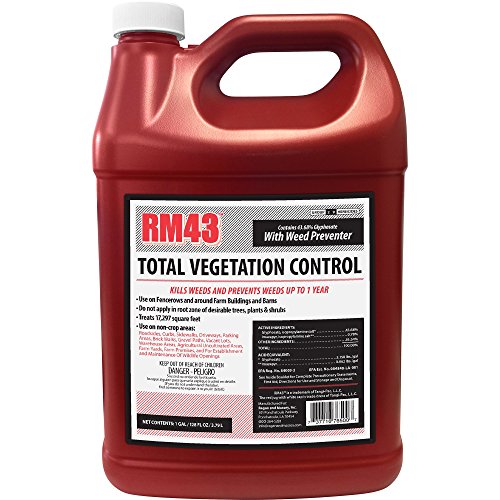
RM43 Concentrated Extended Control Weed Killer differs from RM18 by focusing on extended total-vegetation control rather than a fast-acting spot-treatment description. The manufacturer claims up to one year of control, making it more relevant to areas where the goal is to keep vegetation from returning than to beds or borders where plants will be added soon. This is a concentrate mixed with water in a sprayer. Its one-gallon container is smaller than the RM18 container, but the product facts do not give a dilution rate, so confirm the label’s mixing directions and intended-site limits before treating a large area. Avoid choosing it where you want to preserve desirable plants.
Bottom line: Choose this for a bare area where extended total-vegetation control is the objective.
Spectracide Weed & Grass Killer, 1.33 gal

Spectracide Weed & Grass Killer, 1.33 gal is the ready-to-use alternative for buyers who value application convenience over a concentrate’s batch flexibility. The included AccuShot powered sprayer has an extendable wand and two-finger trigger, and the manufacturer says it is rainfast after 15 minutes and can show visible results in 3 hours. Its uses include driveways, walkways, patios, and areas around trees, shrubs, and flower beds. The limitation is that it is a different product, not RM18, and the 1.33-gallon container is a finite ready-to-spray supply rather than a mix-to-volume concentrate. Direct spray only where vegetation is meant to be killed.
Bottom line: Choose this when a powered ready-to-use sprayer matters more than buying RM18.
Natural Elements Vinegar-Derived Weed Killer, 1 gal

Natural Elements Vinegar-Derived Weed Killer, 1 gal stands apart as a vinegar-derived, ready-to-use spray, so there is no dilution step. The manufacturer says it is intended for most broadleaf weeds and grasses and can be used around landscaping, rock beds, and mulched areas; it also cautions that the spray will kill grass, so it should not be applied directly to a lawn unless that is the goal. The one-gallon container suits focused use rather than large-scale mixing. The product’s natural-origin wording does not remove the need to prevent spray contact with desirable plants, and this is not the RM18 formula.
Bottom line: Choose this if you want a vinegar-derived ready-to-use spray and accept its grass-killing action.
How to choose a weed killer
Start by deciding whether the goal is to kill visible weeds or suppress all vegetation for an extended period. A nonselective weed killer can injure desirable plants it contacts, so keep spray off lawns, flowers, shrubs, and tree foliage unless the label specifically allows that use. Concentrates require accurate dilution; RM18’s range is 3 to 6 fl oz per gallon, with the lower rate for small, easy-to-kill seedlings and the higher rate for larger, harder-to-kill weeds. Ready-to-use products remove measuring but provide a fixed volume. Choose a concentrate for repeated or larger jobs when its label covers the site, and a ready-to-use sprayer for smaller, targeted applications.
| Need | Useful type | Check before spraying |
|---|---|---|
| Mix for multiple batches | Concentrate | Correct dilution and label site |
| Skip mixing | Ready-to-use spray | Container coverage and target area |
| Keep an area bare | Extended-control formula | Whether nearby plants or replanting are affected |
When and how to apply weed spray
Apply when weeds are actively growing and conditions are calm; wind can carry droplets onto plants you intend to keep. Warm, sunny weather is the application condition recommended for RM18 in the product facts. Rain timing is product-specific: the manufacturer says Spectracide Weed & Grass Killer, 1.33 gal is rainfast after 15 minutes, but do not transfer that interval to other formulas. Spray only enough to cover target foliage as directed by the label; excess runoff can move herbicide beyond the intended patch. Keep people and pets away during application and until the label’s reentry directions allow return, and wear the protective equipment named on the label. Never mix products together unless their labels expressly permit it.
Spot treatment versus extended vegetation control
Spot-treatment sprays target existing foliage, while extended-control products are intended to suppress regrowth for longer. That distinction matters around fences, walkways, and other hardscape: a long-control formula may be unsuitable if you plan to plant or maintain vegetation there. For bare ground, confirm both the allowed application site and the replanting interval on the product label before applying. A ready-to-use bottle trades dilution flexibility for convenience; a concentrate requires measuring but can make multiple spray batches. Do not assume that “kills to the root,” visible wilt, or a fast visible result means every weed species is controlled equally well. Perennial weeds and mature plants can require different label-approved timing or repeat treatment.
Common weed-spraying mistakes
Spraying on a windy day is a common way to damage nearby desirable plants; wait for calm conditions and use a shield or directed wand where the label permits. Another mistake is using a seedling rate on mature or difficult weeds: RM18’s mixing guidance distinguishes 3 fl oz per gallon for easy-to-kill small seedlings from 6 fl oz per gallon for larger, tougher weeds. Measure concentrate with a dedicated tool and never use food utensils. Do not treat a lawn with a nonselective formula unless killing the grass is intended. Store herbicides in their original labeled containers, away from children and pets, and follow label disposal directions rather than pouring leftover spray into a drain or waterway.
Frequently Asked Questions
How much RM18 goes in one gallon of water?
The RM18 guidance gives 3 fl oz per gallon for small, easy-to-kill seedlings and up to 6 fl oz per gallon for larger, harder-to-kill weeds. Use the product label’s directions for the exact target and site.
How soon can rain fall after weed killer?
Rainfast timing depends on the formula; the manufacturer says Spectracide Weed & Grass Killer, 1.33 gal is rainfast after 15 minutes. Do not apply that interval to other products, and check their labels for rain or watering limits.
Can weed killer spray drift onto flowers?
Yes, wind can carry spray onto flowers, shrubs, or lawn grass and injure them. Apply in calm conditions, direct the spray at target weeds, and leave a buffer from plants you want to keep.
Will vinegar weed killer kill grass?
Yes, the manufacturer specifically cautions that Natural Elements Vinegar-Derived Weed Killer, 1 gal will kill grass and says not to apply it directly to a lawn unless killing grass is intended. Shield nearby turf and ornamental plants from spray.
When should I choose extended-control weed killer?
Choose an extended-control formula only when the treated area is meant to remain without vegetation; the manufacturer claims RM43 Concentrated Extended Control Weed Killer provides up to one year of control. Check its label before treating near plants you want to keep or a site you plan to replant.